

Best Brushed Nickel Knobs for White Cabinets (2026)
Ranked: the best brushed nickel knobs for white cabinets in 2026. Round, oval, T-bar, mushroom profiles compared by durability, fit, and price.

Brushed nickel knobs on white cabinets is one of the most durable finish pairings in kitchen and bath design — the warm silver tone prevents the stark contrast you get with chrome while keeping the look crisp and timeless. This guide ranks the best options available in 2026, breaks down exactly what to look for, and tells you which profiles work for which cabinet styles.
Shop the finish
Every brushed nickel knob and pull we carry, in one place — filter by size, style, and brand.
Browse Brushed Nickel Cabinet Hardware →- Brushed nickel knobs with a round or oval profile at 1.25– 1.5 inch diameter are the sweet spot for white cabinets
- Bin pulls and bar pulls in brushed nickel read well on white shaker and flat-front fronts
- The Knobs.co brushed nickel collection spans 50,000+ SKUs across price points
- Skip chrome (too cold) and satin brass (clashes on true-white paint)
Shop the picks from this guide
In stock at Knobs.co · Free shipping on hardware orders $99+ · 110% price match
-
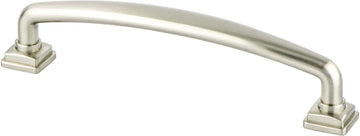 Berenson
Tailored Traditional 128mm CC Brushed Nickel Pull 1284-1BPN-P
Berenson
Tailored Traditional 128mm CC Brushed Nickel Pull 1284-1BPN-P
$10.93
$13.66 -
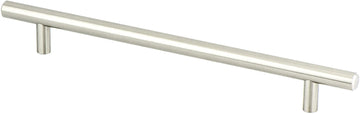 Berenson
Tempo 192mm CC Brushed Nickel Bar Pull 0806-2BPN-P
Berenson
Tempo 192mm CC Brushed Nickel Bar Pull 0806-2BPN-P
$11.53
$14.41 -
 Berenson
Bravo 56mm CC Brushed Nickel Edge Pull 1057-4BPN-P
Berenson
Bravo 56mm CC Brushed Nickel Edge Pull 1057-4BPN-P
$9.83
$12.28 -
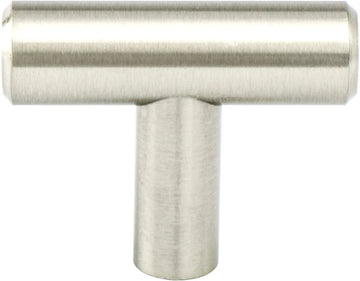 Berenson
Transitional Advantage Two Brushed Nickel T-Bar Knob 9435-2BPN-P
Berenson
Transitional Advantage Two Brushed Nickel T-Bar Knob 9435-2BPN-P
$2.80
$3.50 -
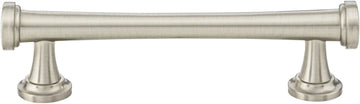 Atlas Homewares
Browning Pull 3 3/4'' ccBrushed Nickel
Atlas Homewares
Browning Pull 3 3/4'' ccBrushed Nickel
$14.50
$16.11 -
 Berenson
Folklore 3in. CC Brushed Nickel Cup Pull 8340-1BPN-P
Berenson
Folklore 3in. CC Brushed Nickel Cup Pull 8340-1BPN-P
$12.92
$16.15


Why This Pairing Works in 2026
White cabinet finishes — Benjamin Moore Chantilly Lace, Sherwin-Williams Extra White, and their cousins — reflect light without adding warmth. Brushed nickel sits at roughly 60–70% reflectance on a spectrophotometer scale, which means it bounces enough light to feel bright but absorbs enough to avoid the clinical glare of polished chrome. The mechanical brushing process also hides fingerprints and micro-scratches better than any polished finish, which matters on high-touch cabinet doors. For homeowners and trade professionals designing kitchens or bathrooms in 2026, that maintenance advantage is a real selling point to end clients.
How We Ranked
Rankings are based on four criteria: finish durability (lacquer vs. PVD coating), profile suitability for white cabinet styles (shaker, flat-front, raised-panel, beadboard), dimensional fit for standard 1-3/8" overlay doors, and price-per-knob at standard project quantities of 20–40 pieces. Only brushed nickel SKUs with verified availability in 2026 are included. No sponsored placements.
The Ranked List
1. Round Knob — The Workhorse
Label: The safe pick
A 1.25" round cabinet knob in brushed nickel fits every white cabinet style built since 2000. The round profile requires no orientation during installation, which cuts labor time on 30+ knob projects by roughly 15 minutes. PVD-coated versions hold finish integrity for 5–10 years under daily use, compared to 2–4 years for lacquer-coated alternatives.
Verdict: Buy. If you are outfitting a full kitchen and want zero risk, this is the call.
2. Oval or Egg Knob — The Upgrade
Label: The designer pick
An oval knob in brushed nickel adds visual weight without switching to a pull. The elongated shape reads well on taller upper cabinet doors where a round knob can look undersized. Typical dimensions run 1.5" × 1" — enough grip surface to feel substantial. Interior designers spec this profile frequently for transitional kitchens with white Shaker uppers.
Verdict: Buy. Costs 10–20% more than round, justified on any project where the hardware will be photographed or staged.
3. T-Bar Knob — The Modern Option
Label: The flat-front specialist
A T-bar knob is a cylindrical post knob — essentially a miniature bar pull in knob form. On flat-front or slab-door white cabinets, the horizontal orientation creates a consistent line rhythm across the cabinet run. Most T-bar knobs in brushed nickel are 1.25"–1.5" in projection, which keeps them proportional to thin Euro-style doors.
Verdict: Buy on flat-front cabinets. Hold on raised-panel or beadboard styles where the linear form fights the door's vertical detailing.
4. Mushroom Knob — The Classic
Label: The traditional fit
The domed mushroom profile has been standard on raised-panel cabinets since the 1990s and still reads as intentional rather than dated when the finish is brushed nickel rather than antique brass. The wide base (typically 1.5"–1.75" diameter) distributes finger pressure over a larger surface, which reduces wear on the paint around the knob hole — a real consideration on white cabinets where touch marks show.
Verdict: Buy on traditional or transitional white cabinets. Skip on modern flat-front doors where the domed profile looks out of period.
5. Bar Pull (Knob-Scale) — The Mix-and-Match
Label: The wildcard
A 3"–4" bar pull in brushed nickel used on lower cabinets alongside round or oval knobs on uppers is the most common hardware mixed spec in 2026 kitchen projects. The Top Knobs M2604 Amwell bar pull is a frequently specified option — the Amwell's clean rectangular profile and brushed nickel finish coordinate with round knobs without looking matchy. Bar pulls on base cabinets reduce wrist strain compared to knobs, which is a selling point for accessibility-conscious clients.
Verdict: Buy as part of a mixed hardware spec. Hold if budget requires a single hardware profile throughout.
Comparison Table
| Profile | Best Cabinet Style | Typical Diameter | Finish Durability | Price Range (per piece) | Verdict |
|---|---|---|---|---|---|
| Round | All styles | 1.25" | PVD: 5–10 yr | $4–$18 | Buy |
| Oval / Egg | Transitional, Shaker | 1.5" × 1" | PVD: 5–10 yr | $6–$24 | Buy |
| T-Bar | Flat-front, Slab | 1.25"–1.5" proj. | PVD: 5–10 yr | $8–$22 | Buy / Hold |
| Mushroom | Traditional, Raised-panel | 1.5"–1.75" | Lacquer: 2–4 yr | $4–$16 | Buy / Skip |
| Bar Pull (3"–4") | Base cabinets, mixed spec | N/A (3"–4" ctc) | PVD: 5–10 yr | $10–$38 | Buy / Hold |
What to Avoid on White Cabinets
- Polished chrome knobs. The high reflectance of polished chrome creates a cold, clinical contrast on warm-white or off-white cabinets. It reads fine on true-white contemporary kitchens but reveals fingerprints at 3× the rate of brushed nickel.
- Antique or "oil-rubbed" brushed nickel. Some SKUs labeled brushed nickel are actually a darkened or antiqued variant. On white cabinets, these read muddy rather than warm — always check the finish code. True brushed nickel has a warm silver tone, not a brown or grey undertone.
- Undersized knobs on large cabinet doors. A 1" or smaller knob on a 24"H upper cabinet door looks like a drafting error. Minimum 1.25" diameter on standard uppers; 1.5" on pantry or tall cabinet doors.
Where to Buy
- Knobs.co brushed nickel collection — 50,000+ SKUs, trade account pricing available, ships in 2026 to US addresses. The full brushed nickel finish collection is the deepest single-source catalog for this finish.
- Buy by the project, not the knob. Standard kitchens run 25–40 knobs. Pricing per piece drops meaningfully at quantities above 20 units on most brands.
- Verify bore size before ordering. Standard US cabinet bore is 35mm (1-3/8"). European imports occasionally ship with different bore assumptions — confirm the spec sheet before purchasing 40 units.
FAQ
What size brushed nickel knob works best on white kitchen cabinets?
1.25" diameter for standard upper and lower cabinets; 1.5" for pantry and tall cabinets. Under 1" reads undersized on any door taller than 18".
Is brushed nickel better than matte black on white cabinets?
Both work. Brushed nickel reads warmer and more traditional; matte black reads more graphic and contemporary. If the kitchen has warm-white or cream cabinets, brushed nickel is the lower-risk choice. True-white flat-front cabinets can take either finish well in 2026.
How many knobs do I need for a standard kitchen?
Count one knob per upper door, one knob or pull per lower door, and one pull per drawer. A typical 10×10 kitchen layout runs 25–35 hardware pieces total.
Do brushed nickel knobs tarnish on white cabinets over time?
PVD-coated brushed nickel does not tarnish under normal household use. Lacquer-coated versions can dull or discolor after 2–4 years, especially near the sink or stove where humidity and heat are elevated.
Can I mix brushed nickel knobs with brushed nickel pulls on white cabinets?
Yes — mixing profiles in the same finish is standard practice. Round or oval knobs on upper doors with bar pulls on lower doors and drawers is the most common mixed spec in 2026 kitchen projects.
What's the difference between brushed nickel and satin nickel?
The terms are used interchangeably by most US hardware brands. Some manufacturers distinguish them by sheen level — satin nickel is slightly less reflective — but there is no industry-standard definition. When ordering, compare finish photos rather than relying on the label.
How do brushed nickel knobs hold up near the kitchen sink?
PVD-coated brushed nickel resists moisture, soap, and mild acids (citrus, vinegar) better than lacquer finishes. For cabinets within 12" of the sink, specify PVD coating explicitly.
Are brushed nickel knobs compatible with white painted MDF cabinets?
Yes. The installation method (35mm bore, machine screw through the door) is identical regardless of cabinet substrate. MDF cabinets painted white are the most common pairing for brushed nickel knobs in US residential projects in 2026.
One Last Thing
Brushed nickel's finish consistency improved significantly after 2018, when PVD (Physical Vapor Deposition) became the standard coating method for mid-to-upper-tier hardware brands. Pre-2018 brushed nickel stock — still in circulation at some liquidators — uses lacquer that yellows noticeably on white cabinets within 3 years. If you are buying from a closeout or discount source in 2026, ask for the coating method before committing to a full kitchen quantity.
Related Guides
Shop Brushed Nickel Cabinet Hardware
-
 Bradbury Pull 6 5/16'' cc
$16.57
Bradbury Pull 6 5/16'' cc
$16.57
-
 Crystal Legacy Square Knob 1 5/16''
$41.36
Crystal Legacy Square Knob 1 5/16''
$41.36
-
 Dot Knob 1 1/4''
$10.23
Dot Knob 1 1/4''
$10.23
-
 Dot Knob 2''
$14.63
Dot Knob 2''
$14.63
-
 Malin Pull 3 3/4'' cc
$13.64
Malin Pull 3 3/4'' cc
$13.64
-
 Malin Pull 6 5/16'' cc
$19.71
Malin Pull 6 5/16'' cc
$19.71
-
 Malin Pull 7 9/16'' cc
$23.63
Malin Pull 7 9/16'' cc
$23.63
-
 Sweetbriar Lane Pull 5 1/16'' cc
$18.27
Sweetbriar Lane Pull 5 1/16'' cc
$18.27


Browse all 1076 in Brushed Nickel Cabinet Hardware → Cabinet knobs Cabinet pulls & handles