

Brushed Nickel Cabinet Hardware for Bathrooms 2026
Best brushed nickel cabinet hardware for bathrooms in 2026: top picks, sizing guide, and finish comparison across 50,000+ SKUs at Knobs.co.

Brushed nickel cabinet hardware is one of the most forgiving finish choices in a bathroom — it reads warm or cool depending on surrounding tile, hides water spots better than chrome, and ships from dozens of brands in a wide range of price points.
TL;DR: For bathroom cabinetry in 2026, brushed nickel cabinet hardware wins on durability, spot resistance, and style range. The Knobs.co brushed nickel collection carries hardware across knobs, pulls, and hinges — enough selection to match any vanity profile, from shaker to mid-century. If your bathroom tiles run cool and gray, matte black is the only real alternative worth considering. Otherwise, brushed nickel is the safe, lasting call.
Shop the picks from this guide
In stock at Knobs.co · Free shipping on hardware orders $99+ · 110% price match


Why this matters in 2026
Bathrooms took over from kitchens as the most hardware-intensive renovation room in the last few years. A standard double-vanity with 6 drawers and 4 doors needs 10–14 pieces of hardware. At that quantity, finish consistency, corrosion resistance, and availability across product types (knob vs. pull vs. hinge) all matter more than in a kitchen where a single cabinet type often dominates. Brushed nickel handles that pressure well — it's a PVD or satin-lacquer finish over zinc or brass, which resists the high-humidity cycling a bathroom throws at hardware daily.
Who this is for
This guide is for homeowners replacing vanity hardware on an existing bathroom, interior designers spec'ing a new build, and contractors sourcing hardware for a full bath remodel. If you're working with a pre-built shaker or inset vanity, brushed nickel is almost certainly the finish that ships with the builder-grade pulls — and you're here because you want something better without disrupting the finish palette.
What to look for in brushed nickel cabinet hardware for bathrooms
Finish process — PVD vs. electroplating vs. lacquer
PVD (Physical Vapor Deposition) finishes bond at the molecular level and won't chip or tarnish under bathroom humidity. Electroplated brushed nickel is cheaper but thins over time, especially around high-touch edges. For a primary bathroom used daily, pay the premium for PVD — it's the difference between hardware that looks new at year 5 and hardware that's pitting by year 3.
Substrate material — solid brass vs. zinc alloy vs. stainless
Solid brass is the benchmark for longevity and weight feel. Zinc alloy costs less and works fine in low-moisture guest baths but corrodes faster in steam-heavy primary baths. Stainless steel is underused in cabinetry hardware but excellent for humidity tolerance. If the product listing doesn't name the base metal, treat it as zinc.
Center-to-center sizing
Bathroom vanity drawers typically ship with 3-inch (76mm) or 3-3/4-inch (96mm) drillings. Measure your existing holes before ordering — or before specifying on a new build. Pulls with adjustable or multi-hole backplates give contractors flexibility across a mixed cabinet order. Ordering wrong is the most common and most expensive mistake in a hardware refresh.
Profile and projection
Bar pulls and cup pulls project 1–1.5 inches off the face. In a narrow bathroom with a pedestal sink opposite, that projection matters — someone reaching past a pull at 6am will notice. Knobs project 0.75–1 inch and are a smarter call in tight footprints. Flat bin pulls project the least of all types.
Backplate compatibility
Many brushed nickel pulls come with optional backplates that cover old hole pairs or fill an oversized pre-drill. In a renovation scenario where you're replacing hardware on an existing vanity, a backplate can save a refinishing job. Confirm backplate availability before committing to a pull SKU.
ADA compliance for accessible baths
If the bathroom serves anyone with limited grip strength, loop pulls and D-ring handles rate better than round knobs under ADA guidelines. A 4-inch D-pull requires less than 5 pounds of lateral force to operate. Knobs are the hardest pull type for arthritic hands — plan accordingly if this is a master bath that needs to age well.
Top picks for 2026
The safe pick — Top Knobs Amwell Bar Pull (8-13/16")
Hook: The go-to for trade professionals spec'ing a full bath.
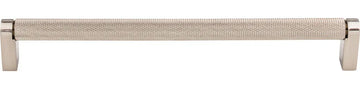
The Top Knobs Amwell bar pull comes in a Brushed Satin Nickel finish, at an 8-13/16-inch (224mm) drill center. At that length, it reads architectural on a drawer front without dominating a small vanity door.
Verdict: Buy. This is the pull to default to when a client wants brushed nickel on a shaker vanity and doesn't want to revisit the spec in five years.
The catalog pick — Knobs.co brushed nickel collection
Hook: The range means you can find the exact center-to-center, projection, and style you need.
The full brushed nickel collection at Knobs.co spans knobs, pulls, cup pulls, appliance pulls, and backplates across brands including Atlas Homewares, Berenson, Amerock, and Schaub and Company. That range matters for a bathroom remodel where you need the vanity knob, the appliance pull, and the linen closet pull to all read as the same finish family. Buying them from a single catalog eliminates finish-lot variation.
Verdict: Buy. For any bathroom project with more than 5 hardware pieces, source from one collection, not multiple retailers.
The style play — Mid-century modern profiles
Hook: If your vanity has tapered legs and a floating design, standard bar pulls will read wrong.
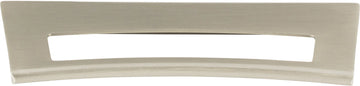
The Atlas Homewares Edge Pulls Mid Century Tab Pull, in Brushed Nickel, uses an edge-mounted tab profile that sits flush against the door — a better match for floating vanities and walnut-fronted cabinets than a traditional bar pull. It's a zinc alloy pull at a 5-1/16-inch center-to-center.
Verdict: Consider. Only if your bathroom's design language genuinely calls for it. Don't force a style because it's trending.
The contrast option — matte black
Hook: For bathrooms with white subway tile and black grout lines, brushed nickel will compete. Matte black won't.
Matte black is the only finish in 2026 that consistently outperforms brushed nickel in bathrooms with heavy graphic tile work or dark-stained vanities. The matte black collection is the natural next stop if brushed nickel feels too warm for your space. The two finishes should not coexist on the same vanity — pick one.
Verdict: Consider if your tile palette runs dark or high-contrast. Skip if the rest of your bathroom fixtures (faucet, towel bar, toilet paper holder) are already brushed nickel.
What to avoid
- Chrome pulls marketed as "brushed nickel adjacent." Chrome and brushed nickel don't read the same under warm bathroom lighting. Chrome is cooler, higher-gloss, and will stand out against a true brushed nickel faucet. Check the finish name on the spec sheet, not just the photo.
- Hollow zinc pulls from unbranded listings. They feel light, the finish flakes within 18 months in a steamy bathroom, and they're rarely available in replacement quantities if you need to source more later. Spend a little more for a named-brand zinc at minimum.
- Oversized pulls on a small vanity. A 12-inch bar pull on a 24-inch single vanity looks like a mistake. Scale the pull length to the drawer or door width — as a rule, a pull should span 1/3 to 1/2 the drawer front width.
Verdict comparison table
| Pick | Substrate | Finish Process | Best For | Verdict |
|---|---|---|---|---|
| Top Knobs Amwell Bar Pull | Not specified | Not specified | Primary bath, shaker vanity | Buy |
| Knobs.co brushed nickel collection | Varies by brand | Varies by brand | Full bathroom sourcing | Buy |
| Atlas Homewares Edge Pulls Mid Century Tab Pull | Zinc alloy | Not specified | Floating/walnut vanities | Consider |
| Matte black alternative | Brass or zinc | PVD | Dark tile, high-contrast baths | Consider/Skip |
FAQ
What's the best brushed nickel cabinet hardware for bathrooms in 2026? For a primary bathroom, a durable brushed nickel finish is the best choice — it tolerates daily humidity cycling without tarnishing. The Top Knobs Amwell bar pull in Brushed Satin Nickel is a proven pick among trade professionals for shaker and transitional vanities.
Is brushed nickel or matte black better for bathroom cabinets? Brushed nickel is better for most bathrooms because it pairs with chrome, gold, and satin fixtures without clashing. Matte black wins only when the bathroom has dark tile, black grout, or dark-stained wood — and only if all other metal fixtures are also matte black.
How do I know if brushed nickel hardware will match my existing fixtures? Bring a photo of your existing faucet or towel bar to the hardware retailer. Brushed nickel varies slightly by brand — Moen's finish reads warmer than Kohler's. Order one sample pull before committing to 14 pieces.
What center-to-center size do most bathroom vanities use? Most pre-built vanities drill at 3 inches (76mm) or 3-3/4 inches (96mm). Measure the existing holes before ordering. If you're buying new cabinetry, confirm the drilling specification with the cabinet manufacturer before selecting hardware.
How much does brushed nickel cabinet hardware cost per piece? Pricing varies by base metal, finish process, and brand — zinc alloy with an electroplated finish costs less than solid brass with a PVD finish, and designer profiles cost more than either. Check the live price on each product page before budgeting a full order.
Can brushed nickel hardware rust in a bathroom? A PVD brushed nickel finish will not rust under normal bathroom conditions. An electroplated finish can show surface corrosion near the edges after 2–4 years in a high-steam primary bath. The base metal matters — solid brass will not rust even if the surface finish wears; zinc alloy will corrode if the finish degrades.
Does brushed nickel hardware work with white shaker vanity cabinets? Yes — white shaker is the most common pairing for brushed nickel in 2026 bathroom design. The warm silver tone complements both warm white (antique white, linen) and cool white (bright white, Swiss coffee) cabinet finishes without competing.
How many pulls do I need for a standard bathroom vanity? A 36-inch single vanity with 2 drawers and 2 doors needs 4 pieces. A 60-inch double vanity with 4 drawers and 4 doors needs 8 pieces. Add 1–2 extras per order as spares — finish lots can vary on reorders.
One last thing
Brushed nickel is one of the only finishes that Pantone-equivalent color-matches across categories — meaning the brushed nickel on your cabinet pull, your faucet, and your towel ring can all come from different manufacturers and still read as one finish family in the same room. Chrome cannot do that. Matte black almost cannot do that. That cross-brand finish tolerance is the real reason designers keep specifying brushed nickel in 2026 even as trendier finishes cycle in and out.
Related guides
Shop Brushed Nickel Cabinet Hardware
-
 Bradbury Pull 6 5/16'' cc
$16.57
Bradbury Pull 6 5/16'' cc
$16.57
-
 Crystal Legacy Square Knob 1 5/16''
$41.36
Crystal Legacy Square Knob 1 5/16''
$41.36
-
 Dot Knob 1 1/4''
$10.23
Dot Knob 1 1/4''
$10.23
-
 Dot Knob 2''
$14.63
Dot Knob 2''
$14.63
-
 Malin Pull 3 3/4'' cc
$13.64
Malin Pull 3 3/4'' cc
$13.64
-
 Malin Pull 6 5/16'' cc
$19.71
Malin Pull 6 5/16'' cc
$19.71
-
 Malin Pull 7 9/16'' cc
$23.63
Malin Pull 7 9/16'' cc
$23.63
-
 Sweetbriar Lane Pull 5 1/16'' cc
$18.27
Sweetbriar Lane Pull 5 1/16'' cc
$18.27


Browse all 1076 in Brushed Nickel Cabinet Hardware → Cabinet knobs Cabinet pulls & handles