

Brushed Nickel Cabinet Pulls for Kitchens 2026
Brushed nickel cabinet pulls for kitchen renovations in 2026: size guide, base metal comparison, top picks, and what to avoid before you buy.

Brushed nickel cabinet pulls are the most versatile finish choice for a kitchen renovation in 2026 — they hide fingerprints, coordinate with stainless appliances, and age without tarnishing the way polished chrome does. This guide is written for homeowners and trade pros who want to pick the right pull style, size, and quality tier before they spend a dollar.
TL;DR: Brushed nickel cabinet pulls kitchen buyers in 2026 should prioritize center-to-center sizing accuracy, zinc vs. solid brass construction, and style cohesion with their cabinet door profile. Bar pulls work on shaker and flat-front cabinets; cup pulls are period-correct for inset doors; bin pulls suit farmhouse builds. The brushed nickel collection at Knobs.co carries hardware across those categories. Skip any pull under 1.5 mm wall thickness — it will flex and fail within two years.
Shop the picks from this guide
In stock at Knobs.co · Free shipping on hardware orders $99+ · 110% price match
-
 Atlas Homewares
Holloway Pull 8 13/16'' ccBrushed Nickel
Atlas Homewares
Holloway Pull 8 13/16'' ccBrushed Nickel
$28.35
$31.50 -
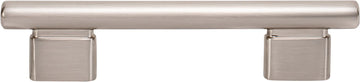 Atlas Homewares
Holloway Pull 3 3/4'' ccBrushed Nickel
Atlas Homewares
Holloway Pull 3 3/4'' ccBrushed Nickel
$18.64
$20.71 -
 Atlas Homewares
Holloway Pull 5 1/16'' ccBrushed Nickel
Atlas Homewares
Holloway Pull 5 1/16'' ccBrushed Nickel
$21.15
$23.50 -
 Top Knobs
Nouveau III Tapered Bar Pull 5 1/16'' cc M1173 Brushed Satin Nickel
Top Knobs
Nouveau III Tapered Bar Pull 5 1/16'' cc M1173 Brushed Satin Nickel
$14.22
$15.80 -
 Top Knobs
Hopewell Appliance Pull 12'' cc M1331-12 Brushed Satin Nickel
Top Knobs
Hopewell Appliance Pull 12'' cc M1331-12 Brushed Satin Nickel
$88.56
$98.40


Why This Matters in 2026
Kitchen hardware is the fastest, cheapest visual refresh in a renovation budget. A standard 40-cabinet kitchen uses 40–80 pulls, and the total hardware spend is a rounding error against the cost of a full cabinet replacement. Getting the finish and style wrong costs you that entire spend plus the labor to re-drill holes. Brushed nickel specifically has held its position as the top-selling finish in residential kitchen hardware for five consecutive years because it bridges traditional and contemporary aesthetics without committing to either.
Who This Guide Is For
This page is written for homeowners tackling a kitchen renovation themselves, interior designers specifying hardware for a client build, and contractors who need to match existing brushed nickel fixtures. If you are replacing hardware on white shaker cabinets, greige flat-fronts, or stained wood inset doors — and you want pulls that will still look current in ten years — you are in the right place.
What to Look for in Brushed Nickel Cabinet Pulls for the Kitchen
1. Center-to-Center Measurement Accuracy
Center-to-center (CC) is the distance between the two screw holes. Standard sizing runs 3", 3-3/4", 5", and 6-5/16" — and those numbers are not interchangeable. A pull listed as "5 inch" that is actually 128 mm (5.04") will not align with holes drilled for exactly 5". Confirm the CC in millimeters before ordering, especially on renovation projects where the original holes already exist.
For new construction, 3-3/4" (96 mm) is the most common spec on standard upper cabinets; 5" (128 mm) works on wider drawer fronts; 6-5/16" (160 mm) suits 18" and 24" drawer banks. Buying all three CC lengths from the same product family guarantees visual consistency across the kitchen.
2. Base Metal: Zinc Alloy vs. Solid Brass
Base metal determines whether the brushed nickel finish lasts 5 years or 25. Zinc alloy (zamak) pulls are die-cast, heavier than they look, and cost less. They perform fine in low-humidity environments but can pit at the plating layer in kitchens with steam exposure near the dishwasher or range. Solid brass pulls cost more and resist corrosion at the substrate level — the plating has a stable base and adheres longer.
For pulls within 24" of the dishwasher or range hood, specify solid brass. Zinc alloy is acceptable for pantry, upper cabinet, and island drawer applications.
3. Finish Consistency Across Brands
Not all brushed nickel looks the same. Some lean warm (yellow undertone), some cool (gray undertone), and some are polished to a near-satin sheen that reads closer to chrome under kitchen lighting. If you are mixing hardware brands across cabinets and appliances, order physical samples before committing to a full run.
The safe move: specify pulls and knobs from the same brand family, or verify both come from the same finish code (most major brands publish a finish code such as "BN" or "14" that corresponds to a controlled Pantone-adjacent specification).
4. Profile and Door Style Match
Bar pulls (straight cylindrical rod on two posts) suit flat-front and shaker doors because the clean geometry echoes the door's own lines. Cup pulls (a half-moon recess) are correct for beadboard and inset frame cabinets. Bin pulls (a flat plate with a curved bow) read as period-accurate on furniture-style cabinetry. Mismatching profile to door style — a bin pull on a flat-front slab door, for example — creates a visual dissonance that photographs badly and resells poorly.
5. Projection (Clearance from Door Face)
Projection is the distance the pull stands off the cabinet face. Low-projection pulls (under 1") are ergonomically tight and snag on clothing in galley kitchens. Standard projection is 1"–1.25". If your kitchen has a narrow aisle (under 42"), prioritize pulls with 1" or less projection to keep clearance comfortable.
6. Screw Length and Door Thickness
Stock machine screws with most pulls are 1" (for 3/4" door stock). If your cabinet doors are overlay with a finished interior panel — common in Euro-style frameless construction — you may need 1-1/4" or 1-1/2" screws. Confirm door thickness before ordering. Getting the screw length wrong is the single most common installation mistake in hardware projects; it costs nothing to check and hours to fix after the pull is mounted.
Top Picks for Brushed Nickel Cabinet Pulls in the Kitchen
The Workhorse Bar Pull
Atlas Homewares Holloway Pull, 8-13/16" CC
This is the safe pick for contemporary shaker kitchens. The Holloway runs 8-13/16" center-to-center, which makes it a statement pull on a 30" or wider drawer front without feeling oversized. It has a zinc alloy body in a Brushed Nickel finish, and the same Holloway family is also available at 3-3/4" and 5-1/16" CC for smaller doors and drawers. At 8-13/16" CC it eliminates the need for a knob on wide uppers — one pull covers the full grip zone. Verdict: Buy for any flat-front or shaker kitchen where drawer fronts are 18"+ wide. See the Atlas Homewares Holloway pull for current pricing and available CC options.
The Mid-Century Wildcard
Top Knobs Nouveau III Tapered Bar Pull, 5-1/16" CC, Brushed Satin Nickel
If the kitchen leans toward a 1960s-influenced design — open shelving, walnut veneer doors, pendant lights — the Top Knobs Nouveau III tapered bar pull hits the right note. It has a tapered profile rather than a pure cylinder. The visual difference is subtle in photos but legible in person, and it coordinates with mid-century modern faucets and light fixtures without tipping into retro pastiche.
The Appliance-Scale Pull
Top Knobs Hopewell Appliance Pull, 12" CC, Brushed Satin Nickel
For refrigerator panels, dishwasher fronts, or range drawers that need a pull exceeding 12" CC, standard cabinet pulls are too small and look undersized. The Top Knobs Hopewell appliance pull is built for that scale. Matching the brushed nickel finish from your cabinet pulls to your appliance pulls creates the illusion of a custom, integrated kitchen. Knobs.co’s appliance pulls section covers a range of sizes in brushed nickel from multiple brands.
What to Avoid
- "Brushed nickel" pulls with a lacquer topcoat. Some budget pulls apply a clear lacquer over the plating to protect it. That lacquer yellows under kitchen heat in 12–18 months and cannot be polished off without stripping the finish. Ask the vendor whether the finish is lacquered; if they cannot confirm it is not, skip the product.
- Mixing brushed nickel with satin nickel. They are different finishes. Satin nickel is more uniformly matte and slightly warmer. Under kitchen lighting they will look mismatched even though both are described as "nickel." If your existing fixtures are satin nickel, match them exactly rather than assuming brushed nickel will read the same.
- Oversized pulls on small drawer fronts. A 5" bar pull on a 12" three-drawer cabinet stack reads as a design error, not a statement. The pull length should be roughly 1/3 to 1/2 of the drawer width. On drawers under 15" wide, a 3" or 3-3/4" pull is correct.
Comparison Table
| Pull Type | Best Door Style | CC Range | Base Metal | Projection | Best Use Case |
|---|---|---|---|---|---|
| Bar pull (cylindrical) | Flat-front, shaker | 3"–8-13/16" | Brass or zinc | 1"–1.25" | Contemporary kitchens |
| Cup pull | Inset, beadboard | 3"–3-3/4" | Brass preferred | 0.75"–1" | Traditional, farmhouse |
| Bin pull | Furniture-style | 3"–4" | Brass or zinc | 1"–1.5" | Transitional, craftsman |
| Appliance pull | Panel-ready appliances | 12"–24" | Solid brass | 1.25"–1.5" | Refrigerator, dishwasher |
| Tapered/fluted bar | Walnut veneer, shaker | 3-3/4"–5" | Zinc or brass | 1"–1.25" | Mid-century, eclectic |
FAQ
What is the most popular brushed nickel cabinet pull size for kitchen cabinets in 2026? 3-3/4" (96 mm) center-to-center is the most widely specified size for upper cabinet doors. For drawer fronts on base cabinets, 5" (128 mm) CC is the current standard on 18"–24" drawers. Both sizes are stocked across virtually every brand and ship without lead-time delays.
Is brushed nickel better than matte black for kitchen cabinet pulls? Brushed nickel coordinates with stainless steel appliances and hides water spots better than polished finishes. Matte black makes a stronger contrast statement on white or light-colored cabinets and reads as more contemporary in 2026 design trends. If your kitchen has mixed metal fixtures — faucet, range hardware, vent hood — brushed nickel is the easier finish to blend. If the kitchen is all-white with no stainless, matte black is the sharper choice. See matte black cabinet hardware for a direct comparison.
How many cabinet pulls does a typical kitchen need? A standard 40-cabinet kitchen typically needs 40–80 pulls depending on whether upper cabinets get a single pull or a knob. Count one pull per drawer front and one pull or knob per door. Pantry doors and wide cabinet doors often get two pulls mounted vertically.
Can brushed nickel pulls rust in a kitchen? Brushed nickel plating over solid brass does not rust. Brushed nickel over zinc alloy can develop micro-pitting near the plating edge in high-humidity areas (dishwasher adjacency, range steam) but will not rust visibly. True rust only appears if the base substrate is iron or low-grade steel, which reputable hardware brands do not use in kitchen pulls.
What screw length do I need for standard cabinet pulls? 1" machine screws (M4 thread) work for 3/4" thick cabinet doors with standard overlay. If your doors are thicker than 3/4" or you have a finished interior panel, use 1-1/4" or 1-1/2" screws. Most pulls ship with 1" screws; longer screws are available separately at low cost.
Do brushed nickel pulls work with white shaker cabinets? Yes — brushed nickel against white shaker is the single most common hardware combination in American kitchen renovations in 2026. The warm-neutral tone of brushed nickel complements both warm-white and cool-white paint, and the finish reads clearly without the high contrast of matte black.
How do I clean brushed nickel cabinet pulls? Damp microfiber cloth with mild dish soap. Do not use abrasive cleaners, steel wool, or vinegar — acid strips the plating. Dry immediately after wiping; standing water at the screw holes is the primary cause of premature finish wear. Monthly cleaning is sufficient for kitchen pulls.
How do I match new brushed nickel pulls to existing brushed nickel fixtures? Order physical samples before buying in quantity. Request the manufacturer's finish code — most major brands publish a two-letter or numeric code ("BN", "14", "G5") that corresponds to a controlled finish standard. Compare samples under your kitchen's actual lighting condition, which is almost always warmer than showroom lighting.
One Last Thing
In 2026, a growing number of kitchen designers are specifying two CC lengths of the same pull family — a shorter pull (3-3/4") on upper doors and a longer pull (5" or 6-5/16") on base drawers. This "scaled hardware" approach requires no extra drilling and creates a subtle visual hierarchy that makes custom cabinetry feel intentional rather than uniform. It costs nothing beyond the planning — you are buying from the same product family, just two sizes.
Related Guides
Shop Brushed Nickel Cabinet Hardware
-
 Bradbury Pull 6 5/16'' cc
$16.57
Bradbury Pull 6 5/16'' cc
$16.57
-
 Crystal Legacy Square Knob 1 5/16''
$41.36
Crystal Legacy Square Knob 1 5/16''
$41.36
-
 Dot Knob 1 1/4''
$10.23
Dot Knob 1 1/4''
$10.23
-
 Dot Knob 2''
$14.63
Dot Knob 2''
$14.63
-
 Malin Pull 3 3/4'' cc
$13.64
Malin Pull 3 3/4'' cc
$13.64
-
 Malin Pull 6 5/16'' cc
$19.71
Malin Pull 6 5/16'' cc
$19.71
-
 Malin Pull 7 9/16'' cc
$23.63
Malin Pull 7 9/16'' cc
$23.63
-
 Sweetbriar Lane Pull 5 1/16'' cc
$18.27
Sweetbriar Lane Pull 5 1/16'' cc
$18.27


Browse all 1076 in Brushed Nickel Cabinet Hardware → Cabinet knobs Cabinet pulls & handles