

Cabinet Hardware for Cherry Cabinets: Choose for the Color It Is Now
Warm silver wins on cherry, but the drill centers already in your doors narrow the choice before the finish does.

The finish that works most often on cherry is a warm silver: satin or brushed nickel. Cabinet hardware for cherry cabinets fails in one of two directions, too warm and it dissolves into the wood, too cool and it fights the red, and the nickel family sidesteps both. Two things change that answer. If the faucet is already a warm metal, buy warm hardware and skip the nickel, because two metal temperatures within arm's reach of each other is the mismatch people notice. And if the cabinets are not new, measure the holes already drilled in the doors before you shop for a finish.
Shop the picks from this guide
In stock at Knobs.co · Free shipping on hardware orders $99+ · 110% price match
-
 Berenson
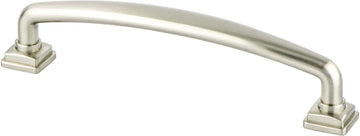
Tailored Traditional 128mm CC Brushed Nickel Pull 1284-1BPN-P
Berenson
Tailored Traditional 128mm CC Brushed Nickel Pull 1284-1BPN-P
$10.93
$13.66 -
 Berenson
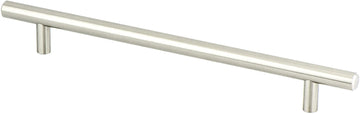
Tempo 192mm CC Brushed Nickel Bar Pull 0806-2BPN-P
Berenson
Tempo 192mm CC Brushed Nickel Bar Pull 0806-2BPN-P
$11.53
$14.41 -
 Berenson
Bravo 56mm CC Brushed Nickel Edge Pull 1057-4BPN-P
Berenson
Bravo 56mm CC Brushed Nickel Edge Pull 1057-4BPN-P
$9.83
$12.28 -
 Berenson
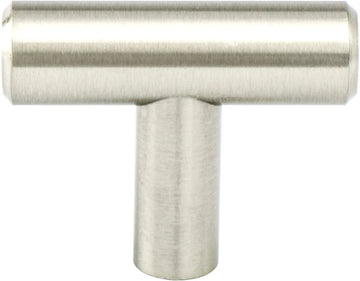
Transitional Advantage Two Brushed Nickel T-Bar Knob 9435-2BPN-P
Berenson
Transitional Advantage Two Brushed Nickel T-Bar Knob 9435-2BPN-P
$2.80
$3.50 -
 Atlas Homewares
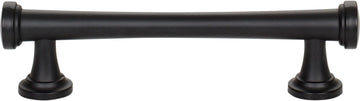
Browning Pull 3 3/4'' ccMatte Black
Atlas Homewares
Browning Pull 3 3/4'' ccMatte Black
$14.50
$16.11 -
 Berenson
Folklore 3in. CC Brushed Nickel Cup Pull 8340-1BPN-P
Berenson
Folklore 3in. CC Brushed Nickel Cup Pull 8340-1BPN-P
$12.92
$16.15


Your cherry is darker than the cherry in the photos
Cherry is the only common cabinet wood I know that changes color on you. It starts pinkish tan and moves toward a deep red-brown over roughly its first six to twelve months in light, then keeps creeping for years. Nearly every photo you see while shopping shows young cherry, which is why those pairings look different in a real kitchen. So if the cabinets are new, do not choose hardware against the sample in front of you. Contrast that looks right on a pinkish door collapses when the door goes red-brown, and the hardware you loved in March looks washed out by Christmas. Choose against the color the wood is becoming, which usually means going a shade cooler or brighter than feels correct today.
If the cabinets have been in a decade or two, they are already at their final color, deeper and redder than almost anything pictured on a hardware website. Open a door and look at the inside face, or find the strip of stile that has lived behind a door that is always open. The distance between that wood and the outside face is how far your kitchen has traveled. The mistake I see most often here is someone ordering a whole kitchen's worth of hardware off a chip held against a two-month-old door.
Nickel suits cherry because it is a warm silver, and chrome is not
Brushed nickel is nickel plating with a directional grain, and it lands as a warm silver. Chrome is cooler and blue-white, closer to a mirror. Against a red-brown door that difference is not subtle. Chrome puts blue next to red, which the eye takes as a clash rather than a contrast, while nickel keeps the contrast in value, light against dark, and leaves the color relationship alone. That is the real reason the nickel family carries cherry, and it beats any rule about warm woods needing warm metals.
Satin nickel and brushed nickel are close enough that brands use the names interchangeably; satin usually has the finer grain and slightly less shine. On aged cherry I lean to the duller of the two, because twenty years of hands and cleaner leave the wood with a sheen of its own, and a bright metal beside it starts a competition nobody wins. Polished nickel is the exception: a mirror, but a warm-silver one, so it holds up where chrome does not. Save it for formal cherry with glass doors, and expect fingerprints.
What nickel costs you is character. It makes a cherry kitchen look updated rather than designed, which is exactly why it is the safe answer and exactly why it is not always the best one.
If you plan to keep the cherry, go warm on purpose
Choosing a warm metal for cherry is a commitment to the cherry. The warm finish I reach for first is champagne bronze, a softer and less yellow gold that started life as a faucet name, which is why it works here: it bridges to the gold faucets people are installing, and keeps enough distance from cherry's red that the pull still registers as hardware. Satin brass and brushed brass are close cousins with more yellow in them, and both sit well on cherry as long as they stay matte.
The failure with warm metal on cherry is not the color, it is the value. Put a warm gold within a shade of the door's own darkness and the hardware turns into texture, visible only when you go looking for it. Hold a sample at arm's length and squint. If it vanishes, go lighter rather than warmer. The tradeoff is that a warm gold ties the kitchen to the wood: nickel survives the day those doors get painted, and a brass kitchen mostly does not.
Oil-rubbed bronze is the internet's answer, and it is the wrong default
Nearly every page ranking for this question recommends oil-rubbed bronze first, and it comes up in almost every cherry consultation. It is a real option and a poor default, for two reasons specific to this wood. On many brands it is a living finish: dark brown-black that wears lighter at the contact points and shows copper underneath. Copper sits very close to cherry's red, so the pull you bought for contrast drifts toward the wood over a few years of use. And on cabinets that have already darkened, oil-rubbed bronze starts with barely any value contrast to lose; under evening light the doors and the hardware become one brown mass, and the pulls exist as shapes you find by hand.
Where I do specify it is mid-tone cherry under a pale counter, and in older houses where the hardware is meant to sit down and stay quiet, which is a real brief but not the common one. Matte black has the same trouble without the warmth to pay for it: usually a powder coat, good at hiding fingerprints, quick to show dust and cooking film, and on dark cherry more silhouette than hardware.
Polished brass is not dated because it is brass
Honey-toned cherry, mirror-polished brass and raised-panel doors went in together in enormous numbers in the 1990s, and the eye now reads that combination as one period rather than three decisions. The brass is not the culprit on its own: unlacquered brass on a flat-panel cherry door beside a black faucet looks current, because everything around it has moved. What dates a cherry kitchen is the mirror shine plus the door profile plus the wood, all agreeing. If you want brass on traditional cherry doors, take the shine out of it. The other pairing I would skip is chrome on cherry above a warm oak floor, where the only cool element in the room floats between two warm ones.
The holes already in your doors decide more than the finish does
This is the part the style guides leave out, and I ask about it before finish. Pull sizes are quoted center to center, meaning the hole spacing, not the overall length of the pull, so measure from the center of one screw hole to the other. Common centers run 3 in (76 mm), 3-3/4 in (96 mm), 5 in (128 mm) and 6-5/16 in (160 mm). A cherry kitchen from the years when cherry was everywhere usually has 3 in centers on the drawers and knobs on the doors. If you can live with that spacing you are free: every finish above exists at 3 in centers, and the job is a screwdriver and an afternoon. If you want longer pulls, and on wide drawers you probably should, since pull centers near a third of the drawer width is the working proportion, there are two routes.
- Backplates. A plate sized to cover the old spread hides the holes without touching the door. Check that it clears each old hole by at least a quarter inch so nothing peeks out, and buy longer screws: cabinet hardware is 8-32 thread, a 1 in screw suits a 3/4 in door, and a backplate adds thickness the stock screw was never sized for.
- Fill and re-drill. A stained repair will not age at the rate of the wood around it: the door has already darkened and the patch has not, so a fix that disappears the week you make it becomes a pale thumbprint a year later. On cherry that is why I push people toward a backplate.
One case leaves no choice. Swapping a door knob for a pull puts the old single hole exactly between the two new ones, dead center, where nothing but a backplate will hide it.
How to test cabinet hardware for cherry cabinets in one evening
- Measure center to center on an existing pull and save the number. That number, not the finish, is your real shortlist.
- Compare the inside face of a door to the outside. The gap tells you how far the wood has shifted and which way it is still heading.
- Name your faucet's temperature, warm or cool. Unless you are mixing on purpose, the hardware should agree with it.
- Narrow to two finishes and order a sample of each; the cost is refunded with your full order. Finish names are not standardized across brands, so one maker's satin brass is another's brushed brass.
- Judge them at night, under the lights you cook by. Warm LEDs near 2700 K push brass toward orange and make nickel look warmer; 4000 K and above turns nickel bluish and pulls brass toward green. Cherry exaggerates both; a red wood bounces warm light back at whatever is screwed to it.
- Tape the samples to a door and leave them two days before ordering for the whole kitchen.
One idea to keep: on cherry, buy for value contrast, not for color harmony. The wood supplies the warmth, and hardware that tries to add more disappears into it.
Shop Brushed Nickel Cabinet Hardware
-
 Bradbury Pull 6 5/16'' cc
$16.57
Bradbury Pull 6 5/16'' cc
$16.57
-
 Crystal Legacy Square Knob 1 5/16''
$41.36
Crystal Legacy Square Knob 1 5/16''
$41.36
-
 Dot Knob 1 1/4''
$10.23
Dot Knob 1 1/4''
$10.23
-
 Dot Knob 2''
$14.63
Dot Knob 2''
$14.63
-
 Malin Pull 3 3/4'' cc
$13.64
Malin Pull 3 3/4'' cc
$13.64
-
 Malin Pull 6 5/16'' cc
$19.71
Malin Pull 6 5/16'' cc
$19.71
-
 Malin Pull 7 9/16'' cc
$23.63
Malin Pull 7 9/16'' cc
$23.63
-
 Sweetbriar Lane Pull 5 1/16'' cc
$18.27
Sweetbriar Lane Pull 5 1/16'' cc
$18.27


Browse all 1075 in Brushed Nickel Cabinet Hardware → Cabinet knobs Cabinet pulls & handles