

Cabinet Hardware for Espresso Cabinets Is a Lighting Decision
Espresso reads brown at noon and near-black at night, so the finish that wins is the one that keeps throwing light back in both.

The finish I put on espresso most often is brushed nickel, or its near twin satin nickel, because a brushed warm silver holds one steady light value whether the doors are reading brown at noon or near-black at nine at night. Cabinet hardware for espresso cabinets is unusual in that the finish name matters less than how much light the piece throws back at you: on a door this dark, the hardware is the only thing in the sightline that catches light, and what you see from across the kitchen is a bright line, not a color. The counter changes the answer. A pale counter has already given the room its contrast, which frees you to go quieter and warmer; a dark counter leaves the pulls doing that work alone, and then bright wins.
Shop the finish
Every espresso knob and pull we carry, in one place — filter by size, style, and brand.
Browse Espresso Cabinet Hardware →Shop the picks from this guide
In stock at Knobs.co · Free shipping on hardware orders $99+ · 110% price match
-
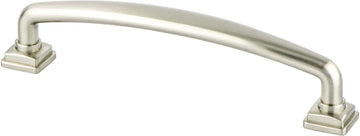 Berenson
Tailored Traditional 128mm CC Brushed Nickel Pull 1284-1BPN-P
Berenson
Tailored Traditional 128mm CC Brushed Nickel Pull 1284-1BPN-P
$10.93
$13.66 -
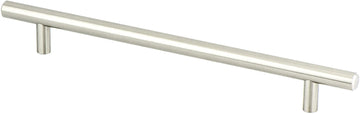 Berenson
Tempo 192mm CC Brushed Nickel Bar Pull 0806-2BPN-P
Berenson
Tempo 192mm CC Brushed Nickel Bar Pull 0806-2BPN-P
$11.53
$14.41 -
 Berenson
Bravo 56mm CC Brushed Nickel Edge Pull 1057-4BPN-P
Berenson
Bravo 56mm CC Brushed Nickel Edge Pull 1057-4BPN-P
$9.83
$12.28 -
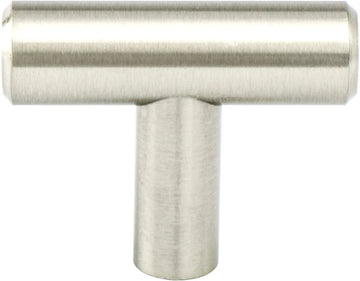 Berenson
Transitional Advantage Two Brushed Nickel T-Bar Knob 9435-2BPN-P
Berenson
Transitional Advantage Two Brushed Nickel T-Bar Knob 9435-2BPN-P
$2.80
$3.50 -
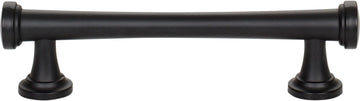 Atlas Homewares
Browning Pull 3 3/4'' ccMatte Black
Atlas Homewares
Browning Pull 3 3/4'' ccMatte Black
$14.50
$16.11 -
 Berenson
Folklore 3in. CC Brushed Nickel Cup Pull 8340-1BPN-P
Berenson
Folklore 3in. CC Brushed Nickel Cup Pull 8340-1BPN-P
$12.92
$16.15


Espresso is two different colors, and your hardware has to survive both
Espresso is a stain color, not a wood, and it sits at the point on the scale where a finish stops behaving like brown. In daylight the doors show their warmth and you can see the grain through them. Under evening light, especially under-cabinet strips raking down the face, the same doors flatten to something very close to black and the grain vanishes. People shop in the first condition and live in the second, and I have had more than one kitchen re-ordered over it.
That is why I ask what time of day the kitchen gets used hard. If the honest answer is dinner, choose the hardware after dark, with the lights you actually cook under, not on a Saturday morning with the blinds open. Warm bulbs around 2700 K keep the brown alive in the doors and push nickel a shade warmer. Cooler bulbs from 4000 K up drain the red out of espresso, leave it a cold near-black, and turn any warm metal near it slightly green. The same brass pull can look right at breakfast and swampy at dinner, and nothing about the pull changed.
Why cabinet hardware for espresso cabinets should be brushed, not polished
A brushed or satin surface scatters light in every direction, so it reads as the same pale gray-silver from any angle and at any hour. That reliability is the whole argument for brushed nickel on espresso, and I trust it further than the usual one about matching stainless appliances.
A polished surface behaves differently, and the difference is specific to dark kitchens. A mirror finish has no color of its own to speak of; it shows you whatever is in front of it. Screw a polished pull to an espresso door in a room with dark counters and it spends most of the day reflecting dark things back at you, so it reads heavier than it looked in the box, then flares white wherever a downlight hits it. That flash is genuinely handsome over an island. It is also why polished finishes look inconsistent on dark cabinetry in a way they never do on white.
The tradeoff on brushed nickel is that it is quiet to the point of being invisible as a design decision. It will not date the kitchen and it will not distinguish it either. If you want the hardware to be seen as a choice, the move is not a louder finish, it is a profile with a curve in it.
On dark doors, shape makes the highlight
A flat-faced pull on a dark door gives you one flat band of light. A shape with a curve or a bevel gives you a gradient, bright along the crown and shading off at the edges, and the eye reads a gradient as an object while it reads a flat band as a stripe. It is the cheapest change I can suggest on an espresso kitchen, and almost nobody mentions it, because most pages about dark cabinets never get past the finish list.
It also matters for another reason. Espresso kitchens went in by the thousand with the same slightly arched bar pull, and that pull, the speckled counter and the door color now read as one moment rather than three decisions. Swapping brushed nickel for brushed brass does not undo that. Swapping the arch for a squared bar, or putting cup pulls on the drawers, does, because a cup's concave face holds a crescent of light and a shadow under it, which is a shape the eye actually registers on a dark front.
Matte black is the finish espresso can swallow
Half the pages on this question recommend matte black for espresso, usually with the claim that it makes the cabinets pop, and I would take that recommendation off the table for most kitchens. A matte black finish is a powder coat or e-coat doing the opposite of what hardware on a dark door needs to do: it absorbs light instead of returning it. Against a door that is already reading near-black after sundown, there is no highlight to see, so the pull stops being an object and becomes a gap in the door. You find it with your hand before you find it with your eye.
The case where I will still specify it is a kitchen with a white or very pale counter and good daylight, where black hardware picks up the line of a black faucet or black window frames and the contrast is happening above the doors rather than on them. Even then, matte black shows cooking film and dust sooner than people expect, and on espresso the two dark surfaces disguise how much of it has built up. Oil-rubbed bronze has the same value problem with more warmth to pay for it, and on the brands where it wears as a living finish, the copper coming through at the contact points ends up closer to the door color than where it started.
Warm metals belong on espresso, but the counter has to be right
Warm hardware on espresso is not a mistake, and the advice to avoid gold on dark brown is too blunt. The failure is a three-part one. A yellow-gold pull on an espresso door above a tan speckled granite counter puts three warm browns in one sightline, none of them far enough apart in color or value to register as separate decisions, and that is the combination people are reacting to when they call espresso dated.
Change one leg of it and the warm metal works. With a white, gray or honed black counter, a warm metal is the only warm thing in the frame and it reads as deliberate. My first pick there is champagne bronze, which is softer and less yellow than brass, sits far enough from espresso's red-brown to stay legible, and gets along with the gold faucets going into kitchens now. Whatever you choose, check it against the faucet before the cabinets: hardware and faucet do not have to match, but two different metal temperatures inside the same three feet of counter is what people notice. Most espresso kitchens came with a stainless or nickel faucet, which is a real argument for staying cool unless you are replacing that too.
Two makers will put the same finish name on two different colors of metal, so satin brass from one is brushed brass from another. Order a sample before committing a whole kitchen; the cost comes back with your full order. Tape it to a door beside the sink and leave it there through a couple of dinners.
Espresso is a stain on something, and that something decides how you drill
This is the part that gets skipped, and it is the one I hear about on install day. Espresso lands on maple, on birch, on oak, and on a lot of doors where the color is a foil or a film over a substrate rather than a stain in wood. You can usually tell by looking at the inside edge of a door or at the back of the drawer front.
If the color is a film, treat the face like a veneer. Drill from the face side only where you have a backer behind the exit, or the film lifts around the hole in a little crescent that no pull footprint quite covers. Go slow, pilot the hole, and stop tightening the second the pull sits flat, because the core under the film compresses and a pull kept turning will sink and dimple the face around it. A hairline crack in a dark film catches light and shows from across the room, which is the cruel part of a dark kitchen: it hides fingerprints badly and hides damage worse.
Screw length is the other one. Standard hardware screws are 8-32 thread, and a 1 in screw is sized for a door of the usual 3/4 in thickness, but plenty of the doors in this category are thinner than that, and a screw that is too long bottoms out inside the pull before it ever clamps down, so the pull stays loose no matter how hard you turn it. If a new pull will not tighten on an espresso door, the screw is long, not defective. Measure the door thickness before you order, and if you are reusing existing holes from the original bar pulls, measure center to center while you are there.
Shop Brushed Nickel Cabinet Hardware
-
 Bradbury Pull 6 5/16'' cc
$16.57
Bradbury Pull 6 5/16'' cc
$16.57
-
 Crystal Legacy Square Knob 1 5/16''
$41.36
Crystal Legacy Square Knob 1 5/16''
$41.36
-
 Dot Knob 1 1/4''
$10.23
Dot Knob 1 1/4''
$10.23
-
 Dot Knob 2''
$14.63
Dot Knob 2''
$14.63
-
 Malin Pull 3 3/4'' cc
$13.64
Malin Pull 3 3/4'' cc
$13.64
-
 Malin Pull 6 5/16'' cc
$19.71
Malin Pull 6 5/16'' cc
$19.71
-
 Malin Pull 7 9/16'' cc
$23.63
Malin Pull 7 9/16'' cc
$23.63
-
 Sweetbriar Lane Pull 5 1/16'' cc
$18.27
Sweetbriar Lane Pull 5 1/16'' cc
$18.27


Browse all 1076 in Brushed Nickel Cabinet Hardware → Cabinet knobs Cabinet pulls & handles