

Cabinet Hardware for Hickory Cabinets: Buy for Sheen, Not Contrast
Hickory swings from cream sapwood to near-black heartwood on one door, so pick a finish that registers by its highlight rather than by contrast.

On hickory, buy the finish for its sheen and the pull for its shape, and let contrast look after itself. Cabinet hardware for hickory cabinets has to solve a problem no other cabinet wood sets: one door can run cream at one end and dark brown at the other, so there is no single background value to stand out against. A brushed metal with a directional grain, satin nickel or pewter first, stays readable across that whole range, because it registers by the light it throws rather than by being darker or lighter than the board behind it. The faucet is the condition that changes the answer. If it is already a warm metal, stay warm and read the brass and bronze section below instead.
Shop the picks from this guide
In stock at Knobs.co · Free shipping on hardware orders $99+ · 110% price match
-
 Jeffrey Alexander
Lafayette 128 mm cc Bar Pull 317-128SN
Jeffrey Alexander
Lafayette 128 mm cc Bar Pull 317-128SN
$19.91
$22.12 -
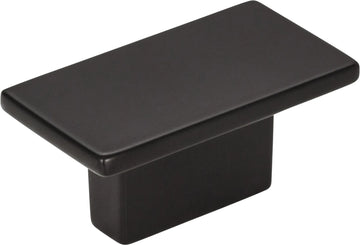 Jeffrey Alexander
Mirada 16 mm Center to Center Rectangle KnobMatte Black
Jeffrey Alexander
Mirada 16 mm Center to Center Rectangle KnobMatte Black
$6.25
$6.94 -
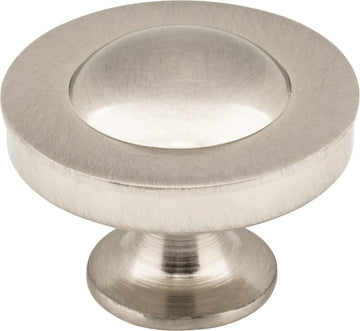 Jeffrey Alexander
Cordova 1-1/4'' diam Mushroom Knob Z111-SN
Jeffrey Alexander
Cordova 1-1/4'' diam Mushroom Knob Z111-SN
$6.03
$6.70 -
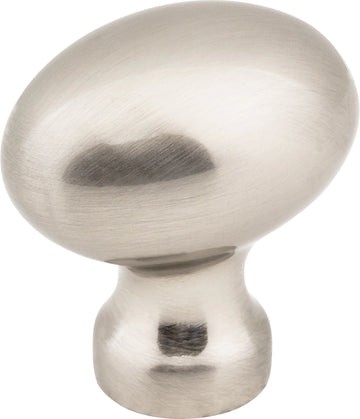 Jeffrey Alexander
Bordeaux 1-3/16'' Length Oval Knob 3990-SN
Jeffrey Alexander
Bordeaux 1-3/16'' Length Oval Knob 3990-SN
$7.83
$8.70 -
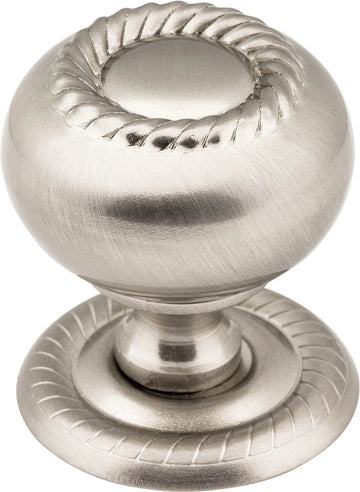 Jeffrey Alexander
Rhodes 1-1/4'' diam Mushroom Knob S6060SN
Jeffrey Alexander
Rhodes 1-1/4'' diam Mushroom Knob S6060SN
$4.23
$4.70 -
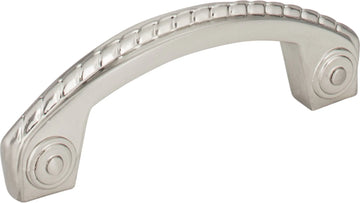 Jeffrey Alexander
Rhodes 3'' cc Bar Pull Z260-3SN
Jeffrey Alexander
Rhodes 3'' cc Bar Pull Z260-3SN
$3.68
$4.08

Hickory puts two woods on the same door
Hickory carries the widest sapwood to heartwood spread of the common cabinet woods. Sapwood is cream to pale blond, heartwood runs tan through a deep reddish brown, and a door shop working from one lift will set both on a single drawer front. Character and rustic grades add knots and mineral streaks that go close to black. The first thing I want to know about a hickory kitchen is how much sapwood is showing, because that is what sets the range. So when a page tells you to pick hardware that contrasts with hickory, the fair question is: contrasts with which part of it? A pull that reads cleanly on a pale door vanishes on the dark door next to it, and the run stops looking deliberate. That unevenness, rather than the color itself, is what registers in a finished hickory kitchen, and it is the thing worth designing around.
Sheen does the work that contrast cannot
Light against dark is only one way for hardware to declare itself. The other is highlight. A brushed or satin surface carries a directional grain that throws a thin line of reflected light down the length of a pull, and that line holds at ten feet no matter what color is behind it. Flat finishes have nothing to fall back on. A powder-coated matte black absorbs light by design, so on pale sapwood it lands as a strong dark stroke and on dark heartwood it becomes a shape you locate with your hand. Of everything that goes sideways in a hickory kitchen, this is the one I get called about after the hardware is already on the doors.
Where I land: satin nickel, or pewter when the grade is wild
Hickory makes cream, amber, brown and near-black. It does not make gray. That is the case for the nickel family here, and it has nothing to do with any rule about warm woods wanting warm metals. Satin nickel carries a fine grain in the plating and slightly less shine than brushed nickel; the two names get used loosely from maker to maker, and on hickory either behaves. On character or rustic grade, where the knots and a wire-brushed or hand-scraped texture are the point, I move to pewter, which is grayer and duller and sits down beside that texture instead of polishing next to it.
Here is the cost. Satin nickel over honey hickory on a raised-panel door is the standard specification of a very large number of kitchens built twenty years ago, and those three decisions now read as a single date stamp. If your doors and counters still belong to that generation, nickel will hold them there. It is the dependable answer, not the interesting one, and a slab or shaker door is what buys it back.
Matte black is the consensus pick, and it needs two conditions
Matte black leads nearly every result you will find for this search, usually on the grounds that a neutral cannot fight with the grain. It does compete, just not in color. Black earns its place on hickory when the wood has been milled to run light, with more sapwood than heartwood showing, and when black already repeats somewhere else in the room, on the faucet, the window frames or the pendants, so the pulls read as a set rather than as dark marks scattered over a wood that is busy on its own. Without that repetition you have added a third pattern to a surface that already has two. Black also shows dust and cooking film well before it shows fingerprints, and hickory kitchens tend to be built with wide flat drawer fronts, which is more of that surface than people expect.
Brass and bronze repeat a color the wood is already supplying
Oil-rubbed bronze is the other finish the search results agree on, and it sits within a shade of hickory's own heartwood: dark brown-black, and on many brands it keeps changing in use, going lighter where hands land and letting the copper underneath come through. Copper is a color the heartwood already has covered. I have put oil-rubbed bronze on hickory and been pleased with it, on mid-tone doors under a pale counter, so this is a caution rather than a ban. Warm metals do work on hickory, but they have to come in from above rather than alongside: a brushed brass or a honey bronze that is plainly brighter than the darkest board in the run will hold, while anything level with the heartwood turns into texture. Hold the sample against the darkest door in the kitchen and back off to the doorway. If it stops reading as hardware at that distance, what it needs is more brightness, not more warmth.
Hickory is hard, and that shows up on drilling day
Hickory is one of the hardest domestic woods put on cabinet doors, and it does not drill like maple or birch. A dull bit wanders going in and tears a crescent off the face coming out. I would rather someone spend ten minutes setting up than an afternoon repairing a door. Three habits deal with it: a sharp brad-point bit instead of a twist bit, a scrap block clamped hard behind the door so the bit exits into wood rather than air, and a jig so both holes of a pull land level and parallel on every door in the kitchen. Cabinet screws come in 8-32 thread; a 1 in length suits a standard 3/4 in door, while a thicker door, or a drawer box sitting behind an applied front, wants more.
Repair is the second hickory caution. Filling an old hole and re-drilling is a gamble on any wood, and here the board you are patching may be two colors at once, so a fill mixed to match the pale half sits on the dark half like a spot of putty. When the old hole spacing is anywhere near the new, a backplate is the cleaner way out.
An evening's test before you order for the whole kitchen
- Find the palest door and the darkest door in the run. Those two are the real test panels, and anything you buy has to survive both.
- Name the faucet's temperature, warm or cool, and agree with it unless the mix is deliberate. I treat this as the first constraint, not the last.
- Get your two finalists onto the door: try a sample first, refunded with your full order. Finish names are not standard between makers, so one company's pewter lands close to another's antique nickel.
- Tape both samples to the pale door, then move them to the dark one. Judge from the doorway, not from eighteen inches away.
- Do it again once the sun is down, under whatever bulbs hang over that counter. At 2700 K a nickel pull soaks up the room's yellow and behaves almost like a warm metal; at 4000 K the same pull goes cold, and hickory's amber heartwood looks a shade greener than it does by day.
What does center to center mean on a bar pull?
Center to center is the distance between the two screw holes, measured from the middle of one to the middle of the other, and it is the number every bar pull is sold by. It is not the overall length, which runs past the holes at both ends. In inches, the sizes you will meet most are 3, 3-3/4, 5, 6-5/16 and 7-9/16, with appliance lengths carrying on well past those. The same five in millimeters, which is how a lot of imported hardware is labelled: 76, 96, 128, 160 and 192. As a working proportion, hole spacing at roughly a third of the drawer's width holds up to about a 24 in drawer; at 30 in and wider, go past the proportion or fit two pulls.
Is Hickory Hardware the same thing as hickory cabinets?
No. Hickory Hardware is a cabinet hardware brand, sold under the Belwith-Keeler name, and it has nothing to do with the wood beyond sharing a word. The overlap confuses the search results in both directions: people shopping for pulls to put on hickory doors land on brand catalogs, and people looking for a specific brand collection land on wood pairing pages. If you came here for the wood, everything above stands. If you came for the brand, search by maker rather than by finish and you will get there faster.
Shop Satin Nickel Cabinet Hardware
-
 Lafayette 96 mm cc Bar Pull 317-96SN
$17.90
Lafayette 96 mm cc Bar Pull 317-96SN
$17.90
-
 Lafayette 128 mm cc Bar Pull 317-128SN
$19.91
Lafayette 128 mm cc Bar Pull 317-128SN
$19.91
-
 Capri 128 mm cc Bar Pull Z500-128SN
$13.72
Capri 128 mm cc Bar Pull Z500-128SN
$13.72
-
 Retail Pack Hardware 3'' cc Bar Pull 400SN-R
$43.51
Retail Pack Hardware 3'' cc Bar Pull 400SN-R
$43.51
-
 Lafayette 1-3/8'' diam Mushroom Knob 218SN
$13.61
Lafayette 1-3/8'' diam Mushroom Knob 218SN
$13.61
-
 Anwick 96 mm cc Bar Pull 867-96SN
$16.37
Anwick 96 mm cc Bar Pull 867-96SN
$16.37
-
 Key West 1-7/8'' Length Bar Knob
$6.56
Key West 1-7/8'' Length Bar Knob
$6.56
-
 Sutton 96 mm cc Bar Pull 635-96SN-25
$304.20
Sutton 96 mm cc Bar Pull 635-96SN-25
$304.20


Browse all 3286 in Satin Nickel Cabinet Hardware → Cabinet knobs Cabinet pulls & handles