

Cabinet Hardware for Maple Cabinets: First Work Out Which Maple You Have
Natural, toned and painted maple are three different problems. Matte black solves the most common one, and cool metals make it worse.

Most people asking this own natural maple that has ambered with age, and on that wood my first call is matte black. Cabinet hardware for maple cabinets goes wrong when the finish and the wood end up in the same yellow family, and black steps out of the hue argument altogether by working on value alone. Settle one thing before you shop, though. Natural, stained and painted maple are three different problems, and on painted doors the species stops mattering at all.
Shop the picks from this guide
In stock at Knobs.co · Free shipping on hardware orders $99+ · 110% price match
-
 Alno
Alno A726 Charlie's 3 1/2'' CC Cabinet PullAntique English / 3''
Alno
Alno A726 Charlie's 3 1/2'' CC Cabinet PullAntique English / 3''
$24.26
$26.95 -
 Berenson
Advantage Wire Pulls 3'' CC Matte Black Steel Pull 6129-2055-P
Berenson
Advantage Wire Pulls 3'' CC Matte Black Steel Pull 6129-2055-P
$1.58
$1.97 -
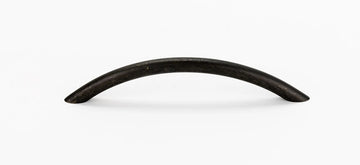 Alno
Alno A1298 128mm 5'' CC Brass Cabinet PullBarcelona
Alno
Alno A1298 128mm 5'' CC Brass Cabinet PullBarcelona
$19.76
$21.95 -
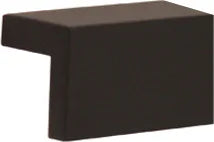 Alno
Alno A960 Tab 1 1/2'' CC Brass Cabinet PullBronze / 3/4''
Alno
Alno A960 Tab 1 1/2'' CC Brass Cabinet PullBronze / 3/4''
$16.16
$17.95 -
 Alno
Alno A1145 1 1/4'' Brass Cabinet KnobBarcelona
Alno
Alno A1145 1 1/4'' Brass Cabinet KnobBarcelona
$17.96
$19.95 -
 Alno
Charlie's 6'' Pull A726-6Antique English
Alno
Charlie's 6'' Pull A726-6Antique English
$62.96
$69.95


Three cabinet materials go by the name maple
Maple takes stain unevenly. It blotches, because the grain is tight and drinks pigment at different rates across a single board, which is why cabinet shops rarely put a deep penetrating stain on it. They clear-coat it, tone or glaze it, or they paint it. Maple's tight grain is also the reason so many painted doors are maple underneath: it sands flat and holds a paint film without the open pores telegraphing through. So the word on your invoice tells you less than you think, and I would not shop for a finish before you know which of the three is hanging on your walls.
| What you have | How to tell | What actually decides the hardware |
|---|---|---|
| Natural or clear-coated maple | Cream to honey, very fine grain, almost no figure | How far the wood has ambered |
| Toned, stained or glazed maple | Mid to dark brown, often with a darker line caught in the door profile | The color it was taken to, not the species |
| Painted maple | Solid color, grain barely readable through the film | The counter and the faucet |
Natural maple is more orange now than the day it went in
Maple leaves the shop pale cream and yellows as it ages, and light drives it. The shift is slow, small each year, and it only goes one way, so a run of doors hung twenty years ago now sits at a honey color that no maple sample in a showroom will match. Hardware chosen against a fresh chip is being chosen against a color your kitchen has already left behind.
There is a quick way to see where yours sits, and I run it on every maple consultation. Compare a door at the window end of the run with one from the darkest corner, the cabinet that has never had sun on it. In a kitchen with a decent window those two will not match, and the window-end door is the one to hold your hardware against, because that is the color the room reads as maple. If the two are close, your maple is still young or the room is dim, and you have more latitude than the paragraphs below assume.
Cool metals make maple look more orange, not less
The advice you will find everywhere is to fight honey maple with something cool: stainless, chrome, a cold silver. It does the opposite of what the advice promises. Put a blue-white metal next to a yellow-orange wood and each drives the other further from neutral. The chrome looks bluer, the maple looks more orange, and the contrast you bought to calm the kitchen down has sharpened the exact quality you were trying to mute.
If you want a silver on maple, take a warm one. Satin nickel carries enough yellow in the plating to sit beside ambered maple without starting that fight, and it is the quiet answer for anyone who wants the kitchen to look tidy rather than redesigned. Polished chrome I would keep off natural maple in most kitchens. The exception is real: maple that still runs cream rather than honey, under gray stone, reads cool enough that chrome joins in instead of arguing.
Why black is what I reach for on ambered maple, and what it costs
Matte black wins here by refusing the argument. It has no hue to clash with the wood's yellow, so it settles the question on lightness alone, and maple hands you the largest value gap available in a wood kitchen because it is the palest of the common cabinet woods. Pulls read as clean drawn lines on a light field. That is also why black has done more to modernise old maple kitchens than any paint color.
The cost is loudness. Black on pale maple is the first thing anyone notices in the room, so the shape has to be one you want noticed; on an ornate raised-panel door it can look like hardware borrowed from someone else's kitchen, while on shaker and slab doors it belongs. The second cost lands on installation day. Dark hardware on a pale door makes every alignment error legible from the doorway, and a pull set a sixteenth of an inch low will announce itself for the life of the kitchen. Use a jig, not a tape measure and a pencil.
Maple exposes the outline of a pull more than any other cabinet wood
Maple gives hardware nothing to hide behind. The grain is fine and close, the figure is faint, and the surface behaves like a blank sheet, where hickory or walnut supply a pattern that absorbs a mediocre casting. On maple the silhouette is fully visible: soft edges, a seam left by the mold, a screw head standing proud of the face. Shape choices that disappear on a busy wood carry across a maple kitchen, which cuts both ways.
It is also the reason a warm finish can work here if it is not another yellow. Champagne bronze reads as a soft warm neutral rather than a gold, so it does not restate the color of the wood the way a satin brass tends to. It started as a faucet finish, which makes it the easy bridge when the faucet is already warm. Polished brass on honey maple is the one pairing I argue people out of: two yellows at two different levels of shine, close enough to look like an attempt at matching that missed.
If the maple is painted, the wood has left the conversation
On a painted door the species is a manufacturing detail. Nobody in the room can see maple, so every argument above about ambering and yellow is beside the point, and the finish follows the counter, the faucet and the paint color instead. The one thing the maple underneath still controls is the drilling. A hard, tight-grained wood under a cured paint film chips at the edge of a new hole, and on a painted door a chip is not a touch-up, it is a repaint of that door, because paint will not blend the way a stain can be feathered. Lay a strip of low-tack tape over the mark and drill through the tape, slowly, letting the bit cut rather than pushing it.
The order I would decide in
- Name your maple: natural, toned, or painted. Everything after this depends on the answer.
- If it is painted, stop looking at the wood. Match the temperature of the faucet, then check the counter's undertone, and treat the doors as a paint color.
- If it is natural, find the door that gets the most sun and the door that gets none. Shop against the sunny one.
- Decide whether you want the kitchen quieter or more current. Warm silver for quieter, black for more current, champagne bronze if the faucet is already warm.
- Take the two you cannot separate and try a sample first, refunded with your full order. Finish names drift between makers, and two boxes both marked satin nickel can land a shade apart.
- Hold them at the doorway distance, in daylight and again at night. Warm bulbs deepen maple's yellow and pull a nickel pull toward it; cooler bulbs separate the two and make the wood look more orange than it does by day.
If you take one thing from this, make it the first step. Half the bad hardware decisions I see on maple come from treating a painted door and a twenty-year-old natural one as the same question.
Shop Matte Black Cabinet Hardware
-
 Sutton 96 mm cc Bar Pull 635-96MB-25
$304.20
Sutton 96 mm cc Bar Pull 635-96MB-25
$304.20
-
 Sutton 160 mm cc Bar Pull 635-160MB-10
$176.04
Sutton 160 mm cc Bar Pull 635-160MB-10
$176.04
-
 Sutton 128 mm cc Bar Pull 635-128MB-20
$291.24
Sutton 128 mm cc Bar Pull 635-128MB-20
$291.24
-
 Epoch Edge 128mm CC Matte Black Pull 1215-1055-P
$10.93
Epoch Edge 128mm CC Matte Black Pull 1215-1055-P
$10.93
-
 Galloway 128mm CC Matte Black Round Backplate 3100-1055-B
$10.61
Galloway 128mm CC Matte Black Round Backplate 3100-1055-B
$10.61
-
 Statler Matte Black Cutout Backplate 3118-1055-B
$5.66
Statler Matte Black Cutout Backplate 3118-1055-B
$5.66
-
 Galloway 96mm CC Matte Black Round Backplate 3099-1055-B
$7.67
Galloway 96mm CC Matte Black Round Backplate 3099-1055-B
$7.67
-
 Statler 224mm CC Matte Black Cutout Backplate 3117-1055-B
$11.19
Statler 224mm CC Matte Black Cutout Backplate 3117-1055-B
$11.19


Browse all 2293 in Matte Black Cabinet Hardware → Cabinet knobs Cabinet pulls & handles