

Cabinet Hardware for Navy Cabinets: Match the Sheen, Not the Color
Warm metal on navy is the easy part. Whether it should be brushed or polished depends on how glossy the paint is, and almost nobody says so.

Warm metal on navy is the right instinct, and every page on the subject says so. The decision that actually separates a good navy kitchen from a fussy one is sheen: set the hardware's shine against the paint's shine, not against the color. Cabinet hardware for navy cabinets does its best work in a brushed warm metal on the satin and semi-gloss doors most cabinet shops spray, because the pull stays matte while the door behind it reflects. On a flat or dead-matte navy the polished finishes come back, since nothing else in that run of doors is throwing light. The faucet overrides all of it: if it is already a warm metal, buy warm and let the faucet set the tone.
Shop the picks from this guide
In stock at Knobs.co · Free shipping on hardware orders $99+ · 110% price match
-
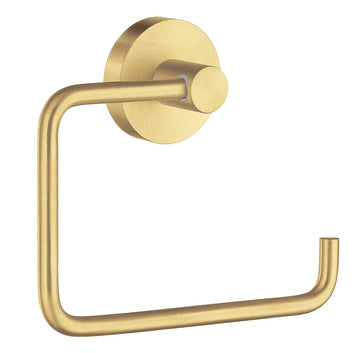 Smedbo
Home Toilet Roll Holder Brushed Brass HV341
Smedbo
Home Toilet Roll Holder Brushed Brass HV341
$126.00
$140.00 -
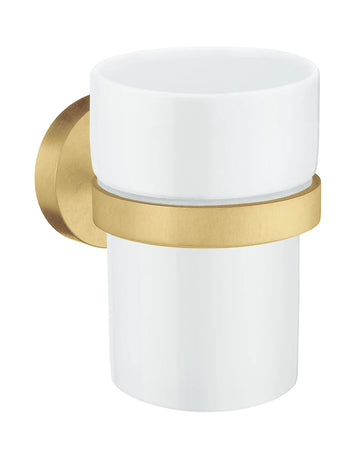 Smedbo
Home Holder With Tumbler Br Brass/Porcelain HV343P
Smedbo
Home Holder With Tumbler Br Brass/Porcelain HV343P
$153.00
$170.00 -
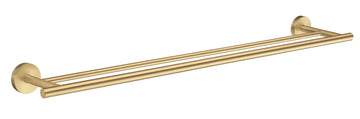 Smedbo
Home Double Towel Rail Brushed Brass HV3364
Smedbo
Home Double Towel Rail Brushed Brass HV3364
$326.70
$363.00 -
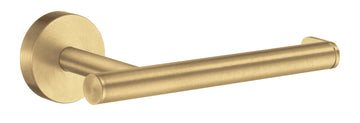 Smedbo
Home Toilet Roll Holder Brushed Brass HV3411
Smedbo
Home Toilet Roll Holder Brushed Brass HV3411
$142.21
$158.00 -
 Century Hardware
Kai 6-5/16 inches (160mm) cc Square Bar PullPolished Nickel
Century Hardware
Kai 6-5/16 inches (160mm) cc Square Bar PullPolished Nickel
$18.00
$20.00 -
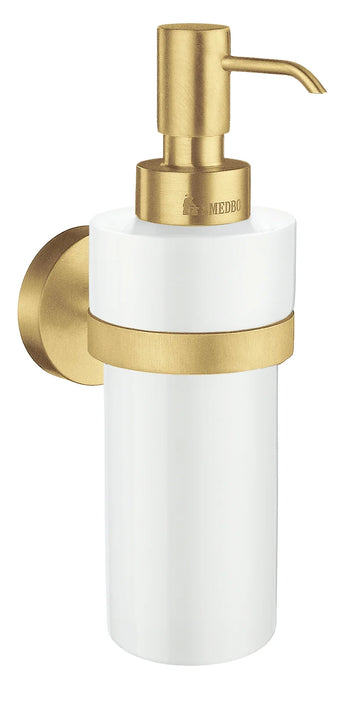 Smedbo
Home Soap Dispenser Br Brass/Porcelain HV369P
Smedbo
Home Soap Dispenser Br Brass/Porcelain HV369P
$307.80
$342.00

Hold a white card against a door before you shop
Navy is a family, not a color. Some navies are mixed toward green and some toward violet, and on their own, in a painted kitchen with nothing to compare them against, they all read simply as dark blue. I carry a sheet of plain copy paper for exactly this. Put it flat on a door in daylight and the lean shows up at once: one navy goes slightly teal beside the white, another throws a faint purple.
This matters because it changes what a yellow gold does in the room. Violet sits opposite yellow, so gold hardware on a violet-leaning navy is a full opposition and lands hard and bright, which is either the point or too much depending on how many pulls you are hanging. On a green-leaning navy the gold has less to push against, and the two settle into a softer, slightly olive relationship that most people like better and nobody warns them about. Neither is wrong. But it explains why the same brass pull looks confident in one navy kitchen and muddy in the next, and it is worth five seconds with a piece of paper before you spend an afternoon choosing.
The paint's sheen decides the hardware's sheen
Dark paint shows every ripple in a door, so cabinet shops usually spray navy in satin or semi-gloss to keep the surface even, and those doors already have a soft reflection running along the rails. Add a mirror-finish pull and you have two competing reflections within a few inches of each other, and the hardware stops reading as an object on the door and starts reading as one more highlight.
That is the case for brushed brass as the default on navy. The grain in the surface breaks up the reflection, so the pull holds a steady warm line against a door that is busy bouncing the window around. Flat and matte navy flips it. A dead-matte door absorbs light, and a polished brass or a polished nickel becomes the only bright thing in the run, which is the closest a kitchen gets to jewelry. The first thing I ask a navy client to send is a photo of a door taken at an angle rather than straight on, because that is the only way sheen shows up in a picture. Check your own doors the same way before you decide, because a satin and a semi-gloss look identical straight on and completely different at forty-five degrees.
This is the one pairing question where a printed swatch is close to useless. Brushed, satin and polished versions of the same warm metal photograph almost identically, and the names move between makers, so one company's brushed brass arrives duller than another's satin brass. Narrow it to two and try a sample first, refunded with your full order, then hold both against a door with the room lights off and the daylight coming across the surface. Do it again after dark. Warm bulbs will deepen the navy and pull any gold toward orange; cooler bulbs lift the blue and leave the same gold looking greener than it did at noon.
How much gold the room can take
Navy and gold arrived together, hard, in the second half of the last decade, and the version of it that will look dated is the room where the pulls, the faucet, the pendant frames, the window hardware and the mirror are all the same warm yellow. One metal repeated five times is a decorating scheme, and schemes age. The navy kitchens I still like in five-year-old photographs are the ones that stopped at two. Hardware plus faucet is plenty, and hardware alone against a nickel or a black faucet ages more slowly than either.
If the navy leans green, or if your faucet is a softer gold rather than a yellow one, champagne bronze is the version of this pairing I specify most often. It carries less yellow than brass, so it stays warm without adding a second saturated color to a room that already has one strong one; we have a separate piece on champagne bronze pulls on navy if that is the direction you are going. Unlacquered brass is the other honest route, with one thing to know: it darkens as it is handled and the paint does not change at all, so the contrast you choose in the first month is not the contrast you will live with in the third year.
Black and the cool metals are doing different jobs
Matte black on navy is not an accent. It is closer to a shadow: dark on dark, almost no value contrast, so the eye reads the shape of the door and the line of the pull rather than the pull itself. I specify it when the cabinetry is the feature and the hardware is not meant to interrupt it, which is often a navy island meant to sit as one block of color. Two costs. In evening light you will find the pulls by hand before you find them by eye, which matters more on a pantry or a bank of deep drawers than it does on a base cabinet. And a black powder coat on a dark painted door gives dust and cooking film a stage twice over.
The nickel family goes the other way. Cool metal on a cool color is a tonal pairing rather than a contrast, and it reads quiet and modern rather than decorative, which is the answer when the navy is doing enough work on its own. Chrome takes that furthest: blue-white against blue, crisp and slightly clinical, and better in a navy bathroom vanity than in a navy kitchen.
Dark paint keeps a record of your hands
This is the part nobody mentions until the kitchen is six months old, and it is the most common thing I hear back about. Navy shows a halo of hand oils around every knob the way white never does, and on a satin sheen the mark sits there until it is wiped. It is not a reason to avoid navy, but it is a reason to think about the footprint of what you buy. Anything that gives the hand a wider target keeps fingers off the paint: a bar pull rather than a small knob on doors people open twenty times a day, cup pulls on drawers, a backplate behind a knob where the traffic is heaviest.
The other caution is repair. A chip in dark paint shows the pale primer underneath immediately, which means replacing hardware on painted navy doors is less forgiving than on wood. If the doors came factory-finished, ask for the touch-up pen that matches your paint batch and keep it, because a mixed-to-match repair a year later is never quite the same color.
Do navy blue cabinet knobs exist, or only hardware for navy cabinets?
Both, and I get the question in both directions. Knobs and pulls that are themselves navy blue are real: ceramic, glass and painted-metal hardware all come in blue, and they belong on white, cream or light wood doors where the blue becomes the accent. On navy cabinets they are the opposite of useful, since blue hardware on a blue door disappears completely. If you have navy doors, you want a metal finish. If you want navy hardware, you want pale doors to put it on, and the knob shapes that carry color well are the simple round and mushroom profiles, where the glaze or the glass is the whole point.
Shop Brushed Brass Cabinet Hardware
-
 Home Toilet Roll Holder Brushed Brass HV341
$126.00
Home Toilet Roll Holder Brushed Brass HV341
$126.00
-
 Home Holder With Tumbler Br Brass/Porcelain HV343P
$153.00
Home Holder With Tumbler Br Brass/Porcelain HV343P
$153.00
-
 Home Double Towel Rail Brushed Brass HV3364
$326.70
Home Double Towel Rail Brushed Brass HV3364
$326.70
-
 Home Toilet Roll Holder Brushed Brass HV3411
$142.21
Home Toilet Roll Holder Brushed Brass HV3411
$142.21
-
 Kai 6-5/16 inches (160mm) cc Square Bar Pull
$18.00
Kai 6-5/16 inches (160mm) cc Square Bar Pull
$18.00
-
 Home Soap Dispenser Br Brass/Porcelain HV369P
$307.80
Home Soap Dispenser Br Brass/Porcelain HV369P
$307.80
-
 Home Holder With Soap Dish Br Brass/Porcelain HV342P
$153.00
Home Holder With Soap Dish Br Brass/Porcelain HV342P
$153.00
-
 Kai 7-9/16 inches (192mm) cc Square Bar Pull
$21.60
Kai 7-9/16 inches (192mm) cc Square Bar Pull
$21.60


Browse all 23 in Brushed Brass Cabinet Hardware → Cabinet knobs Cabinet pulls & handles