

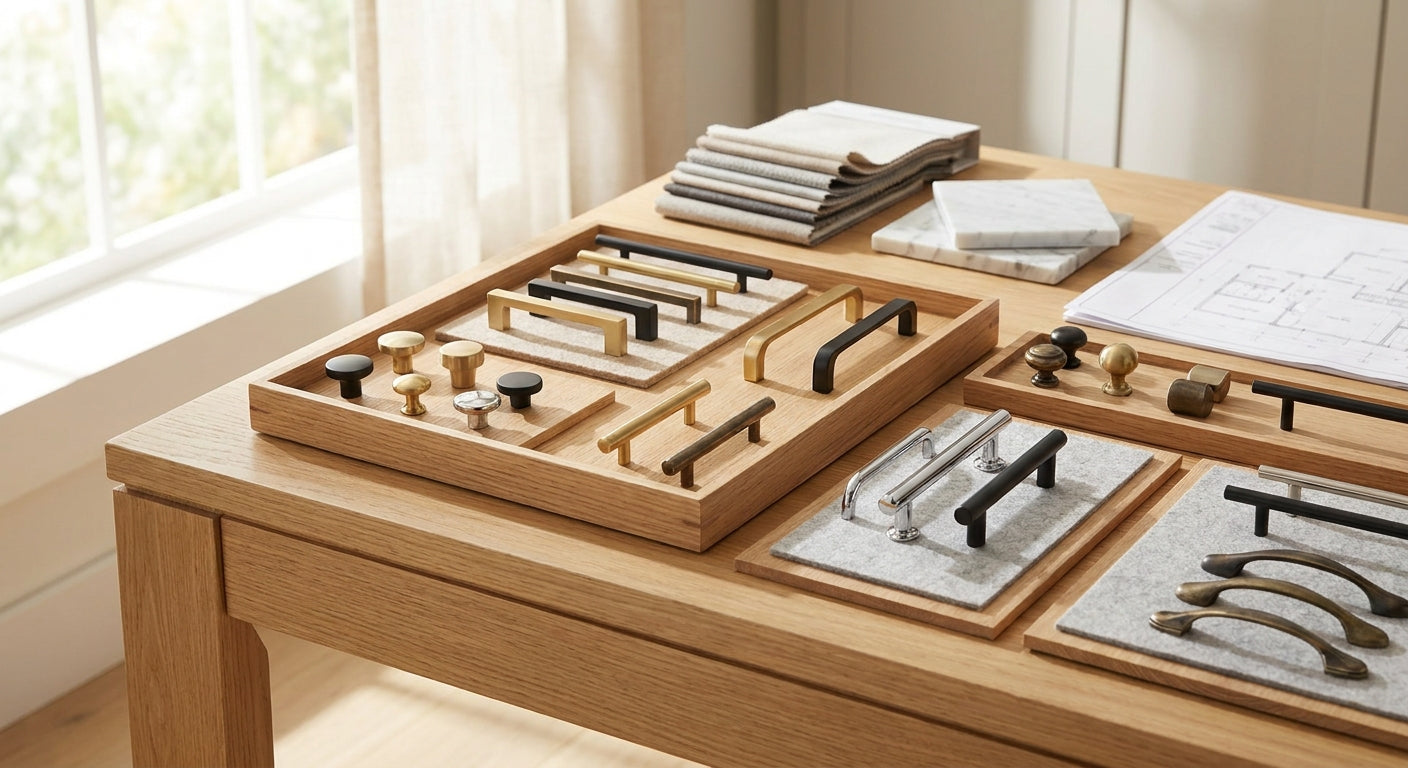
Ordering cabinet hardware samples before a client sign-off is the difference between a finish that reads right in a lookbook and one that reads wrong under a client's kitchen pendants. This guide breaks down what interior designers should actually check before locking a spec sheet.
TL;DR
Cabinet hardware samples exist to catch finish and scale mistakes before a full order ships, and in 2026 the fastest way to do that is to pull 2-3 physical finishes side by side rather than trust a screen. Buy: Atlas Homewares' A505-BL Alaire Pull and Schaub and Company's 704-PN Traditional Round Knob both hold up as safe, repeatable picks across finish batches. Consider: Top Knobs' TK1014PN Grace Riverside Pull for a softer, transitional line. Skip any sample kit that ships without the exact SKU you plan to spec — a "similar" finish is not the finish.
Why this matters
A finish photo on a manufacturer's site and a finish under a client's under-cabinet lighting are two different objects. Matte black can read charcoal, brushed nickel can pick up a warm cast next to warm-toned quartz, and a pull that looks substantial in a render can feel thin in hand. Designers who skip physical samples end up re-specifying mid-install, which costs more in labor than the sample ever would have. Knobs.co stocks over 50,000 SKUs across dozens of brands, which means the sample decision is really a filtering decision — you need criteria, not a scroll through the full catalog.
Who this is for
This is for interior designers and kitchen and bath professionals speccing hardware for a client project — not a homeowner buying one drawer's worth of knobs for a weekend refresh. If you're managing finish consistency across 40+ pulls, multiple rooms, and a client who will notice if the powder room doesn't match the kitchen, sampling before ordering is not optional. It's the step that protects your margin and your reputation.
What to look for in cabinet hardware samples
Finish accuracy under real light
A sample's job is to survive your client's actual kitchen lighting, not a studio photo. Bring the sample into the space at the time of day it'll be seen most — morning light for an east-facing kitchen, task lighting for a windowless butler's pantry. Finishes like champagne bronze and brushed gold shift more under warm LED than most designers expect.
Weight and grip feel
A pull that photographs well can still feel hollow when a client's hand is on it. Heavier zinc and solid brass pulls telegraph quality in a way renders can't show. This matters more on appliance pulls and bar pulls over 12 inches, where flex becomes noticeable.
Center-to-center accuracy against your cabinet drawings
Sample the exact center-to-center spacing you plan to order, not a close variant. An 8-13/16-inch pull and an 8-1/2-inch pull look identical in a photo and require different drill templates on site. Cross-check spacing against a cabinet knob and pull sizing guide before you finalize the order.
Brand and line depth
A finish you love from one line should exist across knobs, pulls, appliance pulls, and cabinet hinges so the whole kitchen matches. Confirm the sample's finish name maps to the same finish across the manufacturer's full line before you spec five different products in five different rooms.
Reorder consistency
Ask whether the finish you're sampling today will match a reorder in six months if a client adds a pantry or bar cart later. Batch-to-batch finish drift is real on hand-applied finishes like oil-rubbed bronze and unlacquered brass, less of an issue on plated finishes like polished chrome.
Price and program terms
Check what the sample actually costs you before ordering fifteen finishes across three brands. Knobs.co backs its pricing with a 110% price match, so sampling widely doesn't put you at a price disadvantage once you land on a finish.
Top picks for designer sampling
Atlas Homewares A505-BL Alaire Pull, 8-13/16" CC — the workhorse pick. Matte black finish, straightforward bar profile, and a center-to-center spacing common enough that it drops into most shaker and flat-front layouts without a custom template. It holds its finish evenly across batches, which matters when a project spans multiple order dates in 2026. Verdict: Buy.
Schaub and Company 704-PN Traditional Round Knob, Polished Nickel, 1-1/2" dia — the safe pick. Polished nickel reads clean and consistent under almost any kitchen lighting, and the traditional round profile works across shaker, inset, and even some transitional flat-front doors. This is the knob to spec when a client can't commit to a strong design point of view. Verdict: Buy.
Top Knobs TK1014PN Grace Riverside Pull — the wildcard. A softer, organic curve that reads more transitional than modern, this one earns a second look on projects where the rest of the palette is warm wood and stone rather than hard-edged surfaces. It's a riskier pick for a strictly minimalist kitchen. Verdict: Consider.
Amerock BP36838 Status, 5" pull — the budget stand-in. Useful as a placeholder sample when a client hasn't approved final spend, but the profile and hand-feel are noticeably lighter than the Atlas and Schaub picks above. Fine for a mood board, thinner for a final spec on a high-end kitchen. Verdict: Consider, not for premium builds.
What to avoid
- Sample kits that ship a "representative" finish instead of the exact SKU. A close match is not a match — order the actual product number you intend to spec.
- Single-finish samples when the project needs mixed metals. If a client's kitchen mixes brushed nickel faucets with warm brass hardware, sample both together, not separately, so you can judge the pairing in person.
- Skipping the appliance pull sample when a panel-ready fridge is in scope. Appliance pulls run longer and heavier than cabinet pulls, and a finish that looks fine on a 5-inch knob can look different stretched across an 18-inch appliance pull.
Verdict comparison
| Pick | Finish | CC Spacing | Feel | Verdict |
|---|---|---|---|---|
| Atlas Homewares A505-BL Alaire | Matte black | 8-13/16" | Solid, consistent | Buy |
| Schaub and Company 704-PN | Polished nickel | N/A (knob) | Clean, traditional | Buy |
| Top Knobs TK1014PN Grace Riverside | Polished nickel | Varies | Soft, organic | Consider |
| Amerock BP36838 Status | Varies | 5" | Lighter, thinner | Consider / Skip for premium |
FAQ
What are cabinet hardware samples for interior designers? They're individual pieces — a knob, a pull, an appliance pull — ordered ahead of a full project order specifically to check finish, weight, and spacing in the client's actual space before committing to a full spec.
Are cabinet hardware samples free? Knobs.co offers free samples as part of how it competes on price and service, which lets designers test multiple finishes without adding cost to a project budget.
How many samples should a designer order per project? 2-3 finishes per hardware category is typical — enough to compare directly against each other without turning the sampling process into its own project.
How long do cabinet hardware samples take to arrive? Timing depends on the brand and finish in stock; check current shipping estimates on the product page before promising a client a decision date.
Do sample finishes match the full-size order exactly? They should, provided you order the exact SKU rather than a similar-looking variant — finish names are not standardized across brands, so matching the product number matters more than matching the color description.
Is polished nickel or brushed nickel better for high-traffic kitchens? Brushed nickel hides fingerprints and light scuffing better than polished nickel, which is why it shows up more often on daily-use pulls versus decorative knobs.
What's the best way to test cabinet hardware samples in a client's kitchen? Hold the sample against the actual cabinet door, at the height it will be installed, under the lighting that will be on most often — not on a countertop under a phone flashlight.
Should appliance pulls match cabinet pulls exactly? They should match in finish at minimum; profile can vary since appliance pulls carry more length and weight than a standard cabinet pull.
One last thing
Most designers assume store pricing is negotiable the way furniture pricing sometimes is — it isn't. Nearly all cabinet hardware pricing is set by the manufacturer, not the retailer, which is exactly why a 110% price match guarantee matters more than haggling: it protects you against the one store that's pricing outside the manufacturer's set range. Sample widely in 2026, spec confidently, and let the price match do the negotiating.


