


Narrow drawers — nightstand drawers, vanity drawers, spice pull-outs, anything under 6 inches wide — need cabinet pulls sized to the rail, not the whole-kitchen bar pull that looks right on a 30-inch base cabinet. This guide breaks down which narrow drawer cabinet pulls actually fit and which ones you'll be patching holes for by next spring.
- Narrow drawer cabinet pulls should run 3 inches center-to-center or smaller on drawers under 6 inches wide — go bigger and the screws hit the frame edge.
- Top Knobs Chareau Reeded Knob at 1-1/8 inch is the safe pick for drawers under 4 inches wide — Buy.
- Additions Tab Pull at 3 inch CC fits most narrow drawer fronts between 4 and 6 inches — Buy.
- Elements Torino 4 inch CC Bar Pull is the wildcard for 6-to-8-inch drawers — Consider, skip it narrower than that.
- Skip any pull over 5 inches CC on a drawer under 6 inches wide — the backplate overhangs the rail.
Shop the picks from this guide
In stock at Knobs.co · Free shipping on hardware orders $99+ · 110% price match
-
 Jeffrey Alexander
Lafayette 128 mm cc Bar Pull 317-128SN
Jeffrey Alexander
Lafayette 128 mm cc Bar Pull 317-128SN
$19.91
$22.12 -
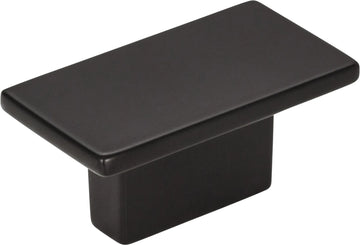 Jeffrey Alexander
Mirada 16 mm Center to Center Rectangle KnobMatte Black
Jeffrey Alexander
Mirada 16 mm Center to Center Rectangle KnobMatte Black
$6.25
$6.94 -
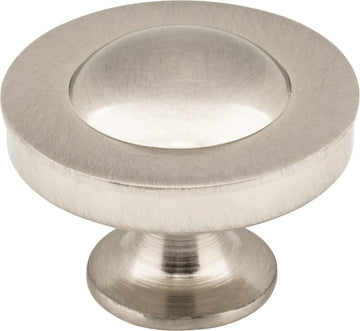 Jeffrey Alexander
Cordova 1-1/4'' diam Mushroom Knob Z111-SN
Jeffrey Alexander
Cordova 1-1/4'' diam Mushroom Knob Z111-SN
$6.03
$6.70 -
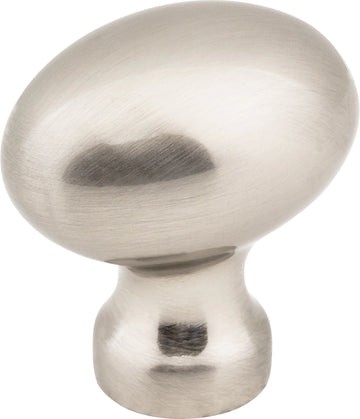 Jeffrey Alexander
Bordeaux 1-3/16'' Length Oval Knob 3990-SN
Jeffrey Alexander
Bordeaux 1-3/16'' Length Oval Knob 3990-SN
$7.83
$8.70 -
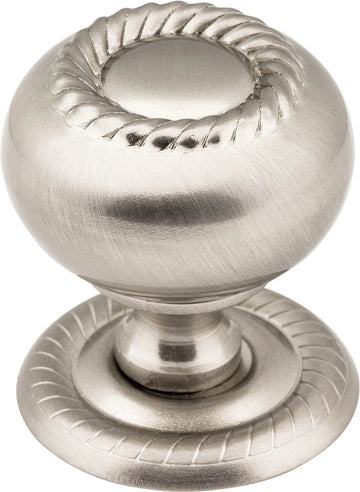 Jeffrey Alexander
Rhodes 1-1/4'' diam Mushroom Knob S6060SN
Jeffrey Alexander
Rhodes 1-1/4'' diam Mushroom Knob S6060SN
$4.23
$4.70 -
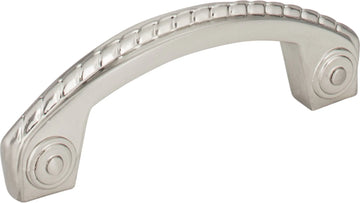 Jeffrey Alexander
Rhodes 3'' cc Bar Pull Z260-3SN
Jeffrey Alexander
Rhodes 3'' cc Bar Pull Z260-3SN
$3.68
$4.08

Why this matters
Most cabinet pull buying guides are written for kitchen base cabinets — 24 to 36 inches of drawer front with room to spare. Narrow drawers don't get that luxury. A nightstand drawer, a vanity drawer next to a sink bowl, or a pull-out spice rack often gives you 4 to 6 inches of usable rail before you hit a hinge, a stile, or the cabinet edge.
Pick a pull sized for a 30-inch kitchen drawer and mount it on a 5-inch nightstand front, and one of two things happens: the screws miss the wood entirely, or the backplate hangs off the edge of the drawer. Neither looks intentional. If your project also involves thin overlay fronts, the thin overlay drawer fronts guide covers the screw-length side of that problem in more depth.
The fix is simpler than most people expect: match center-to-center (CC) length to the actual rail width, not to what looks proportional in a photo. 2026 kitchens are trending toward mixed hardware sizing — knobs on narrow drawers, bar pulls on wide ones — which makes this less of a compromise and more of a design choice.
Who this is for
This guide is for anyone hardware-shopping for drawers under 6 inches wide: a homeowner replacing pulls on a bathroom vanity with two narrow drawers flanking the sink, a nightstand or dresser refresh, or a designer speccing a run of narrow drawers in a custom built-in. If you're outfitting a full kitchen with standard 24-inch base drawers, most of this doesn't apply — go look at a bar pull guide instead.
What to look for in narrow drawer cabinet pulls
Center-to-center length matched to the rail
CC length is the single number that makes or breaks a narrow drawer install. Measure the usable flat rail — not the whole drawer front — and pick a pull with a CC at least 1 inch shorter than that measurement on each side. A 5-inch rail wants a 3-inch CC pull, not a 4-inch one squeezed in.
Projection that clears adjacent hardware
Narrow drawers often sit close to a neighboring drawer, a door, or a sink apron. A pull that projects 1.5 inches off the face is fine on an open kitchen island; it's a knuckle-scraper on a tight vanity bank. Check projection before CC — it's the spec people forget until they've already drilled.
Knob vs. pull — know when to downsize
Anything under 4 inches wide usually reads better with a knob than a pull. A knob gives you one clean mounting hole instead of two, and it avoids the visual imbalance of a stretched-out pull crammed onto a short rail. Knobs also forgive slightly off-center drilling in a way pulls don't.
Backplate coverage for old hole patterns
If you're replacing existing hardware and the old holes don't match your new pull's CC, a backplate can bridge the gap without redrilling. On narrow drawers, though, an oversized backplate is often the exact problem you're trying to avoid — check backplate width against rail width before you buy.
Finish consistency across a set
A nightstand or vanity install usually means 2 to 6 identical pulls. Order samples before you commit finish — brushed satin nickel and brushed nickel look nearly identical on a screen and noticeably different once six of them are lined up under bathroom lighting.
Screw length for thin drawer fronts
Most narrow-drawer applications — nightstands, thin plywood vanity drawers — run 5/8 to 3/4 inch material, thinner than a standard 3/4-to-1-inch kitchen drawer front. Standard 1-inch screws often bottom out or poke through. Confirm screw length against your actual drawer thickness before ordering hardware for more than one drawer.
Top picks for narrow drawers
The minimalist pick: Top Knobs Chareau Reeded Knob, 1-1/8 inch, Honey Bronze
One mounting hole, a reeded texture that hides fingerprints better than smooth knobs, and a diameter small enough for drawers as narrow as 3 inches. This is the pick for anything where a pull would overwhelm the rail — think jewelry drawers, narrow vanity drawers, or a run of small drawers in a built-in. Buy for any drawer under 4 inches wide.
The safe pick: Additions Tab Pull, 3 inch CC, Brushed Satin Nickel
A 3-inch CC pull is the workhorse size for narrow drawer cabinet pulls — short enough to clear a tight rail, long enough to grip with three fingers instead of one. Brushed satin nickel hides fingerprints and daily wear better than polished finishes. Buy for drawers in the 4-to-6-inch range; it's the size most narrow-drawer projects should default to.
The wildcard: Elements Torino 4 inch CC Bar Pull, Matte Black
At 4 inches CC this pull is on the upper edge of what qualifies as "narrow drawer" sizing — it works on a 6-to-8-inch rail but crowds anything smaller. Matte black gives strong contrast against light cabinetry, which matters more on a narrow drawer where there's less surface area to make a statement. Consider it for the wider end of narrow; skip it under 6 inches.
View the Torino 4 inch bar pull
The runner-up: Belwith Keeler Fuller Collection Pull, 3.3 inch CC
A touch longer than the Additions tab pull at a similar profile, the Fuller Collection pull works as a near-identical substitute if you need a slightly different finish family to match existing hardware elsewhere in the room. Consider it as a finish-matching alternative rather than a first pick.
“If the pull's backplate hangs off the edge of the drawer, you bought the wrong size.”
What to avoid
- Anything over 5 inches CC on a rail under 6 inches wide. It photographs fine on a product page and looks wrong the moment it's mounted next to a hinge or a neighboring drawer.
- Deep-projection pulls on tight vanity banks. A 1.5-inch projection is comfortable on an open kitchen drawer; it's a hand-scraper when two narrow vanity drawers sit 2 inches apart.
- Mismatched CC across a visible run. Buying three different 3-to-4-inch pulls because they were in stock creates a set that reads as accidental rather than intentional — order enough of one CC and finish to cover the whole run before checking out.
Verdict comparison
| Product | CC / Diameter | Best Drawer Width | Verdict |
|---|---|---|---|
| Top Knobs Chareau Reeded Knob | 1-1/8 in | Under 4 in | Buy |
| Additions Tab Pull | 3 in CC | 4-6 in | Buy |
| Elements Torino Bar Pull | 4 in CC | 6-8 in | Consider |
| Belwith Keeler Fuller Collection Pull | 3.3 in CC | 4-6 in (alt finish) | Consider |
FAQ
What size cabinet pulls work best for narrow drawers?
A 3-inch center-to-center pull or a knob under 1.5 inches works best on drawers under 6 inches wide. Measure the usable flat rail first, not the full drawer width, since hinges and stiles eat into that space.
Should I use knobs or pulls on narrow drawers?
Use a knob on any drawer under 4 inches wide. A knob needs one mounting hole and looks proportional on a short rail, while a pull stretched across the same space tends to look crammed.
How much projection is right for narrow drawer pulls?
Keep projection under 1.25 inches on tight vanity or nightstand banks where drawers sit close together. Deeper projection is fine on a single, isolated narrow drawer with clearance on both sides.
Can I put a 4-inch pull on a 6-inch-wide drawer?
Yes, a 4-inch CC pull fits a 6-inch drawer with room on both sides. Going smaller than 6 inches wide, drop to a 3-inch CC pull or a knob instead.
What screw length do narrow drawer pulls need?
Confirm screw length against actual drawer thickness before ordering — thin plywood or MDF drawer fronts around 5/8 inch often need shorter screws than the 1-inch standard included with most pulls, or the screw will poke through the drawer box.
Do narrow drawers need backplates?
Only if you're covering an old hole pattern that doesn't match your new pull's CC. On a truly narrow drawer, an oversized backplate is usually the exact overhang problem you're trying to avoid, so measure backplate width against rail width first.
What finish works best for a run of narrow drawers?
Brushed satin nickel and matte black both hide fingerprints and daily wear better than polished finishes on high-touch narrow drawers like vanities and nightstands. Order samples before committing to a full run since finishes read differently under real lighting.
How do I measure center-to-center hole spacing on an existing narrow drawer?
Measure from the center of one existing screw hole to the center of the other in a straight line — that number is your current CC. Match a new pull to that exact CC to avoid drilling new holes.
One last thing
The most common narrow-drawer mistake isn't the pull size — it's ordering one pull to "see how it looks" and then discovering the finish batch has shifted slightly by the time you order five more. On any run of narrow drawers, order the full quantity in one batch, even if it means holding off installation for a day or two.


