

Hinge Overlay Size: Measure the Door, Then Read the Hinge
Overlay is one measurement taken on the hinge side, and whether it lives in the hinge's steel or in its mounting plate decides what you can order.

Hinge overlay size is how much of the face frame or the cabinet box edge a closed door covers on its hinge side, and the honest way to get it is a strip of tape: stick it on the frame flush with the closed door's edge, open the door, and measure from the tape to the edge of the opening. Round what you read to the nearest step the hinges are sold in. Then one thing decides how much that number binds you. On a face-frame wrap hinge the overlay is bent into the steel and has to match; on a European concealed hinge the mounting plate sets the overlay, so the same hinge body covers a range and a mismatch is often a plate problem rather than a hinge problem.
Shop the picks from this guide
In stock at Knobs.co · Free shipping on hardware orders $99+ · 110% price match
-
 Amerock
Functional Hardware 3/8'' Offset Non-Self Closing Face Mount Cabinet Hinge - 1 Pair BPR3406Antique Copper
$6.99
$8.22 -
 Amerock
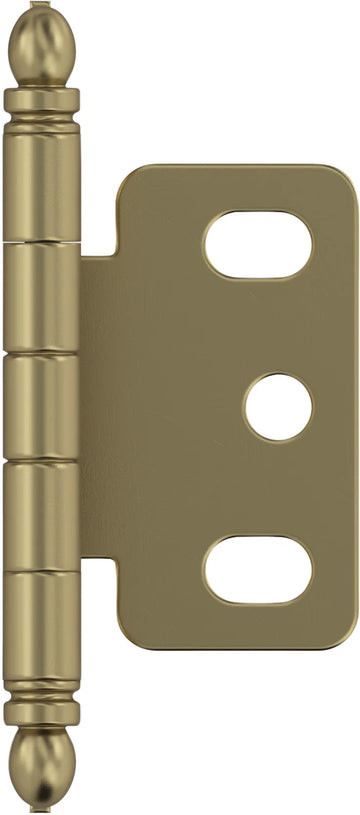
Functional Hardware 3/4'' Door Thickness Full Inset Partial Wrap Ball Tip Cabinet Hinge - Single Hinge PK3180Golden Champagne
$5.90
$6.93 -
 Amerock
Functional Hardware 1/2'' Overlay Double Demountable Cabinet Hinge - 1 Pair BPR8704Burnished Brass
$12.95
$15.23 -
 Amerock
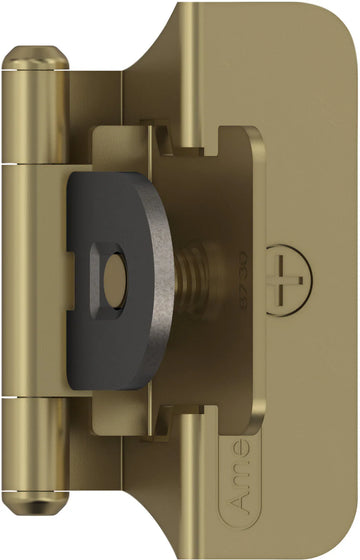
Functional Hardware 1/4'' Overlay Double Demountable Cabinet Hinge - 1 Pair BPR8701Golden Champagne
$12.95
$15.23 -
 Amerock
Functional Hardware Variable Overlay Self Closing Face Mount Cabinet Hinge - 1 Pair BPR3429Polished Chrome
$5.32
$6.25 -
 Amerock
Functional Hardware 3/4'' Door Thickness Full Inset Full Wrap Ball Tip Cabinet Hinge - Single Hinge PK3175Antique Brass
$5.56
$6.54


Measure on the hinge side, top and bottom, one door at a time
Almost every page on this subject hands you the arithmetic instead: door width minus opening width, divided by two. That is right often enough to be dangerous. It assumes the door sits centered on its opening, and plenty of doors do not. End cabinets that die into a wall, runs with a filler strip, and any door that was rehung by somebody solving a clearance problem carry more overlay on one edge than on the other. The hinge only cares about the edge it is screwed to.
So take the reading at that edge. Close the door, lay a piece of painter's tape on the face frame with its edge flush against the door's outer edge on the hinge side, open the door, and measure from the inside edge of the tape to the opening. Do it once at the top hinge and once at the bottom, and keep both numbers. I ask for both because doors sag, and a door reading 1/2 in at the top and 3/8 in at the bottom is not reporting its overlay, it is reporting that the hinge you are about to replace has been giving up for a while.
When the two readings disagree, stop measuring the installed door and measure the two parts you can trust: the door and the opening. Subtract, halve, and you have where the door should sit rather than where it has drifted to. That is the one situation where the formula beats the tape, and it is the reverse of how it usually gets taught.
A pair of doors shares one stile, and the stile sets your ceiling
On a face-frame cabinet with two doors in a single opening, both doors land on the same center stile, so each one can only have half of it. Measure that stile and you have your limit: half its width, less half the gap you want between the doors. A 1-1/2 in stile with a 1/8 in reveal leaves roughly 11/16 in per door, and no hinge will give you a 1 in overlay there without the doors meeting in the middle.
The vocabulary trips people here, and it trips them in a way that costs a return shipment. A hinge sold as half overlay is not a hinge with a 1/2 in overlay. Half overlay describes the geometry for two doors sharing one partition, each taking half of it, and it sits alongside full overlay and inset as a family of arm shapes. A 1/2 in overlay is a measurement. I have had both ordered for the same cabinet by someone certain they were buying the same thing twice. Read the listing for the measurement, and treat full, half and inset as a description of where the door sits, not how far it reaches.
Inset is the zero case: the door lives inside the opening rather than on top of it, so there is no overlay to take. Older inset doors often lean on catches and latches to hold themselves shut and flush, because the spring that does that job on an overlay hinge was not always part of the package.
Where hinge overlay size lives: in the steel, or in the mounting plate
Face-frame wrap hinges, the semi-concealed kind where the barrel shows at the edge of the closed door, carry the overlay as a permanent bend in the leaf that wraps the frame. One hinge, one overlay. There is no adjusting your way out of a wrong one, which is why the size sits right in the product title on those listings. Buy to the measurement you took; I have never talked one of these into a size it was not made for.
Concealed European hinges split the job in two. The cup that bores into the door is a standard 35 mm hole on nearly everything, the arm clips or screws onto a plate fixed to the cabinet, and the plate is what pushes the door out or pulls it in. Plates come in stepped heights, and going up a step takes that same amount off your overlay. So when a frameless kitchen's doors sit a hair too far apart, the fix is usually a taller plate on the hinges already in the door, not new hinges. It also explains why the overlay looks like a range on those listings and like a hard number on the wrap-hinge ones.
Once you have your measurement, it translates into the words a cabinet hinge listing uses:
| What you measured | What the cabinet usually is | What to search for |
|---|---|---|
| 1/4 in (6 mm) | Face frame, two doors on a narrow shared stile | Semi-concealed, 1/4 in overlay, part wrap |
| 3/8 in (10 mm) | Face frame, older cabinetry, single doors | Semi-concealed, 3/8 in overlay, wrap |
| 1/2 in (13 mm) | Face frame, partial overlay, the common case | 1/2 in overlay wrap, or a face-frame concealed hinge |
| 3/4 in (19 mm) | Face frame with wider stiles, partial overlay | Face-frame concealed hinge with an adjustable plate |
| 1-1/4 in (32 mm) | Frameless box, doors nearly covering the edge | Concealed full overlay, frameless, clip-on |
The tradeoff in that third column deserves saying out loud, because I put people into wrap hinges often. They are simple, they hold heavy doors, and on a face frame they usually mount without boring anything. What they cost you is adjustment. A concealed hinge lets you move a hung door three ways with a screwdriver; a wrap hinge puts the door where its steel says and leaves you the screw holes for an argument. If your face frames are not dead square, and in an older house they rarely are, that adjustment is worth more than the simplicity. Our guide to cabinet hinge types covers the rest of that decision.
The overlay you choose shows up again at the inside corner
Overlay is a clearance number as well as a shopping number, and the place it bites is the inside corner where two runs of cabinets meet. The more the door overhangs, the further its hinge-side edge swings back toward the return wall as it opens. On a full overlay corner cabinet with no filler, a door can travel ten degrees and stop against the adjacent run, or clear the cabinet and still catch the hardware on the door beside it. Of all the overlay questions that reach me, this is the one that usually arrives after the holes are drilled.
Swing the doors you have before you order, because this decides hardware too. A knob stands less than an inch off the door and generally clears; a long pull mounted near that edge is the thing that collides. On install day, hang the corner door first and open it all the way before you drill the rest of the kitchen. Hinges that open past 100 degrees exist for exactly this cabinet, and buying one now is easier than explaining a filler strip later.
What is a variable overlay self-closing hinge?
It is the one hinge that declines to commit to a single number. Rather than a fixed bend, it mounts to the face of the frame with slotted or repositionable holes, so the same hinge covers a range of overlays and gets dialed in during installation. Self-closing means a spring or cam pulls the door shut over the last inch of travel, which is not the same as soft close, where a damper slows the door down. I reach for a variable overlay hinge when the overlays are not consistent from cabinet to cabinet, which is normal in a house that has been added to over thirty years, and when a door needs to shift slightly to line up with its neighbor.
What does "semi-concealed, 1/4 in overlay, part wrap" mean on a hinge?
Read it as three separate facts. Semi-concealed means part of the hinge, usually the barrel and a sliver of leaf, stays visible at the edge of the closed door, so its finish is a decision and not a detail. The 1/4 in overlay is the measurement covered above: that hinge suits a door sitting a quarter inch over its opening, most often one of a pair on a narrow stile. Part wrap, sometimes written partial wrap, means the frame-side leaf bends around the edge of the face frame and screws into both faces, which spreads the load better than a flat plate and about half as well as a full wrap. Full wrap is what I specify for tall, heavy or solid-wood doors.
Shop Cabinet Hinges
-
 Magnetic Cabinet Latch
$138.00
-
 Cabinet Hinge CABHNG300
$85.00
-
 Functional Hardware 3/8'' Inset Self Closing Face Mount Cabinet Hinge - 1 Pair BPR3428
$4.01
-
 Cabinet Hinge CABHNG400
$85.00
-
 Cabinet Hinge CABHNG420
$85.00
-
 Functional Hardware Variable Overlay Self Closing Face Mount Cabinet Hinge - 1 Pair BPR3429
$5.32
-
 Functional Hardware 3/8'' Inset Non-Self Closing Face Mount Cabinet Hinge - 1 Pair BPR3417
$5.32
-
 Hinge, Ball Tip Non-Mortise
$23.18


Browse all 83 in Cabinet Hinges → Cabinet knobs Cabinet pulls & handles