

How to Mix Brushed Nickel Hardware Across Rooms (2026)
Mixing brushed nickel hardware across different rooms works when you zone finishes, match undertones within rooms, and use one design thread. Step-by-step guide for 2026.

Brushed nickel is the most forgiving finish in hardware — it reads warm or cool depending on its undertones, pairs with almost every cabinet style, and holds up in every room from the kitchen to the master bath. This guide covers exactly how to mix brushed nickel hardware across different rooms without the result looking accidental.
TL;DR: Mixing brushed nickel hardware across rooms in 2026 works when you treat each room as its own finish zone, keep undertones consistent within a room, and use a single design thread — profile, shape, or material — to connect the spaces. Knobs.co carries 50,000+ SKUs across brushed nickel and complementary finishes, so you have enough range to execute a whole-home plan without sourcing from multiple suppliers. The biggest mistake is mixing warm-toned brushed nickel in one room with cool-toned brushed nickel in the next — it reads as an error, not a choice.
Shop the picks from this guide
In stock at Knobs.co · Free shipping on hardware orders $99+ · 110% price match
-
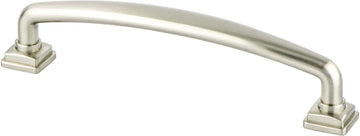 Berenson
Tailored Traditional 128mm CC Brushed Nickel Pull 1284-1BPN-P
Berenson
Tailored Traditional 128mm CC Brushed Nickel Pull 1284-1BPN-P
$10.93
$13.66 -
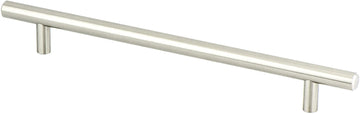 Berenson
Tempo 192mm CC Brushed Nickel Bar Pull 0806-2BPN-P
Berenson
Tempo 192mm CC Brushed Nickel Bar Pull 0806-2BPN-P
$11.53
$14.41 -
 Berenson
Bravo 56mm CC Brushed Nickel Edge Pull 1057-4BPN-P
Berenson
Bravo 56mm CC Brushed Nickel Edge Pull 1057-4BPN-P
$9.83
$12.28 -
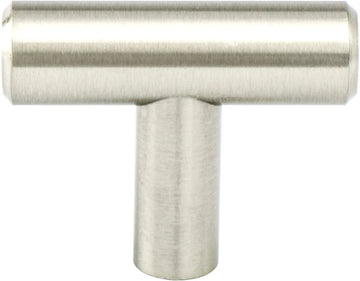 Berenson
Transitional Advantage Two Brushed Nickel T-Bar Knob 9435-2BPN-P
Berenson
Transitional Advantage Two Brushed Nickel T-Bar Knob 9435-2BPN-P
$2.80
$3.50 -
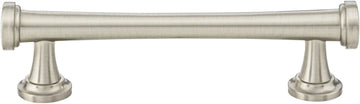 Atlas Homewares
Browning Pull 3 3/4'' ccBrushed Nickel
Atlas Homewares
Browning Pull 3 3/4'' ccBrushed Nickel
$14.50
$16.11 -
 Berenson
Folklore 3in. CC Brushed Nickel Cup Pull 8340-1BPN-P
Berenson
Folklore 3in. CC Brushed Nickel Cup Pull 8340-1BPN-P
$12.92
$16.15


Why this matters
Brushed nickel is not one finish. Different manufacturers produce it with noticeably different undertones — some lean yellow-gold (warm), others lean gray-silver (cool). When you're working across multiple rooms, those differences stack up. A bathroom that looks sharp on its own can look disconnected from the kitchen if the undertones clash. In 2026, the dominant trend in cabinet hardware is intentional finish mixing — contrasting finishes used deliberately across zones — which means the standard has moved from "match everything" to "connect everything." That shift gives you more freedom, but it also raises the penalty for choices that look unintentional.
What you'll need
- A room-by-room hardware inventory (existing or planned)
- Finish samples or photos with known manufacturer and SKU
- A defined design thread (shape, profile, or material) to carry across rooms
- Access to a full brushed nickel catalog — the brushed nickel collection at Knobs.co covers the major brands in one place
- 30–60 minutes to map each room before ordering
Step 1: Audit what finish you already have
Before you add anything, document every piece of hardware in every room — knobs, pulls, hinges, appliance handles — and note the brand and finish name, not just "brushed nickel." A Amerock "Polished Nickel" and a Top Knobs "Brushed Satin Nickel" will look different under identical light. Pull finish chips or order single-unit samples for any hardware you're replacing. This step takes 30 minutes and eliminates the most common mistake: assuming two brushed nickel pieces match because their names match.
Expected outcome: A written list, room by room, with brand and finish name for each existing piece. You'll use this to spot undertone conflicts before you spend anything.
Common mistake: Skipping the audit and ordering by description alone. "Brushed nickel" on five different product pages means five potentially different outcomes on your cabinets.
Step 2: Assign each room a finish zone
Treat each room — or each visual zone in open-plan spaces — as its own finish decision. Within a zone, all hardware should share the same finish from the same manufacturer, or from manufacturers whose brushed nickel output matches closely in undertone. Across zones, you're allowed to vary. A matte-black powder bath adjacent to a brushed-nickel kitchen reads intentional in 2026 because the contrast is clean and sharp. What doesn't work: two rooms that both use "brushed nickel" but from incompatible manufacturers, creating a muddy near-match.
For open-plan spaces where kitchen and living area share sightlines, treat them as one zone even if the cabinets are different. The eye connects spaces it can see simultaneously.
Expected outcome: A zone map — a sketch or a simple list — that assigns each room or visual zone a single finish anchor.
Common mistake: Treating an open-plan kitchen and a visible butler's pantry as separate zones. If you can see both from the same standing position, they're one zone.
Step 3: Pick a design thread that runs through every room
Finishes can vary across rooms; the design thread cannot. A design thread is one repeating element — a bar-pull profile, a round knob shape, a specific material pairing like brushed nickel on a zinc alloy base — that appears in every room regardless of finish. It creates coherence without uniformity. For example, if you use a bar pull profile in the kitchen, use a bar pull profile (even in a different finish) in the bathroom. The shape connection is enough for the eye to read the home as designed.
A clean, high-performing example of a bar pull that works across kitchen and bath is the Top Knobs Amwell bar pull, available in brushed nickel and compatible finishes. The 8-13/16" center-to-center is standard for full-height cabinet doors and works equally well on bath vanities.
Expected outcome: One defined design thread — written down — that you reference when selecting hardware for each new room.
Common mistake: Choosing a design thread after the fact, while standing in a hardware aisle. Define it before you order anything.
Step 4: Handle transition rooms deliberately
Hallways, laundry rooms, and powder baths are the rooms that break whole-home plans because they get treated as afterthoughts. These spaces are actually the connective tissue between your finish zones. In 2026, two approaches work well:
- Mirror the adjacent zone. A laundry room that shares a wall with the kitchen uses the same brushed nickel, same profile. Low-effort, high-cohesion.
- Use a deliberate contrast finish. A powder bath that's fully enclosed can take a statement finish — matte black, unlacquered brass — without disrupting the broader plan. The matte black collection is the most popular contrast choice alongside brushed nickel because the value contrast is maximum and both finishes age well.
Do not use a third finish that sits between your main finish and your contrast finish. A "champagne bronze" in the laundry room when you have brushed nickel in the kitchen and matte black in the powder bath creates a three-finish muddle.
Expected outcome: Every transition room assigned to either the adjacent zone or a deliberate contrast. Nothing in between.
Common mistake: Reusing leftover hardware from a previous project in transition rooms. It almost never matches and it signals that the room wasn't considered.
Step 5: Address appliance pulls and hinges separately
Appliance pulls and hinges operate on different visual rules than cabinet hardware. Appliance pulls are seen at distance and handle heavier use; the finish needs to match the appliance finish or contrast cleanly, not blend. If your appliances are stainless steel, brushed nickel appliance pulls are the closest match and require no further justification. If your appliances are black stainless or matte black, brushed nickel pulls create a deliberate contrast — which works, but only if it matches the room's other hardware.
Hinges are the piece most people forget. Exposed hinges in a brushed nickel room should be brushed nickel. Concealed European hinges can be any finish. Check the appliance pulls collection against your appliance spec before finalizing the kitchen hardware plan.
Expected outcome: Appliance pulls and hinges confirmed against both the room's finish and the appliance finish before ordering.
Common mistake: Ordering appliance pulls in the same quantity as standard cabinet pulls without checking center-to-center measurements. Appliance pulls use different bore spacings — confirm before you order.
Step 6: Order samples before committing to quantity
Even with a complete zone map, a design thread, and a clear finish specification, order one unit of each new SKU before committing to full quantity. Light in your specific space — natural direction, paint color on adjacent walls, countertop reflectivity — changes how a finish reads. A brushed nickel that photographs as cool-gray can read warm-gold under your specific kitchen lighting. Samples cost $5–$20 per piece and eliminate the cost of returning 40 pulls.
This step applies especially when you're mixing brushed nickel hardware across different rooms in 2026 — the finish performs differently in a north-facing bathroom versus a south-facing kitchen, even from the same manufacturer.
Expected outcome: Physical confirmation that each SKU performs as expected in its room before full-quantity order.
Common mistake: Relying on on-screen photos or showroom lighting to evaluate a finish. Neither replicates your home's light conditions.
Troubleshooting
The brushed nickel in two rooms looks like different finishes even though they're the same brand. Light direction is the cause in most cases. North-facing rooms read finishes cooler; south-facing rooms read them warmer. The fix is not to swap the finish — it's to accept the variation and strengthen the design thread (shape, profile) so the connection reads despite the color shift.
One room looks obviously "wrong" even though every finish decision followed the rules. Check the undertone of the paint. A warm greige wall amplifies warm tones in brushed nickel and suppresses cool tones. If the finish looked right at the hardware store and wrong on the wall, the wall is changing the reference point — repaint or swap to a finish with a matching undertone.
The contractor installed the wrong finish in one room after sign-off. Document the correct SKU (manufacturer, finish name, part number) in writing before installation begins. Verbal "brushed nickel" instructions produce errors. Return the incorrect pieces before installation if possible; after installation, replacement is your only option.
Mid-century modern cabinets look off with standard brushed nickel pulls. Most standard bar pulls have a transitional profile that sits awkwardly on clean MCM door fronts. The mid-century modern collection groups hardware by the profile shapes — recessed pulls, thin cylindrical bars — that match the style. Brushed nickel is available across most of those profiles.
Hardware ordered online arrived in slightly different shades despite same SKU. This happens with large-quantity orders drawn from multiple production batches. Order all hardware for a single room in one purchase from one batch. If you see visible variation between pieces, contact the vendor before installation — batch replacement is standard practice at reputable suppliers.
You've mixed finishes and the result looks random, not curated. Count your finishes. Three or more finishes across a home almost always looks random. Reduce to two — a primary finish (brushed nickel) and one contrast (matte black or warm brass) — and reassign rooms that currently hold a third finish to one of those two anchors.
FAQ
Can you mix brushed nickel hardware in different rooms? Yes. Mixing brushed nickel hardware across different rooms is standard practice in 2026. The rule is consistency within each room and a shared design thread — shape or profile — across rooms. Mixing across rooms only looks wrong when undertones clash or when no visual element connects the spaces.
How many hardware finishes should a whole home have? Two. A primary finish for main living spaces and one contrast finish for accent rooms. Three or more finishes require a level of compositional control that most projects don't achieve.
Does brushed nickel go with every cabinet color? Brushed nickel works with white, gray, navy, sage, and natural wood tones. It struggles with heavily saturated warm colors — terracotta, rust-orange — where a warm brass reads more naturally. If the cabinet color is in that warm range, test a sample before committing.
Is brushed nickel or matte black more popular in 2026? Brushed nickel holds the larger market share in kitchen and bath hardware as of 2026. Matte black is the leading contrast finish and is the top choice for powder baths and accent spaces. Both finishes appear in the same home more often now than five years ago.
What's the difference between brushed nickel and satin nickel? The names are used interchangeably by some manufacturers, but in strict usage: brushed nickel has a slightly more visible grain from the brushing process; satin nickel is a finer, more uniform finish. The visual difference is small. The practical step is to compare samples side by side, not to rely on the label.
Do hinges need to match cabinet pulls? Exposed hinges should match the room's primary finish. Concealed European hinges, which are hidden when the door is closed, do not need to match. For brushed nickel rooms with exposed hinges, confirm the hinge manufacturer offers a true brushed nickel — some hinge lines only come in polished or satin variants.
How do I match brushed nickel to stainless steel appliances? Brushed nickel and stainless steel are close but not identical — stainless reads cooler and has a finer surface texture. They coexist well in the same kitchen because the contrast is subtle rather than jarring. Use brushed nickel appliance pulls to bridge the two finishes; the pull references both materials simultaneously.
What's the best brushed nickel pull for a large kitchen in 2026? A bar pull in a 6" to 8-13/16" center-to-center works on most full-height upper and lower cabinet doors. For large drawers, a 12" or longer bar pull gives appropriate visual weight. Confirm the boring pattern before ordering for any center-to-center over 8".
One last thing
Brushed nickel was introduced as a "maintenance-friendly" alternative to polished chrome in the 1980s specifically because the brushed texture hides fingerprints and micro-scratches. That origin is also why it photographs inconsistently — the directional grain catches light differently at different angles, which is why two pieces from the same batch can look like different finishes in photos. In person, side by side, they match. Always evaluate hardware samples in person before making a whole-room call.
Related guides
- Brushed nickel hardware collection
- Matte black hardware collection
- Mid-century modern hardware
- Appliance pulls
Shop Brushed Nickel Cabinet Hardware
-
 Bradbury Pull 6 5/16'' cc
$16.57
Bradbury Pull 6 5/16'' cc
$16.57
-
 Crystal Legacy Square Knob 1 5/16''
$41.36
Crystal Legacy Square Knob 1 5/16''
$41.36
-
 Dot Knob 1 1/4''
$10.23
Dot Knob 1 1/4''
$10.23
-
 Dot Knob 2''
$14.63
Dot Knob 2''
$14.63
-
 Malin Pull 3 3/4'' cc
$13.64
Malin Pull 3 3/4'' cc
$13.64
-
 Malin Pull 6 5/16'' cc
$19.71
Malin Pull 6 5/16'' cc
$19.71
-
 Malin Pull 7 9/16'' cc
$23.63
Malin Pull 7 9/16'' cc
$23.63
-
 Sweetbriar Lane Pull 5 1/16'' cc
$18.27
Sweetbriar Lane Pull 5 1/16'' cc
$18.27


Browse all 1076 in Brushed Nickel Cabinet Hardware → Cabinet knobs Cabinet pulls & handles