

Matte Black vs Oil-Rubbed Bronze, and How Each One Ages
Black matches across brands and never improves; bronze warms and lightens with use but rarely matches a second order.

Matte black is the safer buy for most kitchens, and I do not choose it for stylistic reasons. Matte black vs oil-rubbed bronze comes down to consistency and to wear: black looks close to the same from one manufacturer to the next, and oil-rubbed bronze does not, which matters the moment your hardware comes from more than one source. Bronze takes the decision back in one situation. In a warm kitchen with no other true black in the room, it does the thing black cannot do at all, which is look like it has been there a while.
Shop the picks from this guide
In stock at Knobs.co · Free shipping on hardware orders $99+ · 110% price match
-
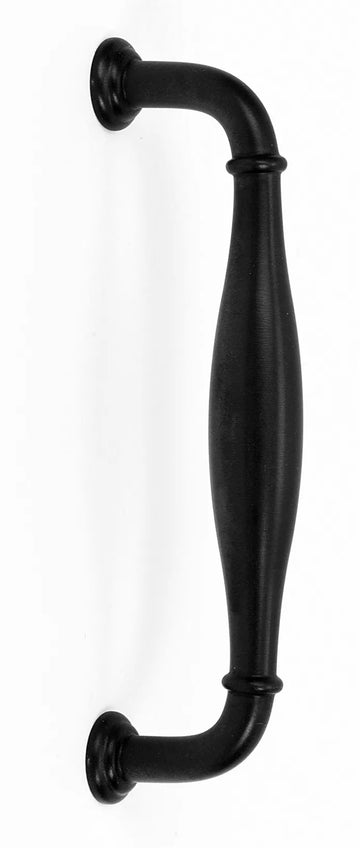 Alno
Alno A726 Charlie's 3 1/2'' CC Cabinet PullMatte Black / 3''
Alno
Alno A726 Charlie's 3 1/2'' CC Cabinet PullMatte Black / 3''
$24.26
$26.95 -
 Berenson
Advantage Wire Pulls 3'' CC Matte Black Steel Pull 6129-2055-P
Berenson
Advantage Wire Pulls 3'' CC Matte Black Steel Pull 6129-2055-P
$1.58
$1.97 -
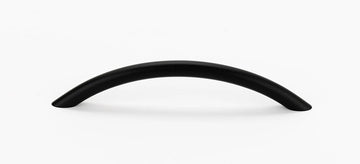 Alno
Alno A1298 128mm 5'' CC Brass Cabinet PullMatte Black
Alno
Alno A1298 128mm 5'' CC Brass Cabinet PullMatte Black
$19.76
$21.95 -
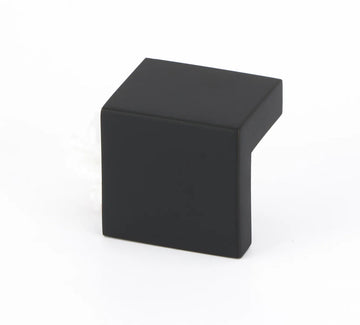 Alno
Alno A960 Tab 1 1/2'' CC Brass Cabinet PullMatte Black / 3/4''
Alno
Alno A960 Tab 1 1/2'' CC Brass Cabinet PullMatte Black / 3/4''
$16.16
$17.95 -
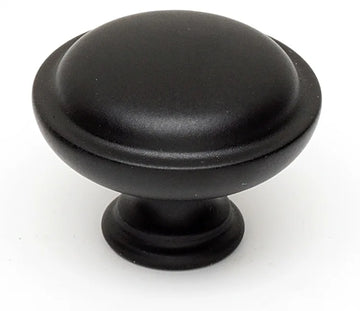 Alno
Alno A1145 1 1/4'' Brass Cabinet KnobMatte Black
Alno
Alno A1145 1 1/4'' Brass Cabinet KnobMatte Black
$17.96
$19.95 -
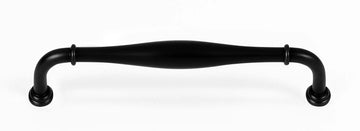 Alno
Charlie's 6'' Pull A726-6Matte Black
Alno
Charlie's 6'' Pull A726-6Matte Black
$62.96
$69.95

One is metal treated, the other is metal covered
Oil-rubbed bronze is a dark brown-black with copper coming through wherever the surface stands proud. Look closely at a single pull and the color is not even across its face; the raised edge is warmer than the hollow. With a good number of makers it is a living finish, meaning it is built to keep moving under your hands rather than hold still.
Matte black is almost always a powder coat or an e-coat laid over the casting. It is opaque, uniform and low in sheen, and it has no grain, no variation and nothing showing through from underneath. That structural difference, a treatment versus a layer, drives nearly everything below. It also explains why the two photograph so similarly and behave so differently.
They fail in opposite directions
Oil-rubbed bronze wears lighter where hands land. Five or ten years on, a set of pulls has warm spots at the thumb positions and darker recesses everywhere else, and the kitchen looks older in the way people actually pay money for. A worn bronze pull is more interesting than a new one.
Black wears at the edges and corners, and what shows through is bright base metal. I have pulled enough of these off drawer fronts to say that plainly. That does not read as patina, it reads as damage, and there is no point in the life of a matte black pull where the wear starts helping. This is where the coating quality earns its keep. PVD finishes hold up best, electroplating comes next, and painted and powder-coated surfaces give way at contact points first. On the drawers that get opened dozens of times a day, the trash pull-out and the cutlery drawer above it, that ranking is the whole story.
One caveat on the bronze side, because the name will not tell you: some manufacturers seal their oil-rubbed bronze so it never moves, and those pulls look identical in year ten to the way they looked in the box. If the aging is the reason you want it, ask whether the finish is a living one before you order a kitchen's worth. I would put that question ahead of every other spec on the page.
Bronze is not a standard; black very nearly is
Across manufacturers, oil-rubbed bronze runs from something a shade off black to a milk-chocolate brown with heavy copper in the highlights. Two brands' versions in one kitchen rarely resolve into a single finish. Matte black varies too, but the variation is mostly sheen, dead flat against a faint eggshell, and black is black in every catalog.
The practical consequence shows up at the edges of the order. Cabinet pulls come from one maker; the exposed hinges, appliance pulls, hooks or a matching bath set often come from another. Black survives that mix. Bronze usually does not, and the mismatch is worse than a clean contrast would have been, because two browns that nearly agree look like a mistake. If bronze is what you want across a whole house, buy it in one order from one maker and buy a few spares while you are at it.
| Matte black | Oil-rubbed bronze | |
|---|---|---|
| Color | Flat neutral black, no undertone | Dark brown-black, copper at the high points |
| Sheen | Dead flat to faint eggshell | Low, brighter along raised edges |
| How it ages | Coating gives way at edges to bright metal | Often lightens where hands touch, showing copper |
| Matching across brands | Close enough to mix | Assume it will not match |
| Cabinets it sits best on | White, gray, charcoal, green, navy, natural oak | Cherry, walnut, hickory, cream, warm stained wood |
Look around the room for another true black
Here is the question I ask before anyone describes their style, because it settles this faster than taste does. Is there something in the room that is genuinely black and staying there? Honed black granite or slate, a faucet in black, window frames in black, appliance panels in black.
If the answer is yes, oil-rubbed bronze becomes the odd element. It is brown standing next to black, and at arm's length the eye files that under mismatch rather than under mix. Black hardware joins the group instead, and the room gains a rhythm it did not have.
If the answer is no, the logic reverses. Bronze has nothing to be measured against, so its warmth is pure gain, while matte black becomes the only absolutely black object in a room of soft colors. That is how black hardware ends up looking applied rather than chosen, and it is the failure I see most often with it.
Fingerprints, and the thing neither finish hides
Both beat polished nickel and chrome on fingerprints, and I want to be precise about why, because the flatness is doing the work: a black with any sheen in it gives prints an edge to catch, which is why two blacks from different makers can perform differently on the same drawer. Bronze hides prints through variation instead, since a surface that is already uneven has nowhere obvious for a smudge to show.
Neither one hides dust or cooking film. Within a few feet of the range, both dark finishes pick up a gray haze that a bright metal shrugs off, and on flat black that haze is visible from across the room. If the pull nearest the cooktop is the one you will resent wiping, that is an argument for bronze, whose surface breaks up the film rather than displaying it evenly.
The dating risk is in the shape, not the metal
People ask which of these will look dated, and the honest answer, having watched both cycles, is that each has already been dated once and each came back. Bronze was in every builder kitchen of the early 2000s next to travertine and honey oak. Black arrived with flat-panel doors and long horizontal bar pulls. What reads as belonging to a period is the combination, the door profile and the counter and the length of the pull, rather than the color of the metal.
A plain round black knob on a shaker door has been made more or less continuously for a century and is not going to date. A very long flat black bar pull on a slab door is a sentence written in a particular decade. If the fear of looking dated is driving this decision, redirect it at the shape and the size, where it actually belongs.
Which to buy
Choose black if the cabinets are painted gray, white, green, navy or charcoal, if anything else in the room is already black, if the order will span more than one brand, or if the doors are flat-panel or a crisp shaker. Its cost is that it will never look older than the day you installed it, and that the coating is the part you are actually buying, so buy the best one available in the shape you want.
Choose bronze if the cabinets are stained wood, if the counters are warm, if nothing else in the room is true black, and if hardware that changes under your hands appeals to you rather than worrying you. Its cost is that you are committing to one manufacturer and, realiztically, to one order.
Choose neither if the kitchen is already dark throughout. Dark stained doors under a black counter give a dark pull nothing to work against, and if the faucet is chrome it ends up stranded as the only bright thing in the room. Venetian bronze is the way out of that corner: lighter than oil-rubbed, with more visible copper and red, so it keeps the warmth while giving you back some contrast against the door. Our guide to bronze pulls in kitchens goes further into shapes.
Then settle it with your own eyes rather than a screen. Put one of each on the door before you decide; the cost is refunded with your full order. Bronze in particular, I would stress, photographs as flat black against a white studio background and only shows its brown next to a real counter under real bulbs, which is why so many people open the box and find something browner than the picture promised.
Shop Matte Black Cabinet Hardware
-
 Sutton 96 mm cc Bar Pull 635-96MB-25
$304.20
Sutton 96 mm cc Bar Pull 635-96MB-25
$304.20
-
 Sutton 160 mm cc Bar Pull 635-160MB-10
$176.04
Sutton 160 mm cc Bar Pull 635-160MB-10
$176.04
-
 Sutton 128 mm cc Bar Pull 635-128MB-20
$291.24
Sutton 128 mm cc Bar Pull 635-128MB-20
$291.24
-
 Epoch Edge 128mm CC Matte Black Pull 1215-1055-P
$10.93
Epoch Edge 128mm CC Matte Black Pull 1215-1055-P
$10.93
-
 Galloway 128mm CC Matte Black Round Backplate 3100-1055-B
$10.61
Galloway 128mm CC Matte Black Round Backplate 3100-1055-B
$10.61
-
 Statler Matte Black Cutout Backplate 3118-1055-B
$5.66
Statler Matte Black Cutout Backplate 3118-1055-B
$5.66
-
 Galloway 96mm CC Matte Black Round Backplate 3099-1055-B
$7.67
Galloway 96mm CC Matte Black Round Backplate 3099-1055-B
$7.67
-
 Statler 224mm CC Matte Black Cutout Backplate 3117-1055-B
$11.19
Statler 224mm CC Matte Black Cutout Backplate 3117-1055-B
$11.19


Browse all 2293 in Matte Black Cabinet Hardware → Cabinet knobs Cabinet pulls & handles