

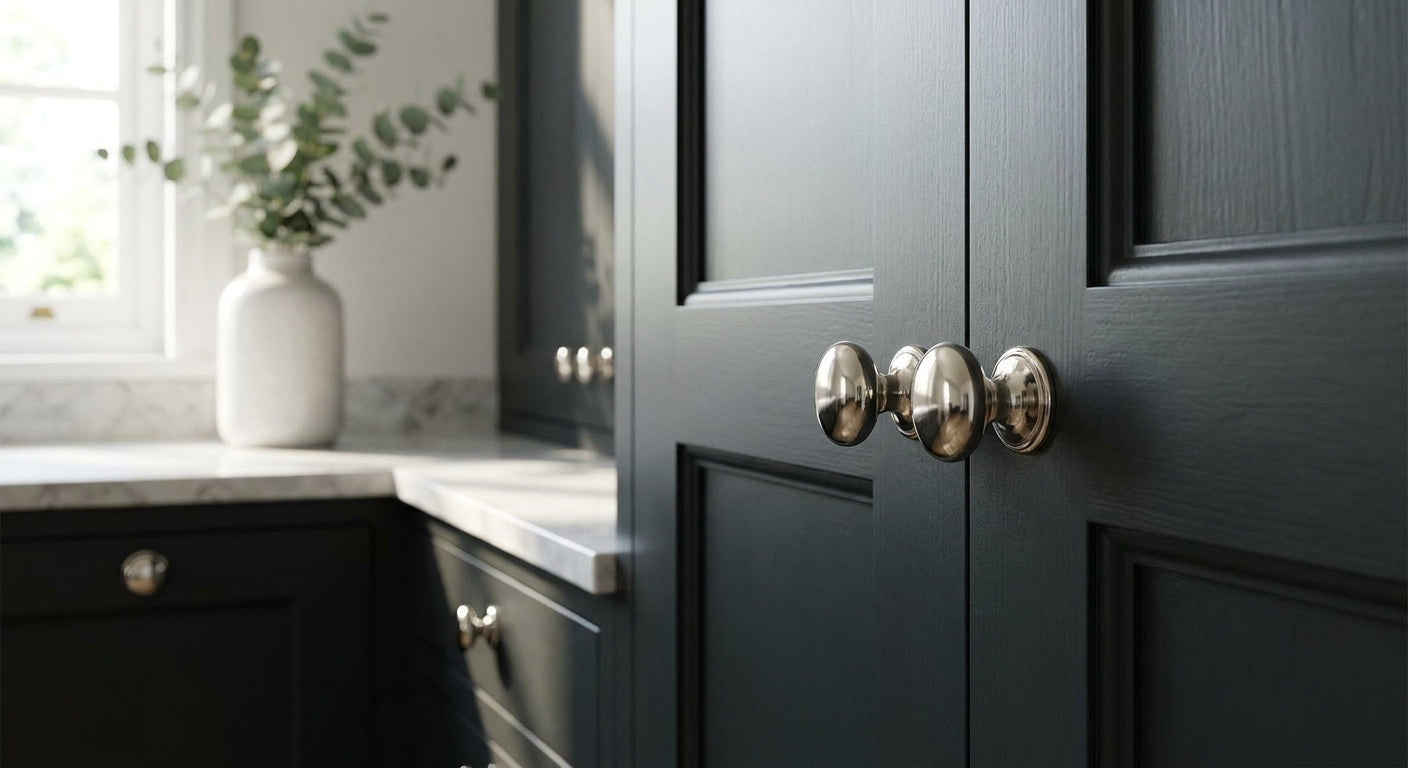
Polished nickel cabinet knobs give kitchens and bathrooms a warm, slightly antiqued metallic finish that reads more traditional than chrome and more formal than brushed nickel. This guide breaks down what separates a knob that holds its shine from one that pits within a year, and which picks are worth buying in 2026.
Shop the finish
Every polished nickel knob and pull we carry, in one place — filter by size, style, and brand.
Browse Polished Nickel Cabinet Hardware →- Polished nickel cabinet knobs run $2,600 monthly searches with a low 27/100 difficulty score in 2026 — an easy category to win.
- Solid brass base metal with a nickel plate outlasts zinc alloy; check the spec sheet before you order 40 knobs.
- Top Knobs Grace Riverside pull in polished nickel is the coordinating pick for kitchen drawers — Buy.
- Skip bright chrome-labeled-as-nickel listings; polished nickel has a warmer, slightly yellow undertone chrome lacks.
- Order samples before committing — finish color shifts under kitchen LED lighting more than people expect.
Why this matters
Polished nickel sits in a strange spot in the hardware market: search demand is steady (roughly 2,600 searches a month heading into 2026) but a lot of listings mislabel bright chrome or nickel-plated zinc as "polished nickel," which is a different animal entirely. Knobs.co stocks over 50,000 SKUs across major hardware brands, and polished nickel shows up across knobs, pulls, and appliance pulls at wildly different quality tiers under the same finish name.
Getting the finish right matters more here than with matte black or oil-rubbed bronze, because polished nickel is a mirror-bright, reflective finish — every inconsistency in tone, weight, or plating thickness shows up under kitchen lighting. A mismatched drawer knob next to a mismatched cabinet pull is the kind of detail a buyer notices at a home showing in 2026, even if they can't name what's wrong.
Who this is for
This guide is for homeowners refreshing a traditional or transitional kitchen or bathroom, and for interior designers and contractors speccing polished nickel across a multi-room renovation where finish consistency across dozens of units matters more than any single knob's price tag.
What to look for in polished nickel cabinet knobs
Base metal, not just plating
Solid brass or zinc-alloy base metal both take a nickel plate, but they age differently. Solid brass holds plating longer under daily hand contact — kitchen drawer knobs get touched dozens of times a day — while thin zinc plating on a budget knob can show brass or gray undertone through wear within 12 to 18 months.
Plating thickness and lacquer
Unlacquered polished nickel develops a soft living patina over years, similar to unlacquered brass, while a clear-coated version stays mirror-bright indefinitely. Neither is wrong, but you need to pick one and apply it consistently — mixing lacquered and unlacquered knobs in the same kitchen produces a visibly two-toned result within a year.
Center-to-center sizing
Most polished nickel knobs use a single mounting hole, so size is really about diameter and projection rather than center-to-center spacing — that measurement matters more for pulls and bar hardware. If your project mixes knobs and pulls, get the spacing right before you drill; a mismatched hole pattern means refinishing the door face. Knobs.co's guide on choosing the right cabinet knob size walks through diameter-to-cabinet-size ratios in more detail.
Warmth versus brightness
Polished nickel carries a warm, faint yellow undertone next to chrome's cool blue-white brightness. Under warm 2700K kitchen lighting, that difference nearly disappears; under cool 4000K LED strips, it's obvious. Order a sample under your actual kitchen lighting before ordering 30 units.
Volume pricing for full kitchens
A full kitchen remodel can run 30 to 50 knobs and pulls combined. Buying from a retailer with a broad in-stock catalog avoids the backorder problem that hits mid-project when a small supplier runs out of a specific finish batch.
Cross-brand consistency
Polished nickel isn't standardized between manufacturers — one brand's version runs warmer than another's. If you're combining knobs from two different lines (say, a knob from one brand and an appliance pull from another), order samples of both before finalizing, not after the cabinets are drilled.
Top picks for 2026
The all-purpose pick. A round or ring-style polished nickel knob in the 1-1/4 inch diameter range covers the widest range of cabinet door styles, from shaker to flat-panel. This size is the industry default for a reason: it's substantial enough to grip comfortably without overwhelming a narrow shaker stile. Buy for standard kitchen and vanity doors.
The shaker match. Shaker cabinets have a recessed panel and a visible frame, which means knob proportion reads differently than on a flat slab door. Knobs.co's roundup of polished nickel knobs for shaker cabinets covers profile shapes that sit well against a shaker rail without looking undersized. Buy if your cabinets are shaker-style, Skip the same knob on flat-front doors — it reads too small.
The coordinating pull. The Top Knobs Grace Riverside pull in polished nickel gives you a matching drawer pull at 6.5 inches center-to-center, built to sit alongside a round knob on adjacent doors without a visible finish gap. Buy for any project mixing knobs on doors with pulls on drawers — matching finish batch numbers across knob and pull lines is the detail that separates a finished kitchen from a mismatched one.
What to avoid
- Chrome relabeled as "nickel." Some budget listings use "nickel" loosely to describe bright chrome. True polished nickel has a warmer cast — if a listing photo looks ice-blue-white, it's probably chrome.
- Mixed lacquer states in one room. One lacquered knob next to one unlacquered knob will age at different rates. Pick one finish treatment and standardize it across the whole project.
- Ultra-cheap zinc-alloy knobs for high-touch areas. A $2 knob on a rarely-used cabinet is fine; the same knob on a daily-use kitchen drawer will show plating wear inside a year.
Verdict comparison
| Pick | Best for | Notable spec | Verdict |
|---|---|---|---|
| All-purpose round knob | Standard kitchen/vanity doors | 1-1/4" diameter | Buy |
| Shaker-profile knob | Shaker-style cabinet doors | Profile sits flush on recessed rail | Buy |
| Top Knobs Grace Riverside pull | Matching drawer pulls | 6.5" center-to-center | Buy |
FAQ
What's the best finish to pair with polished nickel cabinet knobs?
Polished nickel pairs best with matching polished nickel pulls, hinges, and appliance pulls from the same finish batch. Mixing it with brushed or satin nickel in the same room creates a visible warm-versus-cool mismatch under kitchen lighting.
Is polished nickel the same as chrome?
No, polished nickel and chrome are different finishes despite looking similar in photos. Chrome runs cool blue-white and stays static; polished nickel carries a warmer undertone and can develop a soft patina if left unlacquered.
Do polished nickel knobs tarnish or need polishing?
Lacquered polished nickel knobs stay mirror-bright and need only occasional wiping. Unlacquered versions develop a soft living patina over time from hand contact, which many buyers choose intentionally for a lived-in look.
How much do polished nickel cabinet knobs cost in 2026?
Pricing varies by base metal and brand, with solid brass construction typically costing more than zinc-alloy alternatives. Check current listings for exact per-unit pricing since it shifts by collection and order volume.
Can I mix polished nickel with brushed nickel in the same kitchen?
It's possible but risky — the two finishes have different sheens and can look like a mismatch rather than an intentional design choice. Most designers pick one nickel finish and apply it consistently across knobs, pulls, and hinges.
What size polished nickel knob works best for kitchen cabinets versus bathroom vanities?
Kitchen cabinet doors typically use a 1-1/4 inch knob, while bathroom vanities can go slightly smaller since vanity doors are often narrower. Match knob scale to door width rather than using one size everywhere.
Are polished nickel knobs still in style for 2026 kitchens?
Yes, polished nickel remains a steady choice for traditional and transitional kitchens in 2026, especially alongside warm wood tones and white or cream cabinetry. It hasn't seen the trend spike that matte black or champagne bronze saw in recent years, which keeps it a safer long-term choice.
How many knobs do I need for a full kitchen remodel?
A typical kitchen remodel needs 30 to 50 knobs and pulls combined, depending on cabinet count and whether drawers use pulls instead of knobs. Order a few extra to cover future repairs without hunting down a discontinued finish batch.
One last thing
Unlacquered polished nickel is the one finish in this category that improves with use instead of degrading — the patina that forms from hand contact around the knob edge is the same effect that makes unlacquered brass popular, just in a cooler tone. If you like the idea of hardware that ages rather than just wears, skip the lacquered version and let the finish develop on its own through 2026 and beyond.