

Satin Nickel vs Brushed Nickel: The Brand Matters More Than the Name
Two names for one family of finishes, why only satin nickel has a standard code, and the mismatch that actually shows up in a finished kitchen.

Satin nickel vs brushed nickel is a smaller question than the shopping pages make it: both are nickel plating finished to a low sheen, both land as a warm silver, and satin usually carries the finer, softer grain while brushed carries a more visible directional one. Buy either with confidence for a single kitchen. The condition that matters is where the pieces will sit relative to each other. Two brands' satin nickel will differ from one another more than satin and brushed differ inside one brand's catalog, so if you are adding hardware to something already installed, match the maker before you match the word.
Shop the picks from this guide
In stock at Knobs.co · Free shipping on hardware orders $99+ · 110% price match
-
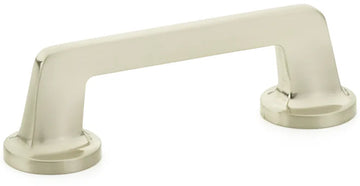 Schaub and Company
Northport Pull, Round Bases, 3-1/2'' ccBrushed Nickel
Schaub and Company
Northport Pull, Round Bases, 3-1/2'' ccBrushed Nickel
$20.40
$22.66 -
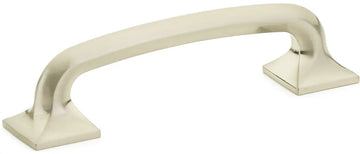 Schaub and Company
Northport Pull, Square Bases, 4'' ccBrushed Nickel
Schaub and Company
Northport Pull, Square Bases, 4'' ccBrushed Nickel
$23.18
$25.75 -
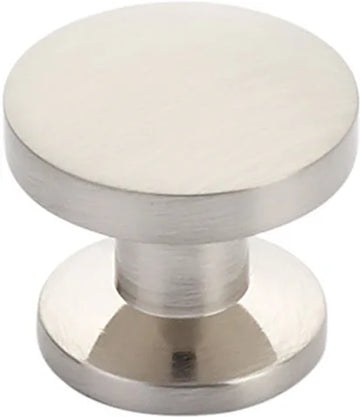 Schaub and Company
Northport Knob, Round, 1-3/8'' dia 211Brushed Nickel
Schaub and Company
Northport Knob, Round, 1-3/8'' dia 211Brushed Nickel
$25.03
$27.81 -
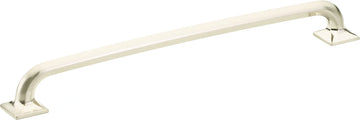 Schaub and Company
Northport Pull, Square Bases, 10'' ccBrushed Nickel
Schaub and Company
Northport Pull, Square Bases, 10'' ccBrushed Nickel
$43.57
$48.41 -
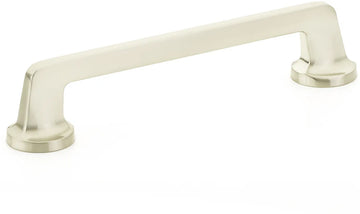 Schaub and Company
Northport Pull, Round Bases, 6'' ccBrushed Nickel
Schaub and Company
Northport Pull, Round Bases, 6'' ccBrushed Nickel
$27.81
$30.90 -
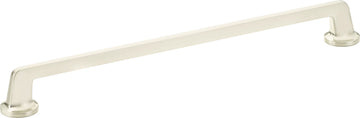 Schaub and Company
Northport Pull, Round Bases, 12'' ccBrushed Nickel
Schaub and Company
Northport Pull, Round Bases, 12'' ccBrushed Nickel
$56.55
$62.83
Two names, and only one of them belongs to a standard
Door hardware has a finish standard, ANSI/BHMA A156.18, and it lists satin nickel as 619, the code older catalogs print as US15. There is no code in it called brushed nickel. Cabinet hardware makers are under no obligation to use those numbers and most of them do not, which is roughly how the industry ended up with two words for one family and no referee.
What the words describe is the last step, not the metal. A nickel-plated piece gets its shine taken down, and how it is taken down decides what you see: a finer, more even surface that reads as a soft glow, or a directional abrasion that leaves fine parallel lines. Satin tends to the first and brushed to the second, and plenty of brands pick whichever name they think sells. Both sit between polished nickel, which is a mirror, and the darker nickels. All of them share nickel's own coloring, which is a warm silver with a faint yellow in it, and that is the trait that makes the whole family behave differently from chrome.
"Brushed satin nickel" is one finish wearing both names
A lot of people arrive searching for brushed satin nickel, and it is not a third finish sitting between the other two. It is a maker hedging, either because its finish genuinely has characteristics of both, or because it wants the listing to be found by shoppers typing either word. I treat a piece labeled that way as a member of the same family, and judge it on the photograph and the sample rather than on the label.
The practical effect of the hedge is that it is useless for matching. If a faucet is stamped brushed nickel and a pull is listed as brushed satin nickel, you have learned nothing about whether they will sit well together. That has to be settled by eye.
Satin nickel vs brushed nickel: the difference is grain, and grain needs length
Here is the part I wish more comparisons covered, because it turns a vocabulary question into a buying decision. Grain is a line, and a line needs length to be seen. On a 1-1/4 in knob, the difference between a fine satin surface and a visibly brushed one is something you notice holding it and nobody notices standing at the sink. On a 12 in appliance pull or a long bar across a drawer, that same grain runs the full length of the piece, catches the light along one axis, and becomes a design element whether or not you chose it.
So the rule I use is that the name matters in proportion to the size of the piece. Buying knobs, buy the one you like and stop worrying. Buying long pulls, look at a large photograph before you order, and if you want the hardware to stay quiet, lean to the finer satin grain, because a strong brush line on a long pull reads as texture from across the room. The tradeoff runs the other way for wear: a visible grain hides small scratches and the dulling that builds up under fingertips, so the finish that reads quieter is also the one that shows its age a little sooner at the contact points.
The mismatch that actually goes wrong is between brands
In twenty years the nickel complaints that reach me are almost never satin against brushed. They are two pieces from two makers, both honestly labeled the same thing, sitting inches apart. One is grayer, one is warmer, and once you have seen it you cannot stop seeing it. It happens most on an appliance panel, where a long pull and a smaller one land on the same refrigerator front, and on a run of drawers where somebody ordered four more pulls a year later from whoever still had them.
That gives me a rule worth more than the name on the label: keep one maker for everything inside a single sightline. Across a room you have more room to move, since a knob on an upper door and a pull on a base drawer are far enough apart that a small difference in warmth is not readable. Inside one sightline, buy together or buy the same brand. If the original maker is gone, order both finishes as samples and hold them against what is installed; the cost is refunded with your full order.
Lighting will exaggerate whatever gap exists. A warm 2700 K bulb pulls both nickels toward a warmer silver and can close the gap between two near-matches. Anything from 4000 K upward cools them toward blue and drives that gap wide open, which is why a pair that agreed under the store's lights can separate over your own sink. Look at them after dark, in the room, before you commit.
Neither nickel matches stainless appliances, and it is better not to try
This is the expectation I most often have to take apart. Brushed nickel is a plated finish with nickel's warm silver underneath; stainless steel is a different metal, cooler and grayer, and no amount of careful shopping brings them to the same color. Side by side, nickel looks faintly golden against stainless, and stainless looks faintly blue against nickel.
That is not a problem to solve. Appliances sit in their own plane, usually in a run of their own, and the eye accepts them as a different material the way it accepts a stone counter. Choose satin nickel for the cabinets because of how it works with the doors and the faucet, and let the appliances be stainless. Where it does deserve attention is the appliance pull itself: if a panel-ready fridge takes cabinet hardware, that pull is nickel touching a nickel-adjacent panel, and that is a sightline where brand matching earns its keep.
Which one to buy, by situation
- New kitchen, one brand, all at once. Pick whichever name that maker uses. This is the case people agonize over, and I have never seen the choice register once the kitchen is finished.
- Adding to hardware already on the doors. Match the maker first, the word second. Bring a spare pull to compare rather than a memory of the finish name.
- Long pulls or appliance pulls. The grain shows. Choose the finer satin surface for quiet, the visible brush for a finish that reads as texture and wears more forgivingly.
- A faucet already installed in one of the two names. Ignore the name and compare in person. A coated, spot-resistant version of brushed nickel sits slightly off plain brushed nickel from the same maker.
- Cool LED lighting or a north-facing kitchen. Both nickels go cooler, so if you want the warmth that drew you to nickel in the first place, live with the sample through a few evenings before committing the whole kitchen. Our notes on satin nickel pulls during a renovation cover the ordering sequence.
Antique nickel vs brushed nickel
Antique nickel is a satin nickel that has been blackened and then relieved, so the dark sits in the low spots and the raised edges come back bright. The standard does have a code for it, 620, next door to satin nickel's 619, which tells you how the finish is made: the same plating with two more steps. Against brushed nickel it reads noticeably darker and warmer, with contrast built into the piece rather than a single even tone, and I put it on detailed traditional shapes rather than a plain bar, which has no relief for the darkness to collect in.
Can brushed nickel and satin nickel go in the same kitchen?
Yes, and most kitchens already do without anyone noticing, since hinges, appliance pulls and cabinet hardware rarely come from one source. The place to be careful is a single sightline, especially two pieces on the same door or the same appliance panel, where a small difference in warmth or grain reads as an error rather than a mix. Splitting by zone works: one finish through the kitchen and its close cousin in the butler's pantry will not trouble anyone.
Shop Satin Nickel Cabinet Hardware
-
 Lafayette 96 mm cc Bar Pull 317-96SN
$17.90
Lafayette 96 mm cc Bar Pull 317-96SN
$17.90
-
 Lafayette 128 mm cc Bar Pull 317-128SN
$19.91
Lafayette 128 mm cc Bar Pull 317-128SN
$19.91
-
 Capri 128 mm cc Bar Pull Z500-128SN
$13.72
Capri 128 mm cc Bar Pull Z500-128SN
$13.72
-
 Retail Pack Hardware 3'' cc Bar Pull 400SN-R
$43.51
Retail Pack Hardware 3'' cc Bar Pull 400SN-R
$43.51
-
 Lafayette 1-3/8'' diam Mushroom Knob 218SN
$13.61
Lafayette 1-3/8'' diam Mushroom Knob 218SN
$13.61
-
 Anwick 96 mm cc Bar Pull 867-96SN
$16.37
Anwick 96 mm cc Bar Pull 867-96SN
$16.37
-
 Key West 1-7/8'' Length Bar Knob
$6.56
Key West 1-7/8'' Length Bar Knob
$6.56
-
 Sutton 96 mm cc Bar Pull 635-96SN-25
$304.20
Sutton 96 mm cc Bar Pull 635-96SN-25
$304.20


Browse all 3286 in Satin Nickel Cabinet Hardware → Cabinet knobs Cabinet pulls & handles