






Cabinet hinges: overlay, inset, and how they mount
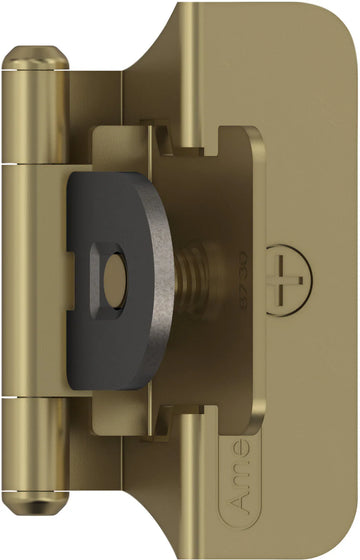
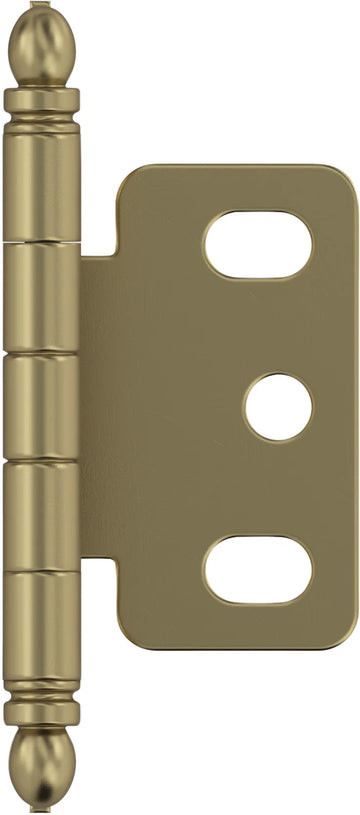
Cabinet hinges get grouped by how much of the door sits over the cabinet frame and how the hinge itself attaches, not by finish or style the way knobs and pulls are. Overlay hinges sit on doors that cover part or all of the face frame; inset hinges are built for doors that sit flush inside the frame opening instead. Amerock's Functional Hardware line represents the bulk of what's stocked here, spanning both hinge types across full wrap, partial wrap, and demountable mounting styles.
Overlay, inset, and how much door movement each allows
A full overlay hinge covers the entire face frame opening; a partial overlay leaves part of the frame visible, common on older cabinetry built with narrower frame stock. Inset hinges, like Amerock's full inset partial wrap and full inset full wrap designs, are made for doors set flush with the cabinet box, where the hinge barrel has to clear the frame edge instead of resting on top of it. Variable overlay hinges add adjustment room for doors that don't match one fixed spec exactly.
Self-closing, ball tip, and demountable options
Self-closing hinges use an internal spring to pull the door shut over the last inch or two of travel, standard on most modern cabinetry and worth matching when swapping a hinge on an existing self-closing door. Ball tip hinges show up mostly on traditional face-frame cabinets as a visible decorative detail at each knuckle. Demountable hinges let the door lift straight off the pin without removing a single screw, useful for cleaning or refinishing a door without taking the cabinet apart.
Measuring before you order
Door thickness and offset both need to match your existing hardware or new door specs exactly. Offset describes how far the hinge sits from the frame edge; a hinge built for the wrong offset won't let the door close flush, even when every other measurement lines up correctly.
Frequently Asked Questions
How do I tell whether I need overlay or inset hinges?
Close the door and look at how it sits. If the door covers part or all of the face frame, it is an overlay door. If it sits flush inside the frame opening, it is inset. For overlay doors, measure how much of the frame the door covers, since hinges are sized to that overlay.
Can I replace a regular hinge with a self-closing one?
Usually yes, as long as the overlay or inset type, the offset, and the mounting style all match your current hinge. A self-closing hinge uses an internal spring to pull the door shut over the last inch or two of travel, so it changes how the door closes, not how the hinge mounts.
What should I measure before ordering cabinet hinges?
Measure the door thickness, the overlay or inset fit, and the offset, which is how far the hinge sits from the frame edge. Note whether the hinge mounts to a face frame or inside the box. The easiest check is to take one old hinge off and match it. Questions? Book a free design consultation.
What Customers Say
Trusted by thousands of designers, builders, and homeowners
Kayla Malo is the most attentive and super human ever! My experience with this company is stellar!

Love working with Kayla, she is extremely helpful and quick with responding to my questions!
Kayla was GREAT!!!! Super help and fast answers. One of the best I've ever dealt with.