

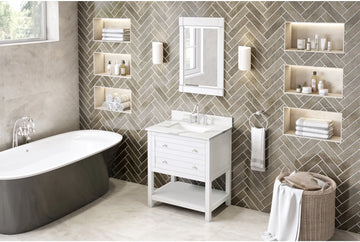
Bathroom Vanities for Single and Double Sink Configurations
Sizing and Layout for Bathroom Vanities
Bathroom vanities anchor the room's storage and plumbing, so cabinet width and sink count drive the layout. Single-sink vanities commonly run 24 to 48 inches wide and suit powder rooms, kids' bathrooms, and tight floor plans, while double-sink vanities at 60 to 72 inches give two people countertop and drawer space in a master ensuite. Standard bathroom vanities sit around 21 inches deep, and shallower 18-inch depths keep a doorway or walkway clear in a narrow room. Freestanding (floor-mounted) models bring a finished base and toe kick, while wall-mounted floating vanities open the floor beneath for a lighter footprint and easier cleaning. Faucet drilling, top thickness, and whether the unit ships with a top or expects a separate stone slab all shape the install.
Materials, Finishes, and Coordinating Hardware
Because a bathroom vanity lives in a humid room, construction holds up better in solid wood, plywood, or moisture-resistant MDF with a sealed paint or laminate surface than in bare particleboard. Painted Shaker vanities in white, gray, navy, and black read clean against tile and quartz, while stained oak, walnut, and maple bring warmth to a transitional or farmhouse bath. The cabinet doors and drawers take standard hardware, so the same bathroom vanity pulls and knobs sold for kitchen cabinetry fit here, letting the faucet, towel bar, and door pulls share one finish such as matte black, brushed nickel, or brushed brass. Matching the vanity's drawer pulls to the rest of the bathroom hardware ties the room together more reliably than matching wood tones alone.
Coordinate your vanity with matching cabinet pulls and cabinet knobs, or browse all bathroom hardware.
Frequently Asked Questions
What is the standard size of a bathroom vanity?
Single-sink bathroom vanities most commonly measure 24, 30, 36, or 48 inches wide, while double-sink vanities typically run 60 to 72 inches. Standard depth is about 21 inches and standard height is about 32 inches, with comfort-height vanities around 36 inches; shallow 18-inch-deep models exist for narrow rooms.
What is the difference between a floating vanity and a freestanding bathroom vanity?
A floating (wall-mounted) vanity attaches to the wall studs with open floor space beneath it, which makes the floor easier to clean and gives a smaller visual footprint. A freestanding vanity rests on the floor with a finished base or legs and a toe kick. Floating models depend on solid wall blocking to carry the weight, while freestanding models are simpler to install and often offer more interior storage.
What size pulls fit bathroom vanity drawers?
Bathroom vanity drawers use cabinet pulls sized by center-to-center spacing, most often 3 inches, 3.75 inches, or 5 inches on smaller drawers. Tall vanity drawer fronts and wide double-vanity drawers take longer pulls, commonly 6 to 8 inches center-to-center or appliance-style pulls, to stay in proportion with the drawer face. Knobs, with a single screw, also fit doors and narrow drawers.
Should I choose a bathroom vanity or a pedestal sink?
A bathroom vanity combines a sink with enclosed cabinet storage for toiletries and plumbing, making it the better fit for primary and family bathrooms where storage is scarce. A pedestal sink takes far less floor space and suits small powder rooms, but it offers no storage and leaves the plumbing exposed. Choose a vanity when storage matters and a pedestal sink when floor space is the priority.
What Customers Say
Trusted by thousands of designers, builders, and homeowners
Kayla Malo is the most attentive and super human ever! My experience with this company is stellar!

Love working with Kayla, she is extremely helpful and quick with responding to my questions!
Kayla was GREAT!!!! Super help and fast answers. One of the best I've ever dealt with.