

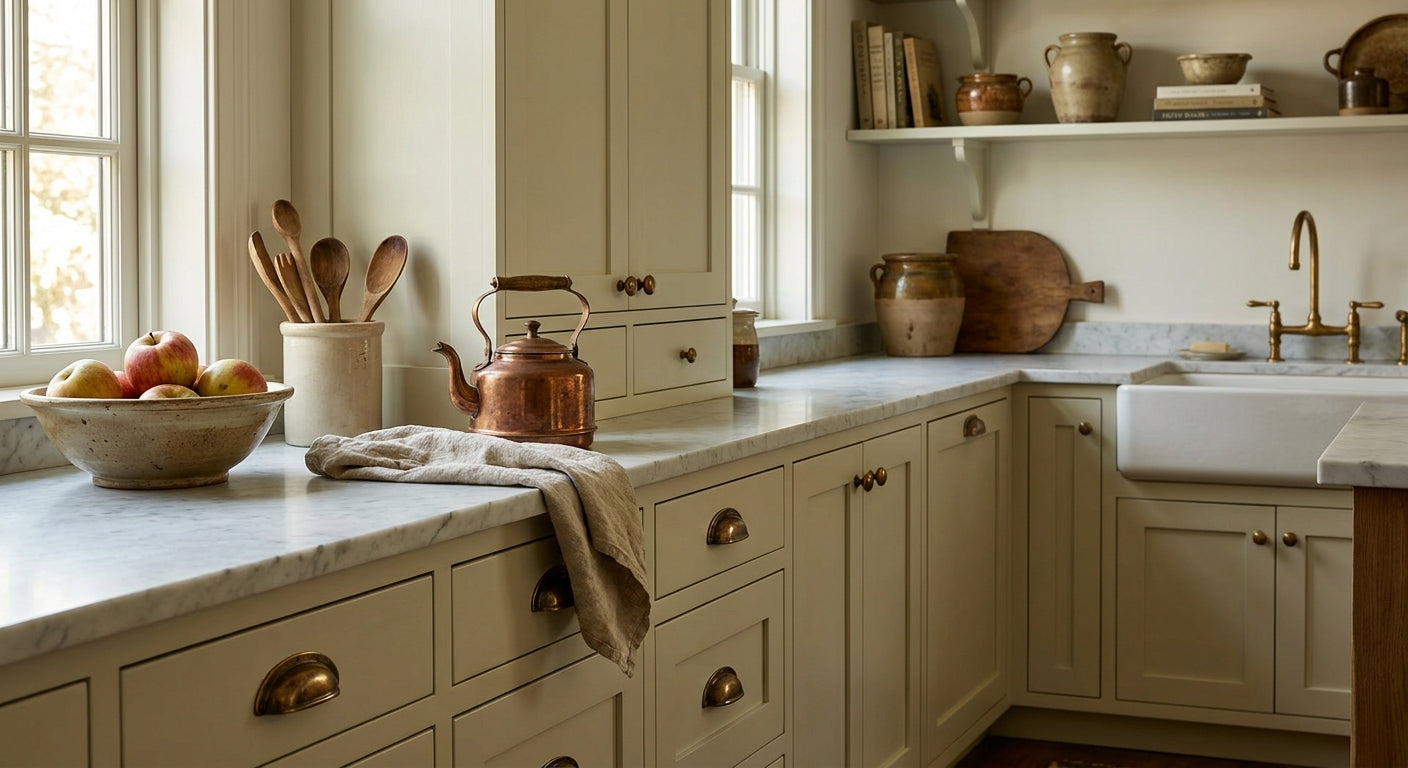
Aged brass cabinet pulls are the fastest way to make a vintage kitchen look intentional instead of dated — the finish reads warm, lived-in, and pairs with everything from painted shaker doors to raw wood face frames.
Shop the finish
Every brass knob and pull we carry, in one place — filter by size, style, and brand.
Browse Brass Cabinet Hardware →Shop the picks from this guide
In stock at Knobs.co · Free shipping on hardware orders $99+ · 110% price match
-
 Atlas Homewares
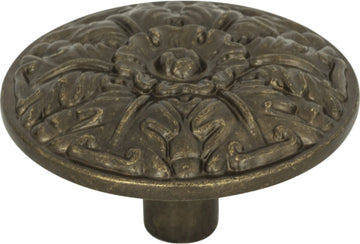
Hammered Medallion Knob 1 1/2''Burnished Bronze
Atlas Homewares
Hammered Medallion Knob 1 1/2''Burnished Bronze
$12.96
$14.40 -
 Atlas Homewares
Austen Oval Pull 5 1/16'' ccVenetian Bronze
Atlas Homewares
Austen Oval Pull 5 1/16'' ccVenetian Bronze
$21.15
$23.50 -
 Atlas Homewares
Alaire Pull 8 13/16'' ccWarm Brass
Atlas Homewares
Alaire Pull 8 13/16'' ccWarm Brass
$28.89
$32.10 -
 Edgar Berebi-Urban Metro
Urban Metro Granada Pull 8'' cc, Burnish Brass 102638BB
Edgar Berebi-Urban Metro
Urban Metro Granada Pull 8'' cc, Burnish Brass 102638BB
$85.86
$95.40

TL;DR
For vintage kitchens in 2026, the Atlas Homewares Hammered Medallion Knob (138-BB) is the safe buy for anyone building out a full run of drawers and doors on a budget, while the Atlas Homewares Austen Oval Pull (347-VB) is the pick if your cabinets are already carrying strong traditional lines and can support a heavier profile. Aged brass and bronze cabinet pulls in a burnished or antiqued finish outperform polished brass and chrome in vintage settings because they hide fingerprints and don't read as "new construction." Verdict: buy burnished or antiqued brass or bronze over polished brass for any kitchen built before 1970 or styled to look like it.
Why this matters
A vintage kitchen lives or dies on hardware finish, not cabinet color. Paint a shaker door any shade you want, but hang it with the wrong pull and the whole room reads like a flip-house remodel from 2026 instead of a house with history. Aged brass — sometimes labeled burnished brass, antique brass, or aged bronze depending on the manufacturer — solves that because the patina already looks broken in.
Browse the full hardware catalog before you commit to one finish family; seeing burnished brass next to oil-rubbed bronze and champagne bronze under the same light tells you more than any swatch. Knobs.co lets you order a paid sample so you can hold the actual finish against your cabinet paint before ordering the full set, refunded with your full order, — worth doing with aged metals more than with flat colors, because patina shifts under different light temperatures.
Who this is for
This guide is for homeowners renovating a kitchen built before 1980, anyone restoring a farmhouse or Victorian-era property, and renovators working from a vintage-inspired mood board on a new build. If your cabinets are flat-front modern slab doors, skip this guide — aged brass fights that look instead of completing it.
What to look for in aged brass cabinet pulls for vintage kitchens
Finish depth, not just color
A true aged brass finish has variation in the recesses — darker in the grooves, lighter on the raised surfaces. Flat, uniform gold-tone hardware photographs fine but looks synthetic in person next to a 1920s farmhouse sink or original wood trim.
Center-to-center spacing that matches your existing holes
Most vintage cabinets were drilled for 3-inch or 3.75-inch centers long before today's wider profiles became standard. Check your existing holes before ordering a pull with different spacing — re-drilling a face frame door is a repair job, not a hardware swap.
Weight and casting quality
Die-cast pulls in aged brass tend to feel hollow and chip at the edges within a couple of years of daily use. Solid cast construction costs more per unit but holds the patina evenly instead of wearing shiny at the grip points by 2027.
Coordinated door bells, robe hooks, and hinges
Vintage-style renovations rarely stop at the cabinet door. If you're matching an aged brass or aged bronze pull program across a kitchen, check whether the same finish family extends to hinges and accessory hardware so the room doesn't end up with three near-matching golds.
Knob-to-pull ratio for the room
Traditional kitchens historically used knobs on doors and pulls on drawers. Sticking to that split keeps the vintage read intact — an all-pull kitchen skews more transitional or contemporary, even in the right finish.
Top picks for 2026
The safe pick: Atlas Homewares Hammered Medallion Knob (138-BB)
Hammered texture does double duty on this knob's Burnished Bronze finish because the surface irregularity hides fingerprints and wear better than a smooth cast knob. At 1 1/2 inches, it's sized right for door applications on face-frame cabinets and reads correctly whether your kitchen is farmhouse, Victorian, or transitional-traditional. Verdict: Buy — this is the hammered medallion knob to standardize on if you're outfitting every door in the kitchen.
The wildcard: Atlas Homewares Austen Oval Pull (347-VB)
The oval profile is a departure from the standard bar pull, and the Venetian Bronze finish leans harder into an antique read than a straight bar ever will. At 5 1/16 inches, it fits standard drawer widths without crowding a face frame rail. Verdict: Consider — pick this if your kitchen has enough traditional detailing (crown molding, beadboard, a farmhouse sink) to support a more ornate austen oval pull instead of a plain bar.
The workhorse: Atlas Homewares Alaire Pull (A505), Warm Brass
Atlas Homewares' Alaire line runs an 8 13/16-inch profile with a clean D-handle silhouette. It ships in Matte Black, Brushed Nickel, Polished Chrome, and Warm Brass — Warm Brass is the finish to pick for a vintage-adjacent look here, not a "burnished" option (Alaire doesn't have one). It's a reasonable middle-ground choice when you want one consistent shape without redesigning the whole hardware plan room by room. Verdict: Consider for larger kitchens where you need one pull length to repeat across 15-plus drawers. Alaire Pull
The splurge: Edgar Berebi Urban Metro Granada Pull (102638BB)
This is the priciest pick on this list, and the finish is the reason: Burnish Brass here means genuine dimensional depth — bright warm highlights paired with a darker, antiqued undertone, not a flat single-tone plate. The 8" cc size and made-in-USA construction set it apart from the Atlas Homewares picks above. Verdict: Consider if budget allows and you want one statement pull — on an island or a single feature drawer — rather than running it across a full kitchen. Urban Metro Granada Pull
What to avoid
- Polished, unaged brass — a mirror-shine gold finish looks like a 1980s builder-grade kitchen, not a restored vintage one. Save polished brass for genuinely period bathroom fixtures where it was historically accurate.
- Chrome or brushed nickel mixed into an otherwise brass kitchen — cool-toned metals fight the warm read that makes aged brass work in a vintage room.
- Undersized pulls on oversized drawers — a 3-inch pull centered on an 18-inch drawer front looks like an afterthought regardless of finish quality.
Verdict comparison
| Pick | Finish | Best for | Verdict |
|---|---|---|---|
| Hammered Medallion Knob (138-BB) | Burnished Bronze | Full-kitchen door standardization | Buy |
| Austen Oval Pull (347-VB) | Venetian Bronze | Ornate traditional kitchens | Consider |
| Alaire Pull (A505) | Warm Brass | Large kitchens, repeat-length drawers | Consider |
| Urban Metro Granada Pull (102638BB) | Burnish Brass | Single statement pull | Consider |
| Polished brass knobs | Bright brass | Period bathroom fixtures only | Skip for kitchens |
FAQ
What's the best finish for aged brass cabinet pulls in 2026? Burnished or antique brass finishes with visible depth in the recesses outperform flat, uniform gold-tone hardware for vintage kitchens, because the variation reads as patina rather than paint.
Is aged brass better than oil-rubbed bronze for a vintage kitchen? Both work for pre-1980 kitchens; aged brass leans warmer and gold-toned while oil-rubbed bronze leans darker and cooler. Choose based on your existing fixtures — faucets and lighting should match the undertone, not just the category.
How much does it cost to re-hardware a full kitchen? Cost scales with cabinet count and pull length, not finish — check current per-unit pricing on the product page before budgeting a full kitchen swap.
Do aged brass pulls tarnish or change color over time? Unlacquered and burnished brass finishes will continue to develop patina with handling and air exposure; lacquered aged-brass finishes are sealed to hold their look longer with less shift.
What center-to-center spacing should I order for vintage cabinets? Measure your existing holes first — vintage cabinets commonly used 3-inch or 3.75-inch spacing, narrower than the 5-to-8-inch pulls common in newer construction.
Can I mix knobs and pulls in the same aged brass finish? Yes — traditional kitchens typically use knobs on doors and pulls on drawers within the same finish family, which is historically accurate and visually cleaner than an all-pull layout.
Should I order samples before buying a full set? Yes — aged and burnished finishes shift more under different lighting than flat colors do. Knobs.co samples are paid and refunded with your full order, and checking one against your actual cabinet paint before committing to 20-plus units is worth doing.
One last thing
Most vintage-kitchen remodels fail on hardware not because the finish is wrong but because the spacing is wrong — a beautiful aged brass pull mounted on mismatched centers from the original 1960s holes forces a redrill on every single drawer front. Measure existing hole spacing on at least three drawers before ordering anything in 2026, because older cabinet runs are rarely drilled with perfect consistency.


