

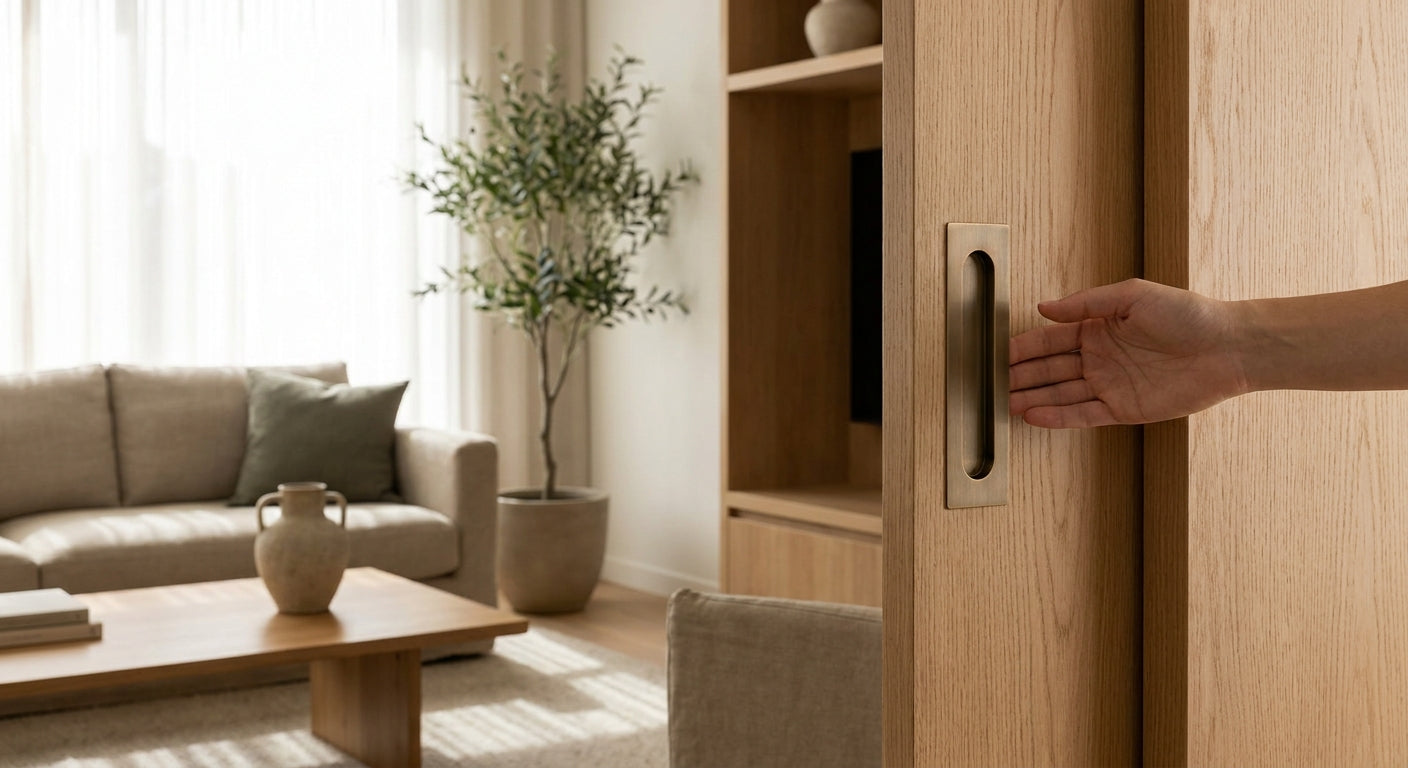
Sliding cabinet doors don't have room for a pull that sticks out — anything with real projection jams the track or gets clipped every time the door slides past it. This guide covers what actually works, what to skip, and which flush pulls for sliding doors hold up under daily use in 2026.
Shop the finish
Every matte black knob and pull we carry, in one place — filter by size, style, and brand.
Browse Matte Black Cabinet Hardware →TL;DR
For sliding and pocket-style cabinet doors, you need hardware with a low profile (under 3/4" projection) and a grip that clears the adjacent panel. The Curved Push-Pull Set (2-3/4" x 13") is the Buy for barn-style and pantry sliders because it sits close to the door face while still giving fingers something to grab. Edge pulls and finger pulls cover flat-front and handleless setups. Standard bar pulls, cup pulls, and anything with a deep backplate are a Skip — they were never designed for a track.
Why This Matters
Sliding cabinet doors move on a horizontal plane, not a swing hinge, so hardware that works fine on a shaker door can physically block a slider from closing. Knobs.co has fielded enough return requests over two decades to know the pattern: someone orders a knob or bar pull that photographs well, installs it, and the door won't clear the frame or the neighboring panel. Flush and low-profile pulls solve that before it becomes a return.
Who This Is For
This is for anyone installing or replacing hardware on sliding cabinet doors — pantry sliders, TV console panels, barn-style kitchen cabinets, RV and boat galley cabinets, or handleless flat-front European-style cabinetry. If your doors run on a track instead of a hinge, standard pull depth rules don't apply to you.
What to Look For in Flush Pulls for Sliding Doors
Profile Depth
Projection is the number that matters most. Anything over 3/4" risks catching on the adjacent door or the cabinet frame as it slides. Look for pulls that state their projection in the spec sheet, not just overall length.
Mounting Style
Most flush pulls for sliding doors use through-bolt mounting rather than a screw-in post, which keeps the back of the pull flat against the door. Recessed and routed options exist for true flush-mount jobs, but they require the door material to support routing without splitting.
Grip Clearance
A pull that's flush enough not to catch a neighboring panel still has to leave a fingertip's worth of space to actually pull the door. Curved and scalloped designs solve this better than straight bar profiles.
Finish and Wear Resistance
Sliding cabinets get touched constantly — pantry doors especially. A finish rated for high-contact use (satin nickel, stainless, matte black powder coat) holds up better than a soft brass plating that shows fingerprints and wear within a year.
Length-to-Door Ratio
A pull that's too short on a wide sliding door forces an awkward grip angle. As a rule, match pull length to roughly a third of the door's width for a natural pull motion.
Top Picks
The safe pick: Curved Push-Pull Set (2-3/4" x 13") This set gives you a 13" pull length with a curved profile designed to sit close to the door face while leaving enough grip clearance for daily use. It works on pantry sliders, barn-style cabinets, and wide pocket doors where a straight bar would catch. Buy — it's the closest thing to a purpose-built flush pull for sliding doors in the current catalog.
The minimalist option: Edge pulls For handleless European-style sliding cabinetry, an edge pull mounted along the top or side rail eliminates projection almost entirely. Knobs.co's guide to edge pulls for modern European-style cabinets walks through sizing and mounting for flat-front doors. Consider — best for new builds where the door edge can be routed during fabrication.
The disappearing act: Finger pulls Finger pulls route into the top edge of a flat-front door and disappear entirely when the door is closed, which is why they show up on so many handleless sliding kitchen and closet systems. The finger pulls for handleless flat-front cabinets guide breaks down which door thicknesses support the routing depth needed. Buy — for retrofits on existing flat-front sliders, confirm door thickness first since finger pulls need at least 3/4" of material to route into safely.
What to Avoid
- Deep bar pulls with 1"+ projection. They look right on a swinging cabinet door and jam immediately on a track.
- Knobs with wide backplates. A backplate adds surface area that can scrape against the frame or an adjacent panel every time the door moves.
- Anything advertised as "appliance pull" for sliding use. Appliance pulls are built for door swing clearance on refrigerators and dishwashers, not for tracks — the mounting posts sit too proud of the surface.
Verdict Comparison
| Option | Projection | Best Door Type | Verdict |
|---|---|---|---|
| Curved Push-Pull Set (13") | Low, curved profile | Barn-style, pantry sliders | Buy |
| Edge pull | Near-zero (mounted on edge) | Flat-front European cabinets | Consider |
| Finger pull | Zero (routed, flush) | Handleless flat-front | Buy (retrofit-dependent) |
| Standard bar pull | 1"+ | Hinged doors only | Skip |
| Cup pull | 3/4"-1" | Hinged doors only | Skip |
FAQ
What's the best pull for a sliding cabinet door? A low-projection pull under 3/4" is the baseline requirement; the Curved Push-Pull Set (2-3/4" x 13") from Knobs.co covers most barn-style and pantry sliding applications without catching on the frame.
Are flush pulls the same as edge pulls? No — a flush pull typically mounts on the door face and sits close to it, while an edge pull mounts along the door's top or side rail and has essentially zero face projection. Both work for sliding doors but suit different door constructions.
Can I install finger pulls on an existing sliding door? Only if the door material is at least 3/4" thick, since finger pulls require routing into the door edge. Thinner doors risk splitting during the routing process.
Do sliding cabinet doors need special hardware, or can I use regular pulls? Standard pulls with more than 3/4" of projection will catch on the track or an adjacent panel. Sliding doors need low-profile or flush-mount hardware specifically, not standard cabinet pulls.
How much clearance do flush pulls need from the door frame? Builders generally leave at least 1/8" of clearance between the pull's outer edge and the frame or neighboring door to prevent rub marks over time.
Is stainless steel or matte black better for sliding cabinet pulls? Both hold up to daily contact; matte black shows fewer fingerprints on light-toned cabinets, while stainless resists visible wear patterns longer on dark cabinets. Pick based on the cabinet finish, not durability alone.
What length pull works best for a wide pantry slider? Match pull length to roughly a third of the door's width — a 13" pull like the Curved Push-Pull Set suits doors in the 30"-40" range comfortably.
Do flush pulls work on RV or boat cabinet doors? Yes, and they're a common choice there specifically because marine and RV cabinetry runs on tight sliding tracks where projection is even more restricted than in a standard kitchen.
One Last Thing
Most people shopping flush pulls for sliding doors focus entirely on projection and skip the grip clearance question — then wonder why their fingers can't get a hold on the door once it's installed. A pull that's flush enough to clear the track but has zero curve or lip to grab is a pull you'll be fighting with every day in 2026 and beyond. Test the grip angle with a sample before committing to a full order.


