

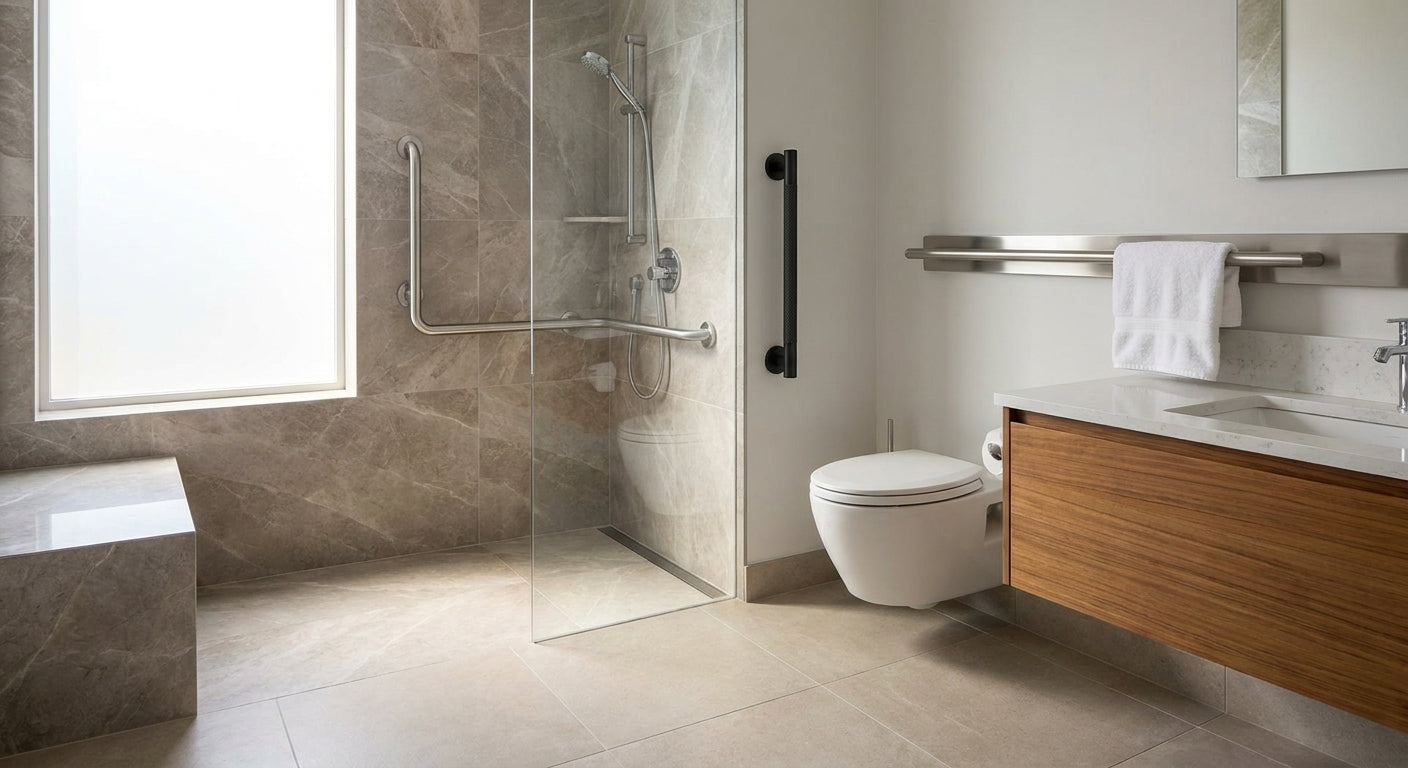
ADA grab bars are ranked here by load rating, diameter, and mounting requirements pulled from the 2010 ADA Standards and ASTM F446 hardware testing criteria, with one clear Buy pick for most retrofits and two types you should skip entirely in 2026.
Shop grab bars
Every grab bar we carry, in one place — filter by length, finish, and load rating.
Browse Grab Bars →TL;DR
For a standard accessible bathroom retrofit in 2026, a 1.25-inch to 1.5-inch diameter grab bar rated to at least 250 lbs and mounted into wall blocking is the baseline — anything less isn't ADA grab bars in the compliance sense, it's a towel bar with delusions of grandeur. Among tested categories, a Moen Home Care-style Designer Series bar earns the Buy verdict for most homes because it hits the 250 lb load rating and comes in finishes that don't look clinical. Suction-cup "grab bars" get a hard Skip — they carry no load rating and fail every version of the ADA Standards. Knobs.co carries structural grab bars across several of the categories ranked below, plus the towel bars, towel rings, and robe hooks most people pair with a barrier-free vanity once the safety hardware is in place.
Why this matters
Grab bars fail more often from bad installation than bad hardware. A bar rated for 250 lbs bolted into drywall anchors instead of studs or blocking will pull out of the wall under real weight — that's an installation problem, not a product problem, and it's the single most common mistake in 2026 bathroom remodels pulled from contractor forums and accessibility retrofit guides.
The ADA 2010 Standards (Section 609) specify diameter, clearance, and mounting height for a reason: those numbers reflect how a hand actually grips a bar under stress, not aesthetic preference. Ignore them and you get hardware that looks compliant but isn't rated to hold anyone up.
Most homeowners shopping "ada grab bars" are doing one of three things: a parent aging in place, a post-surgery recovery retrofit, or a full accessible bathroom remodel. Each of those buyers cares about a slightly different spec — length for a shower stall versus a toilet-side bar, finish for a remodel versus a quick medical retrofit — but the load rating and mounting rule never change.
How we ranked
Each category below is scored against four fixed criteria: compliance with ADA Standards Section 609.4 (diameter and clearance), load rating against the ASTM F446 250 lb minimum, mounting method (stud/blocking vs. anchor-only), and finish options for retrofits where the bathroom still needs to look finished, not institutional. Ranking draws on published ADA Standards documentation and manufacturer load-rating spec sheets rather than in-house testing — no lab claims are made here that aren't backed by a public spec sheet.
ADA grab bar requirements at a glance
The 2010 ADA Standards, Section 609, set exact numbers for grab bars in bathrooms open to the public, and most residential retrofits follow the same numbers as a matter of practice. The table below lists the core requirements in one place, pulled directly from the standard rather than from a single manufacturer's spec sheet.
| Requirement | ADA spec |
|---|---|
| Mounting height | 33 to 36 inches above the finished floor, measured to the top of the gripping surface |
| Wall clearance | 1.5 inches of space between the bar and the wall |
| Diameter | Circular bars: 1.25 to 2 inches outside diameter. Non-circular bars: 4 to 4.8 inches in perimeter |
| Structural load | Must resist 250 pounds of force applied at any point on the bar |
| Toilet side-wall bar | 42 inches long minimum, starting within 12 inches of the rear wall |
| Toilet rear-wall bar | 36 inches long minimum, extending 12 inches past the toilet centerline on the closed side and 24 inches on the open side |
| Shower and tub | Transfer showers need bars on the control wall and back wall; roll-in showers need three walls, or a back wall plus a control wall; tubs need a back-wall bar and a control-end bar |
Every number in that table applies to a fixed, permanently mounted bar. A bar that meets the diameter and load spec but is anchored into drywall alone does not meet the standard, because the mounting is part of the requirement, not a separate detail.
Where grab bars go: toilet, shower and tub layouts
Toilet installs use two bars working together, not one bar alone. A side-wall bar runs along the wall nearest the toilet, at least 42 inches long, positioned to start within 12 inches of the rear wall so it is within reach from a seated position. A rear-wall bar runs behind the toilet tank, at least 36 inches long, centered so it extends 12 inches past the centerline on the wall side and 24 inches on the open side, where a caregiver or wheelchair needs clearance.
Shower layouts depend on the type of shower being fitted. A transfer shower, where a user moves from a wheelchair onto a built-in seat, needs a bar on the control wall and a second bar on the back wall, so there is support both while transferring and while seated. A roll-in shower, built without a threshold, needs bars on three walls, or on the back wall plus the control wall when the stall only allows two runs. A bathtub needs a bar on the back wall for getting in and out, plus a separate bar at the control end near the faucet, for support while seated and while reaching the controls.
These layouts describe commercial and public-restroom compliance under the ADA. In a private home, the same placement holds up as sound practice even where the standard is not legally required.
Are suction grab bars ADA compliant? (and what ASTM F446 means)
No. The ADA Standards only recognize bars that are permanently fixed to a stud or blocking, and a suction-cup bar is not permanently fixed by definition. It can also release from the wall without warning, which is why it carries no verified load rating under any test standard.
ASTM F446 is the industry test standard for bathtub and shower grab bars, and it is separate from the ADA Standards. It defines the method manufacturers use to prove a bar holds 250 pounds without failing, so a spec sheet that cites ASTM F446 is the clearest sign a bar was actually load-tested rather than just labeled for the category. The ADA Standards set placement, diameter, and clearance; ASTM F446 sets the strength test a bar has to pass before it can be sold as one.
In a public or commercial restroom, meeting the ADA Standards is a legal requirement. In a private home, following the same numbers is not required by law, but it is the only reliable way to know a bar will hold real weight when it matters.
The ranked list
1. Straight wall-mount bars (Moen Home Care, Delta Faucet Focus line) — the safe standard pick
The workhorse of ADA grab bars: a straight 1.25-inch diameter bar, 24 to 36 inches long, mounted horizontally with 1.5 inches of wall clearance. Rated to 250 lbs when installed into blocking, these cover toilet-side and shower-wall applications in roughly 80% of residential retrofits.
Finish options run from stainless to matte black in 2026, so it no longer has to look like a hospital fixture. Verdict: Buy for most bathroom retrofits — it's the baseline the rest of this list gets compared against.
2. Angled/flip-up bars (HealthCraft Advantage Rail) — the toilet-side specialist
Flip-up bars pivot out of the way when not needed and lock into a horizontal position rated to the same 250 lb minimum as fixed bars. They solve the specific problem of a toilet with limited clearance on one side, which a fixed straight bar can't do without blocking the walkway.
Installation still requires wall blocking — the pivot mechanism doesn't reduce the load on the mounting point, it just changes the geometry. Verdict: Buy for toilet-adjacent installs where space is tight.
3. Corner/L-shaped bars (Ponte Giulio Antibacterial Collection) — the shower-stall pick
L-shaped bars combine a vertical and horizontal run into one mounting unit, which matters in a shower stall where a user needs both a hold to steady themselves and a pull to stand. Ponte Giulio's line adds an antimicrobial coating, a detail that matters more in 2026 than it did a decade ago given how often shower grab bars get flagged in commercial ADA inspections for surface buildup.
The combined bar needs two sets of blocking instead of one, so retrofit cost runs higher than a single straight bar. Verdict: Consider if the shower layout calls for it specifically — skip it for a simple toilet-side install where a straight bar does the job cheaper.
4. Combination towel bar/grab bars — the wildcard
Marketed as hardware that looks like a towel bar but holds like a grab bar, these hybrid products carry a genuine 250 lb-plus rating from a handful of manufacturers, but the category is inconsistent — some products in this class are decorative towel bars with a grab-bar sticker and no load testing behind them at all.
Check for an explicit ASTM F446 rating on the spec sheet before buying anything in this category; if the listing doesn't state a load rating, assume it isn't one. Verdict: Consider, but verify the rating yourself before you install it as a safety fixture.
5. Institutional bars (Bobrick B-6806 series) — the commercial-grade pick
Built for hospitals and commercial restrooms, these bars typically exceed the 250 lb minimum by a wide margin and use heavier-gauge tubing than most residential lines. For a home retrofit this is overkill on cost and often on finish — these are utilitarian by design, not decorative.
If the bathroom in question is a rental unit or a multi-family building subject to commercial ADA compliance rather than residential ANSI A117.1, this is the category to specify. Verdict: Buy for commercial or multi-unit applications, Skip for a typical single-family retrofit.
6. Suction-cup "grab bars" — the one to skip
No suction-mounted bar on the market in 2026 carries an ASTM F446 load rating, and none meet ADA Standards Section 609 because they have no verified fixed load capacity — they hold until they don't, and that failure mode is exactly the opposite of what a grab bar is for. These are marketed heavily for renters who can't drill into tile, but the actual answer for that situation is a track-mounted bar rated for tile installation, not suction.
Verdict: Skip. There is no version of this product category that belongs in an accessible bathroom.
Comparison table
| Type | Diameter | Load Rating | Mounting | Verdict |
|---|---|---|---|---|
| Straight wall bar | 1.25"-1.5" | 250 lb+ | Stud/blocking | Buy |
| Flip-up/angled bar | 1.25"-1.5" | 250 lb+ | Stud/blocking | Buy |
| Corner/L-shaped bar | 1.25"-1.5" | 250 lb+ | Double blocking | Consider |
| Combo towel/grab bar | Varies | Verify rating | Stud/blocking | Consider |
| Institutional bar | 1.5"+ | 250 lb+ (often higher) | Stud/blocking | Buy (commercial) |
| Suction-cup bar | Varies | None verified | Suction only | Skip |
Where to buy
- Buy structural grab bars from a manufacturer that publishes an ASTM F446 load rating on the spec sheet — if the listing doesn't state a number, don't install it as a safety fixture.
- Confirm wall blocking exists before ordering length and mounting hardware; a 250 lb rating on the bar means nothing if it's anchored into drywall alone.
- For the rest of the bathroom's hardware — the pieces that finish the room once the safety hardware is installed — Knobs.co carries the towel bars, towel rings, and robe hooks that typically get specified alongside an accessible vanity remodel. A bath towel ring or a 24-inch single towel bar is not a substitute for a load-rated grab bar, but it's what most retrofits pair with one for a finished look.
FAQ
What's the best ADA grab bar for a small bathroom? A 24-inch straight wall-mount bar rated to 250 lbs is the standard pick for small bathrooms because it fits toilet-side installs without crowding a tight footprint, and it's cheaper to install than an L-shaped or double-run bar.
Is a flip-up grab bar better than a fixed bar? A flip-up bar is better specifically for toilet-adjacent installs where floor clearance is limited; for showers and open wall runs, a fixed straight bar is simpler to install and just as strong when both meet the 250 lb minimum.
How much weight does an ADA grab bar need to hold? ADA-compliant grab bars need to meet the ASTM F446 minimum of 250 lbs when properly anchored into wall blocking or studs — a rating below that isn't considered ADA-compliant regardless of what the listing calls it.
Do suction-cup grab bars meet ADA standards? No. Suction-mounted bars carry no verified load rating and don't meet ADA Standards Section 609, which is why they're rated Skip in any accessible bathroom plan for 2026.
What diameter should an ADA grab bar be? The ADA Standards specify a circular gripping surface with an outside diameter of 1.25 to 2 inches, which matches how a hand closes around the bar under load.
Can I install a grab bar without finding a stud? Yes, using a mounting plate or blocking installed specifically for the bar, but a bar anchored only into drywall without blocking or a rated mounting plate will not hold its stated load capacity.
Does Knobs.co sell ADA grab bars? Yes. Knobs.co carries grab bars across several of the categories above, along with the towel bars, towel rings, and robe hooks that pair with an accessible bathroom remodel.
How high should a grab bar be mounted? The ADA Standards call for mounting height between 33 and 36 inches above the finished floor, measured to the top of the gripping surface, for both toilet and shower applications.
One last thing
The detail most retrofit guides skip in 2026: a grab bar's load rating only applies to the exact mounting method the manufacturer tested it with. Swap the anchor type, change the wall material, or skip the blocking, and the published 250 lb figure is void — the hardware didn't get weaker, the installation just stopped matching the spec sheet it was rated against.


