

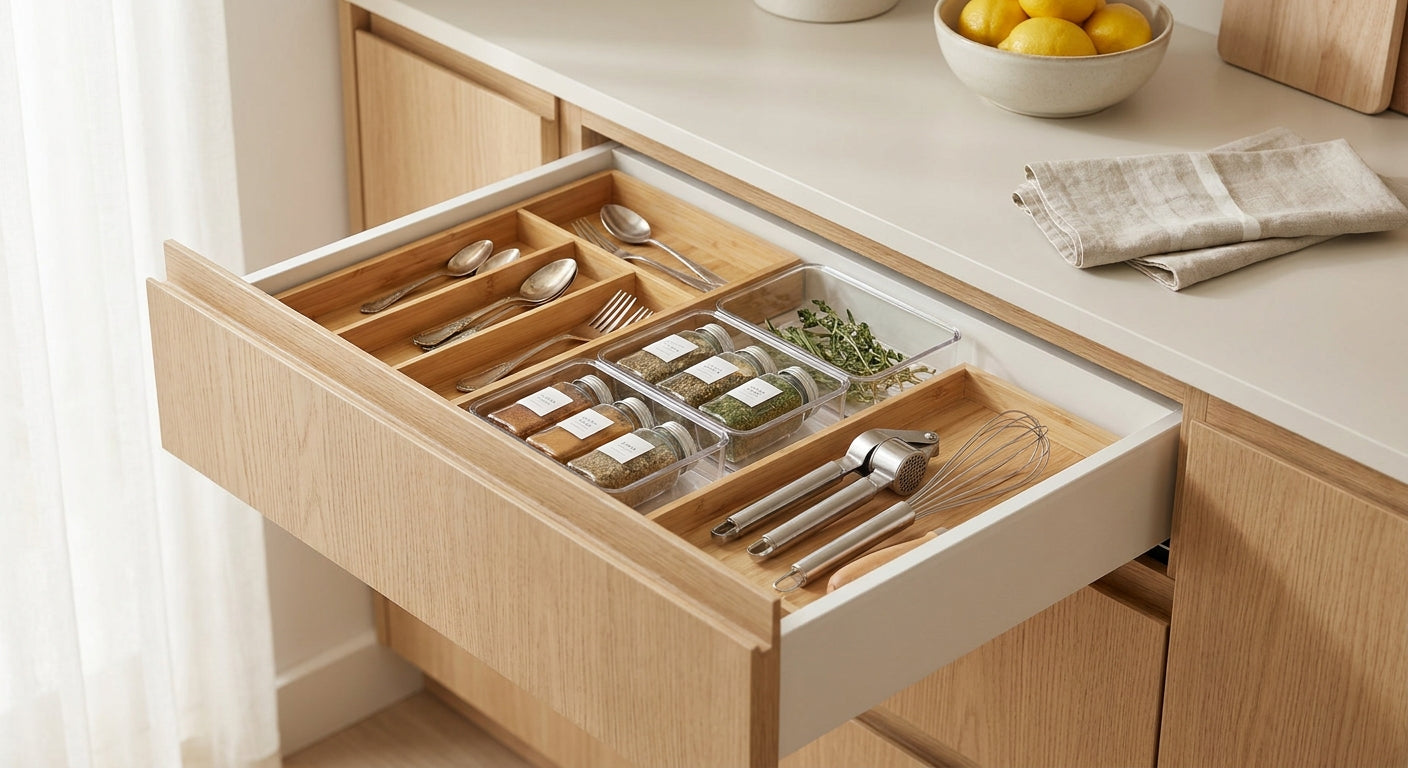
Small kitchen drawers only have so much depth to give, and the wrong knob or pull eats into space your organizer trays desperately need. This guide covers what to buy, what to skip, and which hardware actually clears the way for utensil dividers and cutlery trays.
TL;DR
Small kitchen drawer organizers only work if the hardware on the front doesn't rob interior clearance. For 2026, low-profile knobs like the Atlas Homewares U-Turn Knob and slim bar pulls like the Atlas Homewares Alaire Pull are the safe buys for narrow drawer fronts, while oversized appliance-style pulls are a Skip on anything under 18 inches wide. Get the sizing right first, the organizer tray second, and you won't be drilling new holes twice.
Why this matters
Most people shop for a drawer organizer tray, drop it in, and only then notice the pull hardware sticks down 3/4 inch further than the tray lip allows. That's a returns problem, not a design problem, and it comes down to picking hardware sized for the drawer before the insert goes in. The right knob size matters more in a small drawer than a big one, because there's no slack to absorb a mismatch.
Knobs.co stocks over 50,000 SKUs across dozens of brands, and a meaningful share of returns on small-drawer projects trace back to one thing: hardware bought by look, not by clearance. This guide fixes that order of operations.
Who this is for
This is for anyone retrofitting kitchen drawers under 24 inches wide: apartment kitchens, older homes with shallow cabinet boxes, RV and tiny-home kitchens, and anyone adding a utensil tray or divider insert to a drawer that was never built with organization in mind. If your drawer front is thin veneer, or your existing pulls already look tight against the drawer lip, you're the target buyer here.
What to look for in hardware for small kitchen drawers
Knob profile depth
A knob that projects more than 1-1/4 inches off the drawer face reduces how far an organizer tray can sit without hitting your knuckles. Low-profile knobs under 1-1/8 inches in diameter clear standard cutlery trays without forcing you to trim the insert.
Pull length versus drawer width
A pull under 6 inches works on narrow drawers (12 to 18 inches wide) without looking undersized, while anything over 8 inches on a drawer that narrow starts crowding the corners where organizer dividers sit. Match pull length to at least 60% of the drawer front width, not more.
Screw length for drawer front thickness
Most stock drawer fronts run 1/2 to 3/4 inch thick, and hardware screws that run too long will punch through into the drawer box interior, right where your tray sits. Check the screw length included with the hardware before it ships, not after you're holding a drill.
Spacing to clear tray walls
If you're mounting a pull with two screw holes, the hole spacing (the center to center measurement) has to clear the raised wall of most cutlery trays, which typically sit 1/2 inch off the drawer bottom. Measure your tray's mounting clearance before ordering hardware with wide hole spacing.
Finish durability near sinks and prep zones
Drawers next to the sink or dishwasher take more moisture exposure than drawers across the kitchen. A finish rated for daily wipe-down, not just occasional dusting, holds up better over the years, and matte black and stainless finishes tend to show water spots less than polished brass in these spots.
Backplates for thin or damaged fronts
If the drawer front is thin plywood or already has an old screw hole nearby, a backplate spreads the load and covers the old hole instead of forcing a new cut. It's a cheap fix that saves a full drawer front replacement.
Top picks for small kitchen drawer hardware
The safe pick, Atlas Homewares A845-BN U-Turn Knob At 1-1/8 inches in diameter, this knob projects less than most pulls and clears standard cutlery tray walls without modification. It works on drawer fronts as thin as 1/2 inch. Buy — this is the default choice for any drawer under 18 inches wide going into 2026.
The classic pick, Schaub and Company 704-PN Traditional Round Knob This is a 1-1/2 inch diameter knob in polished nickel, slightly larger than the U-Turn but still low enough profile to clear most organizer trays with a half-inch to spare. It reads more traditional than the Atlas pick, which matters if your cabinets are shaker-style rather than flat-front. Consider if your kitchen already runs traditional hardware elsewhere and you want the finish to match.
The slim pull option, Atlas Homewares A505-CH Alaire Pull This bar pull runs 8-13/16 inches overall with a narrower profile than most appliance-style pulls, so it doesn't crowd tray corners the way a chunky pull does. It's a good middle ground if you want a pull's grip without the bulk. Consider for drawers 20 inches or wider, and Skip it on anything narrower, the proportions look off.
Order a free sample of any finish before committing. Matching an existing kitchen's hardware finish from a screen is a common way projects go sideways, and Knobs.co ships samples specifically to avoid that mistake.
What to avoid
- Full-size appliance pulls on narrow drawers. They look substantial in photos and crowd every organizer tray corner in real life. Save these for 24-inch-plus drawers or actual appliances.
- Deep cup pulls with no clearance check. Cup pulls can project further than a knob depending on the design, and if you haven't measured your tray's front wall clearance, you're guessing.
- Long-screw hardware kits without checking drawer front thickness. A screw built for a 1-inch-thick door will punch straight through a 1/2-inch drawer front and into your organizer tray space.
Verdict comparison
| Pick | Profile | Size | Best for | Verdict |
|---|---|---|---|---|
| Atlas Homewares U-Turn Knob | Low, under 1-1/4 in | 1-1/8 in dia | Drawers under 18 in wide | Buy |
| Schaub 704 Traditional Knob | Low-medium | 1-1/2 in dia | Traditional/shaker kitchens | Consider |
| Atlas Homewares Alaire Pull | Slim bar, moderate projection | 8-13/16 in | Drawers 20 in and wider | Consider |
FAQ
What's the best knob size for small kitchen drawers? A knob between 1-1/8 and 1-1/2 inches in diameter is the safe range for most small drawer organizers in 2026. Anything larger starts crowding tray corners.
Should I use knobs or pulls in a small drawer? Knobs generally clear organizer trays more reliably than pulls because they project less off the drawer face. Pulls work fine on drawers 20 inches or wider, but on anything narrower a low-profile knob is the safer bet.
How much clearance do I need for a drawer organizer tray? Most standard cutlery trays need roughly 1/2 inch of clearance above the tray wall to close the drawer without the pull or knob catching. Measure your specific tray before buying hardware, since tray wall heights vary by brand.
Is a bar pull better than a knob for narrow drawers? No. On drawers under 18 inches wide, a bar pull's length and projection tend to crowd the space an organizer tray needs. A knob is the better default for narrow drawers.
Do backplates help with small drawer fronts? Yes, backplates cover old screw holes and spread mounting pressure across thin or damaged drawer fronts, which is common on older cabinet boxes being retrofitted with organizers.
How do I measure for cabinet pull hole spacing? Measure center to center between the two screw holes on your existing hardware or template, then confirm that spacing clears your organizer tray's mounting wall before ordering replacement pulls.
What's the standard screw length for cabinet knobs? Most knob screws run 1 inch, but drawer fronts thinner than 3/4 inch may need a shorter screw so it doesn't punch through into the tray space. Check the listing before ordering.
Does hardware finish matter for drawers near the sink? Yes. Finishes like matte black and stainless resist water spotting better than polished brass in drawers that see daily moisture exposure near a sink or dishwasher.
One last thing
The single most common mistake on small-drawer organizer projects isn't the tray, it's ordering hardware before measuring the tray's mounting clearance. Buy the organizer insert first, measure the wall height with a tape measure, then pick hardware that clears it by at least a quarter inch. That order reverses what most people do in 2026, and it's why most people end up drilling a second set of holes.


