

Which Brushed Brass Hardware Suits Navy Cabinets Best?
Brass on navy is settled. Which brass is not, and the dark field changes how shape, size and alignment read on the door.

Brushed brass hardware works on navy cabinets, and that is the easy half of the question. The harder half is which brushed brass, because the name covers everything from a pale champagne to a full yellow gold, and navy is dark enough to show the entire range. My default is the warmer, lower-shine end of the family: a brushed brass with real yellow in it rather than a brushed gold with a mirror hiding under the grain. One thing overrides that. If the faucet is already in and it is a cool metal, buy to the faucet first and settle the brass question after.
Shop the picks from this guide
In stock at Knobs.co · Free shipping on hardware orders $99+ · 110% price match
-
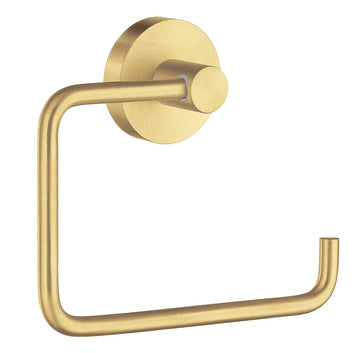 Smedbo
Home Toilet Roll Holder Brushed Brass HV341
Smedbo
Home Toilet Roll Holder Brushed Brass HV341
$126.00
$140.00 -
 Smedbo
Home Double Towel Rail Brushed Brass HV3364
Smedbo
Home Double Towel Rail Brushed Brass HV3364
$326.70
$363.00 -
 Smedbo
Home Toilet Roll Holder Brushed Brass HV3411
Smedbo
Home Toilet Roll Holder Brushed Brass HV3411
$142.21
$158.00 -
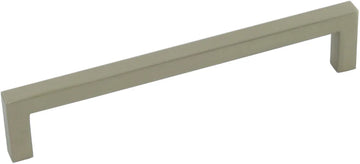 Century Hardware
Kai 6-5/16 inches (160mm) cc Square Bar PullBrushed Brass
Century Hardware
Kai 6-5/16 inches (160mm) cc Square Bar PullBrushed Brass
$18.00
$20.00 -
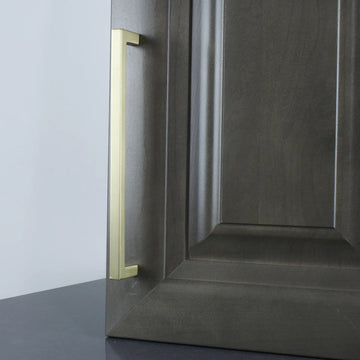 Century Hardware
Kai 7-9/16 inches (192mm) cc Square Bar PullBrushed Brass
Century Hardware
Kai 7-9/16 inches (192mm) cc Square Bar PullBrushed Brass
$21.60
$24.00 -
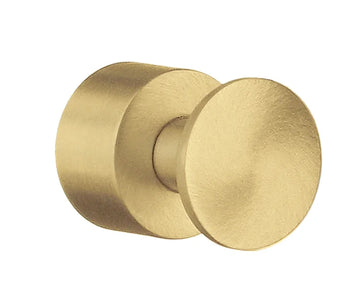 Smedbo
Home Towel Hook Pair Brushed Brass HV3455
Smedbo
Home Towel Hook Pair Brushed Brass HV3455
$69.30
$77.00
On navy, hardware stops being jewelry and becomes drawing
Put a brass pull on a white door and it sits a step or two away in value, so what you notice is the finish. Put the same pull on a navy door and the gap is enormous, closer to type on a dark page. The color recedes and the outline takes over. Three things follow from that, and together they are why some navy kitchens look designed and others look off without anyone being able to say why.
Shape carries more weight here than anywhere else. A round bar is a line. A knurled or fluted one is a line with texture running through it. A cup pull is a solid block. On pale cabinets you can pick a shape because you liked the photograph. On navy you are choosing a mark, and it will be legible from the doorway.
Alignment shows. Pulls a sixteenth of an inch out of line with each other disappear on oak and read as crooked on navy. Drill from a template rather than a tape, and hold the second drawer against the first before you touch the third.
And smaller goes further. Brass reads larger against navy than its measurements suggest, so a pull that felt right in the showroom against maple can sit heavy once it is on a dark door. Caught between two lengths on navy, I take the shorter one, which is the reverse of what I tell people with pale cabinets.
The distance between one brushed brass and the next is wider than the name admits
Finish names are not standardized between makers. One company's brushed brass is another's satin brass, and a third company's brushed gold lands half a shade brighter than either. On a light cabinet that spread is a detail. On navy it decides whether the hardware glows or goes faintly green.
Running from the palest warm metal to the deepest: champagne bronze, the softest and least yellow of the golds, which began as a faucet name; brushed gold, brighter and closer to a polished metal with a grain laid over it; satin brass and brushed brass, close cousins with genuine yellow in them, satin usually the finer grain of the two; then antique brass, darkened and browned deliberately. On navy I want the yellow. Champagne bronze is a fine finish and it does work here, but its softness argues with the one thing navy hands you for free, which is contrast, and a pale gold on a dark blue door can come off dusty rather than warm.
Going warmer costs you flexibility. A yellow brass commits the room: the faucet and the light fixtures then have to join the warm scheme, and walking that back later means replacing more than the hardware. If a champagne bronze faucet is already installed, take the bridge and match it, because two golds half a shade apart within a few feet of each other is the mismatch people spot first, faster than they spot a deliberate mix.
Before ordering a kitchen's worth, try a sample first; the cost is refunded with your full order. Tape it to a closed door rather than holding it up, because a sample in your hand catches light the door never will.
Your navy at nine at night is not the navy in the photograph
Navy paints split roughly three ways: the ones carrying violet, the ones carrying green or teal, and the ones that are effectively a very dark neutral. On a screen all three look like the same color. Brass finds the difference in about a second. A yellow brass against a violet-leaning navy is the cleanest of the three, because those two colors sit furthest apart on the wheel and neither muddies the other. Against a green-leaning navy the same brass turns slightly sour, and a browner antique brass settles it.
Then the bulbs. A warm 2700 K bulb turns brushed brass a shade more orange and takes some of the blue out of navy. Cool LEDs at 4000 K and above leave navy fully blue and drag brass toward green, which is the most common reason somebody tells me the brass they ordered looks wrong on the door. Look at samples after dark, with the kitchen lights on, rather than by a window at noon.
The faucet is the vote that counts
Most people match hardware to the faucet, and most of the time that is correct. Navy does buy you more room to mix than a pale kitchen does, because the dark field holds the two metals apart instead of making them argue across a light one. That is a real allowance, not a loophole.
If you mix, give each metal at least two jobs. Brass on every cabinet and a lone nickel faucet looks like a decision nobody finished; brass on the cabinets with a nickel faucet and nickel on the pot rail or the pendant looks intentional. The split that reads best on navy is by zone rather than by object: warm on the island, cool at the sink wall, or the other way round.
What actually dates navy and brass
Every page ranking for this question calls the pairing timeless. I would not go that far. Navy cabinets with warm brass is the signature of one particular stretch of kitchen design, the way honey oak with mirror-polished brass was the signature of another, and signatures date. That is not a reason to avoid it. It is a reason to be careful about how completely you commit.
What dates the room is total agreement: navy island, brass pulls, brass faucet, brass pendants, brass trim on the range, all the same polished yellow, all installed the same month. The navy kitchens I have watched hold up are the ones where the brass does one job and something in the room disagrees with it politely: a stainless range, a black faucet, an old nickel light over the sink.
The other insurance is a finish that keeps moving. Unlacquered brass is bare brass, and it darkens with handling until it is a different color from the one you bought, which means it cannot be pinned to the year it went in. Lacquered and PVD brass hold their color instead. What unlacquered costs you is evenness: the pulls your family uses most will be the darkest ones in the kitchen, and on navy that unevenness is visible rather than charming to everyone.
Living with a warm finish on a dark kitchen
Two practical notes before you order. PVD finishes wear best, electroplated ones come next, and a painted or powder-coated gold gives way at the contact points first, which on a drawer pull means the underside, where a cool gray base metal starts showing through the warm one. The listing usually names the process, and I look for it on every warm finish before recommending one; it matters more on a gold than on a nickel because the color underneath is nothing like the color on top.
Second, navy shows dust and cooking film worse than any pale color, and a satin-painted door holds the oil from a hand better than you would like. That is a paint problem, not a hardware problem, but it lands on the hardware, because the instinct is to spray cleaner at the pull. Wipe the door instead and keep the spray off the finish. A lacquered brass will go patchy long before the paint does.
Can you mix brass and brushed nickel cabinet pulls?
Yes, and navy is a better field for it than white. I keep the division logical rather than scattered: one metal at the sink and range, the other on the cabinets, or warm on the island and cool on the perimeter, with each metal appearing at least twice. What does not work is mixing two metals of the same temperature, a brass with a warm gold, because the eye takes that as a match that missed rather than a contrast that was chosen. If the cool metal is the one you want carrying the kitchen, our piece on brushed nickel pulls for navy blue cabinets takes that side.
Is brushed antique brass the same as brushed brass?
No. Antique brass has been darkened and browned on purpose, so a brushed antique brass wears the grain of a brushed finish over a much older-looking color. Against navy it gives up a good deal of the contrast that makes plain brushed brass work, and it reads quieter and more traditional in exchange. It is what I reach for when the navy leans green, when the doors are heavily detailed, or when there is an old floor in the room that the hardware has to answer to.
Shop Brushed Brass Cabinet Hardware
-
 Home Toilet Roll Holder Brushed Brass HV341
$126.00
Home Toilet Roll Holder Brushed Brass HV341
$126.00
-
 Home Holder With Tumbler Br Brass/Porcelain HV343P
$153.00
Home Holder With Tumbler Br Brass/Porcelain HV343P
$153.00
-
 Home Double Towel Rail Brushed Brass HV3364
$326.70
Home Double Towel Rail Brushed Brass HV3364
$326.70
-
 Home Toilet Roll Holder Brushed Brass HV3411
$142.21
Home Toilet Roll Holder Brushed Brass HV3411
$142.21
-
 Kai 6-5/16 inches (160mm) cc Square Bar Pull
$18.00
Kai 6-5/16 inches (160mm) cc Square Bar Pull
$18.00
-
 Home Soap Dispenser Br Brass/Porcelain HV369P
$307.80
Home Soap Dispenser Br Brass/Porcelain HV369P
$307.80
-
 Home Holder With Soap Dish Br Brass/Porcelain HV342P
$153.00
Home Holder With Soap Dish Br Brass/Porcelain HV342P
$153.00
-
 Kai 7-9/16 inches (192mm) cc Square Bar Pull
$21.60
Kai 7-9/16 inches (192mm) cc Square Bar Pull
$21.60


Browse all 23 in Brushed Brass Cabinet Hardware → Cabinet knobs Cabinet pulls & handles