

Brushed Nickel Pulls for Navy Blue Cabinets 2026
Brushed nickel pulls are the top pick for navy blue cabinets in 2026. Learn which profiles, finishes, and sizes work — and what to avoid — before you buy.

Navy blue cabinets are one of the few kitchen colors that make brushed nickel look better than it does in a showroom — the cool gray undertone of the finish locks into the cabinet's depth without competing with it. This guide covers how to pick the right brushed nickel pulls for navy blue cabinets in 2026, whether you're finishing a full kitchen renovation or swapping hardware on a single vanity.
TL;DR: Brushed nickel pulls work exceptionally well on navy blue cabinets in 2026 because the warm-neutral finish bridges the gap between cool navy and warm wood or stone surroundings. Bar pulls in 3–5 inch centers are the most versatile format. Look for solid brass or zinc alloy construction with a PVD-coated brushed nickel finish — it resists tarnish far longer than standard electroplated options. The brushed nickel collection at Knobs.co stocks 50,000+ SKUs across major brands including Top Knobs, Liberty, and Amerock, making it the most practical starting point for this combination.
Shop the picks from this guide
In stock at Knobs.co · Free shipping on hardware orders $99+ · 110% price match
-
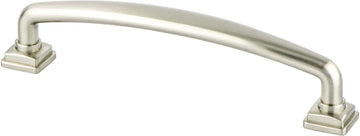 Berenson
Tailored Traditional 128mm CC Brushed Nickel Pull 1284-1BPN-P
Berenson
Tailored Traditional 128mm CC Brushed Nickel Pull 1284-1BPN-P
$10.93
$13.66 -
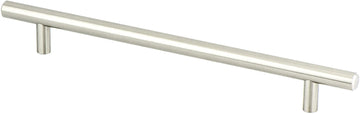 Berenson
Tempo 192mm CC Brushed Nickel Bar Pull 0806-2BPN-P
Berenson
Tempo 192mm CC Brushed Nickel Bar Pull 0806-2BPN-P
$11.53
$14.41 -
 Berenson
Bravo 56mm CC Brushed Nickel Edge Pull 1057-4BPN-P
Berenson
Bravo 56mm CC Brushed Nickel Edge Pull 1057-4BPN-P
$9.83
$12.28 -
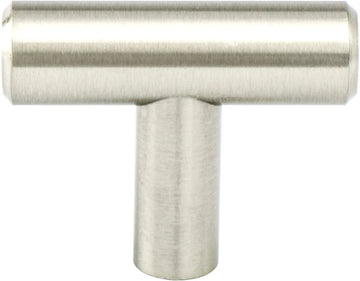 Berenson
Transitional Advantage Two Brushed Nickel T-Bar Knob 9435-2BPN-P
Berenson
Transitional Advantage Two Brushed Nickel T-Bar Knob 9435-2BPN-P
$2.80
$3.50 -
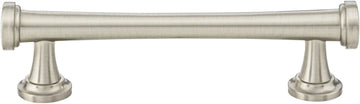 Atlas Homewares
Browning Pull 3 3/4'' ccBrushed Nickel
Atlas Homewares
Browning Pull 3 3/4'' ccBrushed Nickel
$14.50
$16.11 -
 Berenson
Folklore 3in. CC Brushed Nickel Cup Pull 8340-1BPN-P
Berenson
Folklore 3in. CC Brushed Nickel Cup Pull 8340-1BPN-P
$12.92
$16.15


Why Brushed Nickel and Navy Blue Work in 2026
Navy blue sits at roughly 240° on the color wheel — a deep, saturated cool tone. Brushed nickel's surface reads as a warm gray with subtle golden undertones, depending on the light source. That mild tension is what makes the pairing so effective: neither color overpowers the other, and both read as intentional rather than accidental.
The combination also ages well. In kitchens photographed for resale in 2026, brushed nickel on navy consistently outperforms polished chrome (too cold) and oil-rubbed bronze (too heavy) in perceived value. Matte black is a legitimate alternative — see the matte black hardware collection for contrast-heavy options — but brushed nickel allows more flexibility when other metals are present in the space (faucets, light fixtures, appliances).
Who This Guide Is For
This is for you if you have navy blue cabinets — painted, factory-finished, or a stock purchase — and you need pulls that hold up in daily use, photograph well, and don't require matching every other metal in the room. That includes homeowners finishing a kitchen renovation, interior designers specifying hardware for a client, and contractors sourcing hardware at scale for a multi-unit project.
If you have white, cream, or gray cabinets, the calculus shifts. This guide is specifically calibrated to the navy-plus-brushed-nickel combination.
What to Look for in Brushed Nickel Pulls for Navy Blue Cabinets
Finish Type: PVD vs. Electroplated
PVD (Physical Vapor Deposition) finishes bond the nickel coating at the molecular level. They resist tarnish, scratching, and humidity — critical in kitchens and bathrooms. Standard electroplated brushed nickel is cheaper upfront but shows wear within 2–4 years under daily use. On navy cabinets, a tarnishing pull is immediately visible because the dark background amplifies any surface degradation. Spend the extra $2–4 per pull on PVD if the hardware will see any moisture exposure.
Base Material: Solid Brass vs. Zinc Alloy
Solid brass pulls flex slightly under stress, which means they rarely crack at the screw holes over time. Zinc alloy (zamak) is heavier and colder to the touch, which some buyers prefer, but lower-grade zamak can corrode from the inside out in high-humidity environments. For navy blue cabinet projects in 2026, solid brass with PVD brushed nickel is the strongest long-term combination. Zinc alloy from a reputable brand (Amerock, Liberty, Top Knobs) is acceptable for dry environments.
Profile Shape: Bar, Cup, Arch, or Bin
Navy blue cabinets have a strong visual presence. Pulls need enough visual weight to register without overcrowding the door face. Bar pulls (flat or slightly rounded rectangular profiles) work cleanly because their straight lines echo the cabinet's frame. Arch pulls (curved top, flat bottom) soften the combination and suit transitional or traditional kitchens. Cup and bin pulls work specifically on drawer-only setups — they're unusual on doors and look best in farmhouse or utility contexts. Avoid overly ornate pulls with engraving or cut-out patterns: navy already carries a lot of visual information.
Center-to-Center Sizing
The most common mistake in hardware selection is mismatching center-to-center (CTC) distance to cabinet width. On standard 15–18 inch upper cabinet doors, a 3–3.75 inch CTC pull is proportional. On 24–36 inch base cabinet doors and drawers, 5–6.3 inch CTC pulls work better. Navy blue makes undersized hardware disappear — err toward the larger CTC size when in doubt. Measure existing screw holes before ordering: 3 inch and 3.75 inch are not interchangeable without filling and redrilling.
Finish Consistency Across the Pull
Brushed nickel pulls that use hand-applied brushing versus machine brushing show different grain directions. On a single cabinet, inconsistency between pulls is nearly invisible. Across a full kitchen with 20–40 pulls, inconsistent grain direction reads as cheap. Order all pulls from the same product line within the same manufacturing batch when possible. Knobs.co lists brand and collection clearly for this reason — mixing Top Knobs Amwell with a different sub-line introduces visible finish variation.
Screw Compatibility and Backplate Options
Most cabinet pulls ship with 8-32 machine screws in standard lengths (1 inch for face-frame, 1.25 or 1.5 inch for full-overlay doors). Navy blue cabinets are often custom-painted over existing stock cabinetry, which can add 1–2 paint layers to door thickness. Measure total door thickness before ordering screw lengths. Backplates add visual weight and cover patched screw holes from previous hardware — they matter more on navy blue than on lighter finishes because prior holes shadow more on dark surfaces.
Top Picks
The Workhorse Bar Pull — Top Knobs Amwell Bar Pull
The reliable production choice. The Top Knobs M2604 Amwell Bar Pull in 8-13/16 inch length is a solid brass, PVD-finished bar pull built for high-use drawers and doors. At 8.8 inches overall with an 8-13/16 inch center-to-center, it's the right scale for 24–36 inch base cabinet drawers — exactly where navy blue cabinetry tends to dominate a kitchen. The flat bar profile with squared ends stays flush with the cabinet face and reads cleanly against deep navy.
Verdict: Buy. This is the anchor pull for any navy blue kitchen that needs hardware to last a decade without refinishing. See the Top Knobs M2604 Amwell bar pull for current availability.
The Versatile Mid-Range Option
Best for mixed-style kitchens. If your navy blue cabinets sit in a kitchen with transitional or mid-century elements — tapered legs, open shelving, mixed metals — a slightly more architectural pull from the mid-century modern hardware collection pairs better than a flat bar. These pulls typically feature a slight arch or angled return that softens the overall combination without introducing ornamental complexity.
Verdict: Consider if the kitchen mixes modern and traditional elements. Skip if the cabinetry is strictly Shaker or contemporary.
The Appliance Pull Upgrade
For refrigerators, range hoods, and dishwasher panels. Navy blue appliance panels — increasingly common in 2026 as more homeowners panel their dishwashers and refrigerators to match cabinetry — need a longer, heavier-gauge pull than a standard cabinet pull provides. The appliance pull collection stocks options from 8 to 18 inches designed for the pull force and door weight these applications demand.
Verdict: Buy if any appliance in the space carries a matching navy panel. Using a standard cabinet pull on a refrigerator panel is the single most common hardware mistake in 2026 kitchen renovations — the gauge is too thin and screws strip within months.
What to Avoid
- Polished nickel on navy blue. Polished nickel reflects cool light and reads as silver-white against navy. The result looks unfinished rather than elevated. Brushed and polished nickel are not interchangeable in this application.
- Pulls under 3 inches CTC on large doors. On a 30-inch base cabinet door, a 2.5 inch pull disappears. Navy blue's depth absorbs small hardware. If you're unsure, go one size up.
- Mixed finish families from different manufacturers. Brushed nickel from Brand A and "satin nickel" from Brand B photograph as two different colors under kitchen lighting. Satin nickel has a slightly warmer, more gold-toned sheen. On navy, the difference is visible. Standardize on one brand's brushed nickel line for a given project.
Comparison Table
| Pull Type | Best For | Recommended CTC | Finish Grade | Price Range (per pull) |
|---|---|---|---|---|
| Flat bar pull | Shaker, contemporary, modern | 3–8.8 in | PVD brass | $8–$28 |
| Arch pull | Transitional, traditional | 3–5 in | PVD brass or zinc | $6–$22 |
| Cup/bin pull | Farmhouse drawers only | 3–4 in | PVD zinc | $5–$18 |
| Appliance pull | Paneled appliances | 8–18 in | PVD brass | $30–$90 |
| Mid-century pull | Mixed-style kitchens | 3–5 in | PVD brass | $10–$35 |
FAQ
What finish hardware looks best on navy blue cabinets? Brushed nickel is the most versatile finish for navy blue cabinets in 2026. It bridges cool and warm tones without committing to either extreme. Matte black creates higher contrast and suits contemporary spaces. Polished chrome reads too cold against navy.
Is brushed nickel the same as satin nickel? No. Brushed nickel is mechanically abraded to create a directional grain, which gives it a slightly cooler, more gray appearance. Satin nickel uses a chemical process that produces a smoother, slightly warmer tone. On navy blue cabinets, the difference is visible under kitchen lighting. Standardize on one term when ordering.
How many pulls do I need for a standard kitchen? A typical 10x10 kitchen with 24 cabinet doors and 6 drawer fronts uses 30 pulls. Order at least 10% extra — 3 to 4 additional pieces — to account for future replacements and any drilling errors. Pulls from the same batch match finish consistency; a replacement pull ordered 18 months later may show visible variance.
Can I mix brushed nickel pulls with a different metal faucet? Yes, with one rule: stay within one finish family. Brushed nickel pulls mix cleanly with stainless steel faucets, brushed gold fixtures kept to one zone, and matte black accents used in small quantities. Avoid mixing brushed nickel with polished chrome on the same visual plane — the finish difference is immediately obvious.
What CTC size fits a standard 30-inch base cabinet? For a 30-inch base cabinet door, a 3.75 to 5 inch CTC bar pull is proportional. For the 24-inch drawer front typically above a 30-inch base, a 5 to 6.3 inch CTC pull gives appropriate visual weight. On navy blue, err toward the larger size in both cases.
Do brushed nickel pulls tarnish on painted cabinets? The pull finish tarnishes independently of the cabinet color. PVD brushed nickel resists tarnish for 10+ years under normal use. Standard electroplated brushed nickel starts showing wear in high-moisture environments within 2–4 years. Navy blue cabinets make tarnishing more visible than light cabinets do, which makes PVD finish the correct specification for this application.
What's the difference between a bar pull and a cup pull? A bar pull mounts with two screws at a fixed CTC distance and projects outward from the cabinet face. A cup pull is a semi-circular pull recessed into or mounted flush against the door, used almost exclusively on drawer fronts. Cup pulls suit farmhouse and Shaker kitchens. Bar pulls work across contemporary, transitional, and Shaker styles.
How do I avoid drilling in the wrong spot? Use a hardware jig — a $15–$25 tool that clamps to the cabinet corner and marks both screw holes simultaneously. On navy blue cabinets, any patched hole is visible as a shadow even after repainting. Measure twice, clamp the jig, drill once.
One Last Thing
Navy blue cabinets were the single most specified kitchen cabinet color in 2026 designer surveys, replacing greige as the go-to "safe but interesting" choice. That popularity means the hardware market has responded: the brushed nickel options available in 2026 specifically designed for high-contrast dark cabinets are meaningfully better — heavier gauge, better PVD specification, wider CTC range — than what was available five years ago. If you're sourcing hardware for a 2026 project, you're in the best buying environment for this combination that has ever existed. Don't default to whatever ships fastest from a big-box store — the difference between a $9 electroplated pull and a $18 PVD pull is invisible at the register and obvious in three years.
Related Guides
- Brushed nickel cabinet hardware for bathrooms
- Brushed nickel cabinet pulls for kitchen renovations
- How to mix brushed nickel hardware across rooms
- Best brushed nickel pulls for Shaker cabinets
Shop Brushed Nickel Cabinet Hardware
-
 Bradbury Pull 6 5/16'' cc
$16.57
Bradbury Pull 6 5/16'' cc
$16.57
-
 Crystal Legacy Square Knob 1 5/16''
$41.36
Crystal Legacy Square Knob 1 5/16''
$41.36
-
 Dot Knob 1 1/4''
$10.23
Dot Knob 1 1/4''
$10.23
-
 Dot Knob 2''
$14.63
Dot Knob 2''
$14.63
-
 Malin Pull 3 3/4'' cc
$13.64
Malin Pull 3 3/4'' cc
$13.64
-
 Malin Pull 6 5/16'' cc
$19.71
Malin Pull 6 5/16'' cc
$19.71
-
 Malin Pull 7 9/16'' cc
$23.63
Malin Pull 7 9/16'' cc
$23.63
-
 Sweetbriar Lane Pull 5 1/16'' cc
$18.27
Sweetbriar Lane Pull 5 1/16'' cc
$18.27


Browse all 1076 in Brushed Nickel Cabinet Hardware → Cabinet knobs Cabinet pulls & handles