

Cabinet Door Catch and Latch Types: Check the Hinge First
Five mechanisms, each solving a different alignment problem, and a quick test that tells you whether your cabinets need a catch at all.

Before you shop cabinet door catch and latch types, swing one door open and check the hinge. If it is a concealed cup hinge sitting in a round bore in the back of the door, that hinge is almost certainly holding the door closed on its own, and adding a catch will change nothing. Catches earn their keep on doors hung on unsprung butt or surface hinges, on inset doors, on freestanding furniture and glass-front cases, and on handleless doors meant to open by pushing. Anywhere else, a door that will not stay shut is usually a hinge problem in disguise.
Shop the picks from this guide
In stock at Knobs.co · Free shipping on hardware orders $99+ · 110% price match
-
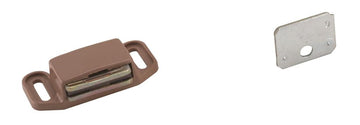 Amerock
Functional Hardware Magnetic Catch BP3473Tan
$1.53
$1.80 -
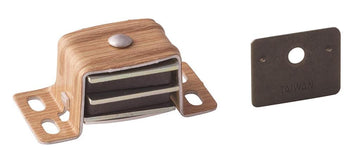 Amerock
Functional Hardware Wood Grain Magnetic Catch BP9798AW
$6.63
$7.80 -
 Top Knobs
Additions Cabinet Latch 2 Inch Honey Bronze M2225
$31.37
$34.85 -
 Amerock
Functional Hardware Nickel Roller Catch BP347414
$1.53
$1.80 -
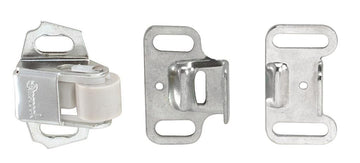 Amerock
Functional Hardware Zinc Roller Catch BP98232G
$3.60
$4.23 -
 Hardware Resources
15 lb Double Magnetic Catch Brown/Bronze, Retail Pack 50622-R
$1.52
$1.68


Start with the hinge, not the catch
Most kitchens built in the last few decades run concealed European hinges: a cup pressed into a round bore in the door, an arm screwed to the cabinet side. Those hinges come sprung, soft-close, or free-swinging, and the first two pull the door closed and hold it there without help. If that is what you have, a catch is a second mechanism fighting the first: the door already wants to be shut, and now you break a magnet loose every time you want a bowl.
The cabinets that genuinely want a catch are the ones with hinges that do nothing once the door is moving. Older face-frame cabinets with unsprung surface-mount or wrap-around hinges, butt hinges on a built-in, almost any inset door, and freestanding furniture or glass-front cases. The test I use before ordering anything: close the door and let go. If it drifts back open a quarter inch and sits there, you need a catch. If it swings wide, you have a bigger problem than a catch.
Four reasons a door swings open, and only one of them a catch fixes
This is the part that gets skipped, and it is why I ask two questions before recommending anything. A door that will not stay shut is telling you one of four things.
- The hinge screws have let go. Screws into particleboard or the edge of an MDF door strip out with use, and the door drops a hair. Every fix downstream is wasted until those are solid.
- The door or the case has moved. Cabinets racked during install, a settled floor, a heavy door on light hinges. The door and the frame are no longer parallel, so nothing meets where it used to. We have a separate walkthrough for a door that has sagged.
- Something inside is pushing. A shelf loaded past the door line, a stack of storage containers, a bin sitting proud. The door is not failing; it is being held open from the inside.
- The hinge has no spring, and never did. This is the only one a catch is designed to solve, and it is the only one where buying hardware is the right first move.
A magnet on a sagging door gives you a sagging door you now have to yank. I would rather sell nothing and have someone tighten four screws.
The five types, and what each is actually good at
Once a catch is the right answer, the choice narrows fast. These are not one product in different shapes; each solves a different tolerance problem.
| Type | Holds by | Tolerates a door slightly out of line | Belongs on | Watch for |
|---|---|---|---|---|
| Magnetic catch | A magnet pulling a steel strike | Some, as long as the two faces still meet | Face-frame doors with unsprung hinges, most retrofits | Holding force drops off sharply across an air gap, so the strike has to arrive touching |
| Roller catch | A sprung roller riding into a slot | The most of any type; it steers the door in | Older cabinets, doors that no longer sit square | Springs and rollers wear, so the grip drifts over years |
| Ball or bullet catch | A sprung ball dropping into a dimpled strike | Very little; the drilling has to be right | Inset doors and furniture, where nothing should show | It lives in a bore in the door edge, so there is no second attempt |
| Friction or elbow catch | A sprung tongue gripping a strike | Moderate, and the tension usually adjusts | Utility, garage, shop and basement cabinets | The loudest of the group and the most visible from inside |
| Touch or push latch | A sprung plunger the door presses to release | Low; the depth setting decides everything | Handleless doors with no pull at all | Needs room to travel inward and a hinge with no damper |
If I had to hand one to somebody with an old face-frame kitchen and no diagnosis, it would be a roller catch, not a magnet, which is the reverse of what most guides say. The magnet is quieter and easier to fit, and on a door that closes squarely it is the better piece. But the doors that need a catch are usually the doors that no longer close squarely, and a roller physically pulls the edge into place while a magnet only grabs what happens to land in front of it. The tradeoff is noise and life span: rollers click, and moving parts eventually stop gripping the way they did.
Position beats product
Where you mount it does more for the result than which one you buy, and I would rather someone fit a plain magnet in the right place than anything else in the wrong one. Two rules cover it.
Put the catch on the side away from the hinge, as far from the hinge as the cabinet allows, ideally close to the same height as the pull. A door is a lever. The hold at the far edge is what you feel at the handle, and a catch fitted near the middle of a wide door gives you a door that fights you at the handle and still gapes at the corner. On a tall pantry door, one catch set near the height of the knob beats two spread top and bottom; the pair makes you break both at once, which racks the door and loosens the very screws you just tightened.
Second, a magnetic catch needs a ferrous strike screwed to the door, so a glass door in a wooden frame is fine and a frameless glass door is not. Inset doors are the other special case: with a knob on an inset door, a ball catch in the top edge is the traditional answer and leaves the inside of the cabinet completely clean.
Push latches and soft-close hinges cancel each other out
This one costs people a whole order, and I hear about it more than any other mistake on handleless runs. A push latch works by storing energy when the door is pressed and throwing the door back out at you. A soft-close hinge exists to absorb exactly that kind of energy. Put them on the same door and the door sinks open an inch and stops, and you end up prying at an edge that was designed to have nothing to pry.
Hinge makers sell undamped hinges for push-to-open doors, so match the hinge to the latch while you plan a handleless run, not after. Check the hinges before the latch. The same door also needs somewhere for a fingertip once the latch stops working, which is why a lot of push-to-open kitchens quietly end up with edge pulls on the tall units where the mechanism gets the most use.
Fitting one so it lines up on the first try
Almost every complaint I get about catches and latches is really a complaint about alignment, and the sequence that avoids it is the same for magnets, rollers and friction catches. Mount the body inside the cabinet first, on the shelf or the frame, using the middle of its slotted holes so you keep adjustment in both directions. Then hold the strike loosely against the body, close the door onto it, and mark through the strike's holes with the door shut. The door tells you where the strike goes; you are not measuring for it.
Two details save a second trip. Snug the screws until the parts stop moving, work the door a dozen times, then tighten fully, because a slotted plate migrates a little and settles where it wants. And on any catch that has adjustable tension, set it as light as will hold. People overtighten out of caution, and an overtightened roller or friction catch pulls hinge screws loose over a season, which puts you back where this started.
Cabinet door latch types: is a latch the same thing as a catch?
Not quite, and the difference is worth knowing before you order. A catch holds a door closed by magnetism or friction and releases the moment you pull hard enough, so the door itself needs no mechanism. A latch has a part that has to be actuated to release it, by pressing the door, turning a lever or pushing a button. The two words get used loosely and the products sit on the same shelf, but if it releases by pulling it is a catch, and if it releases by doing something first it is a latch.
Cabinet door catch types: which one is quietest?
A magnetic catch, by a wide margin, which is why it took over kitchens. No spring and no moving part, so the only sound is the strike meeting the magnet, and a strike faced in plastic or rubber softens even that. Roller and ball catches click twice, going in and coming out, and friction catches are louder still. Near a bedroom or a home office, the magnet is worth the alignment fuss it demands.
Shop Catches & Latches
-
 Additions Cabinet Latch 2 Inch Honey Bronze M2225
$31.37
-
 Transcend Cabinet Latch 1 15/16''
$23.63
-
 Black Magnetic Touch Latch 506L2
$0.83
-
 15 lb Black Single Magnetic Catch Bulk Pack 50637
$0.89
-
 Functional Hardware Zinc Double Roller Catch 143
$1.37
-
 15 lb. White Single Magnetic Catch with Polished Brass Strike and Screws 50633
$96.30
-
 15 lb. Brown Single Magnetic Catch with Bronze Strike and Screws 50632
$96.30
-
 Functional Hardware Wood Grain Magnetic Catch BP9798AW
$6.63


Browse all 63 in Catches & Latches → Cabinet knobs Cabinet pulls & handles