

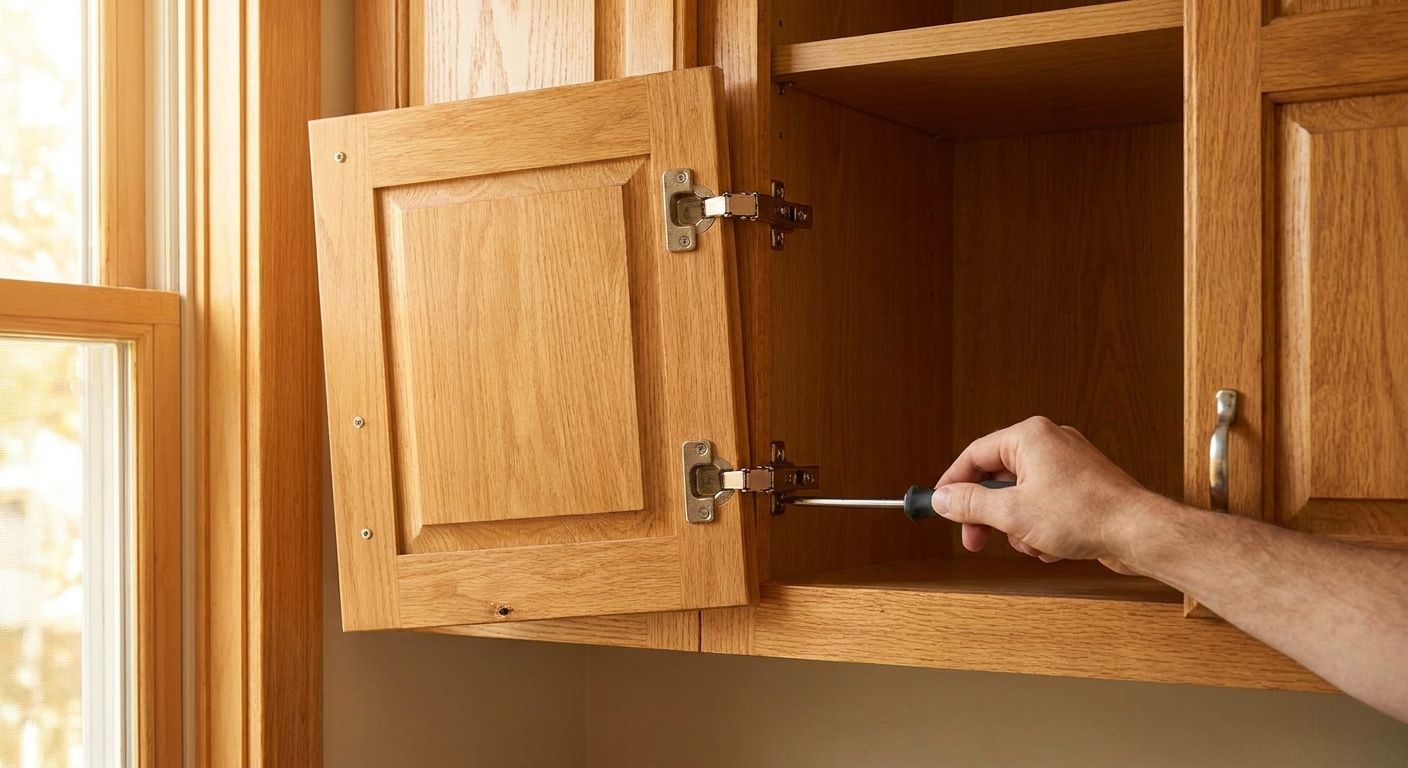
A sagging cabinet door is almost never the door's fault. Something holding it up has failed — a stripped screw, a worn hinge pivot, or a concealed hinge that's drifted out of adjustment — and the fix is usually a 15 to 30 minute job with parts you can buy same-day. The one case where the door itself is the problem is a warped or bowed panel, and that's the one scenario where tightening anything won't help.
Shop the finish
Every antique brass knob and pull we carry, in one place — filter by size, style, and brand.
Browse Antique Brass Cabinet Hardware →- Stripped screw holes cause most sagging cabinet doors — fix with wood filler and a slightly larger screw, not a longer one.
- European concealed hinges have 3 adjustment screws (height, depth, angle) that fix drift before you touch a drill.
- A worn hinge pivot won't re-tighten permanently — replace the hinge instead of chasing the same screw hole.
- A warped MDF or thin-ply door needs replacement, not a hinge fix, no matter how many screws you swap in 2026.
Why This Matters
A door that sags an eighth of an inch doesn't just look wrong — it stops closing flush, stops latching, and starts rubbing against the cabinet frame every time it swings. Left alone through 2026, that rubbing accelerates the wear on the hinge and the finish on the door edge, turning a five-dollar fix into a full hinge and door replacement.
Most sagging complaints trace back to one of three things: a screw that's lost its grip in the particle board or MDF cabinet box, a hinge whose pivot pin has worn loose from years of opening and closing, or a concealed hinge that simply needs choosing the right cabinet hinge re-checked and adjusted. Figure out which one you're dealing with before you buy anything.
How to Fix a Sagging Cabinet Door
Work through these steps in order — most doors get fixed at step 2 or 3 without needing a new hinge.
- Open the door and check the screws by hand. If any screw spins freely or the hinge plate wiggles, that's your stripped hole — skip to the stripped-screw section below.
- Look for adjustment screws on the hinge itself. Most modern cabinets use European concealed hinges with two or three small screws on the hinge body. If you see them, adjust before you replace anything.
- Check the pivot for play. Grab the door and gently push up and down at the hinge. If the hinge barrel itself flexes or clicks, the pivot is worn and the hinge needs replacing, not adjusting.
- Inspect the door for warping. Lay a straightedge across the panel. A gap of more than a sliver at the corners means the door itself has bowed — hinge work won't correct that.
- Test the fix by cycling the door 10 times. A proper repair holds through repeated opening; a temporary one starts drooping again within a few cycles.
Sagging Cabinet Door Fixes by Cause
| Symptom | Likely Cause | Fix | Verdict |
|---|---|---|---|
| Door drops on the hinge side | Stripped screw hole | Fill with wood filler or glued matchsticks, re-drive with a slightly larger screw | Fix now |
| Won't latch or sits crooked | Worn hinge pivot | Replace the hinge | Replace |
| Gap uneven top to bottom, hinges feel solid | Concealed hinge out of adjustment | Turn the height, depth, and angle screws on the hinge body | Adjust |
| Door bows, twists, or won't sit flat on a table | Warped panel (common on thin MDF or veneer doors) | Replace the door — hinge work won't fix warping | Skip hinge fix |
Stripped Screw Holes: The Most Common Fix
This is the repair behind most sagging-door calls. Cabinet boxes are usually particle board or MDF, and both materials chew out around a screw thread faster than solid wood after repeated stress from a heavy door.
The fix: back the screw out, pack the hole with wood filler or a few wood glue-coated toothpicks, let it set, and re-drive the original screw or the next size up. Going one screw size larger — the difference between a common small wood screw and the next gauge up — gives the threads fresh material to grip instead of chasing the same stripped hole. This holds through 2026 and beyond as long as the hole itself isn't blown out to more than double its original diameter; if it is, a hinge repair plate is the better move.
Worn or Broken Hinges: When to Replace
If the screws are tight and the door still sags, the hinge itself has worn out. Hinge pivots are metal-on-metal and wear down with years of daily opening — there's no adjustment that fixes a worn pivot, only a new hinge.
Swap both hinges on the door, not just the failing one, so the door hangs evenly on new hardware instead of one new pivot and one worn one. Match the hinge type — face-frame, inset, or European concealed — to what's already on the cabinet, since mismatched hinge styles rarely mount cleanly on the existing screw pattern.
Warped or Misaligned Doors: Adjustment vs. Replacement
European concealed hinges are built for exactly this problem. Each hinge typically carries three adjustment screws controlling height (up/down), depth (in/out), and side-to-side angle. A door that sags unevenly but has solid hinges usually just needs those three screws turned a quarter-turn at a time until the gap runs even top to bottom.
A warped door is a different story. If the panel itself bows — common on thin MDF doors that have sat near a dishwasher or a sunny window for years — no hinge adjustment corrects it. The verdict: replace the door, and while it's off, this is the moment to also reconsider whether the screw length matches the door thickness.
Why Cabinet Doors Sag
- Screw holes stripped from repeated weight cycling — the most common driver, especially on particle-board or MDF cabinet boxes.
- Worn hinge pivots on cheaper stamped hinges that see years of daily use.
- Door weight exceeding what the original hinge was sized for — heavier solid-wood or glass-front doors need more support than a light MDF panel.
- Humidity and wood movement, which slowly shifts screw grip in solid wood cabinet boxes.
- A concealed hinge that was never fully adjusted after the original cabinet install.
- Moisture absorption in MDF-core doors, which causes the bowing that no hinge fix corrects.


FAQ
How do you fix a sagging cabinet door?
Most sagging cabinet doors are fixed by reinforcing a stripped screw hole with wood filler and a larger screw, or by turning the height, depth, and angle screws on a European concealed hinge. If the hinge pivot itself is worn, replace the hinge instead of re-tightening it.
Why is my cabinet door sagging on one side?
One-sided sagging almost always means the top or bottom hinge has a stripped screw or a worn pivot while the other hinge is still holding. Check both hinges by hand — if one wiggles and the other feels solid, you've found the failing one.
Can you tighten a cabinet hinge without replacing it?
Yes, if the screw hole isn't stripped and the hinge pivot isn't worn — simply re-driving the screws or adjusting a concealed hinge's screws often solves it. If the hinge barrel itself flexes when you push on the door, tightening won't hold and the hinge needs replacing.
Is a sagging cabinet door always a hinge problem?
No — a warped or bowed door panel, common on thin MDF or veneer doors exposed to moisture, causes the same sagging look but no hinge fix corrects it. Lay a straightedge across the door to check for bowing before assuming it's a hinge issue.
How many adjustment screws does a concealed cabinet hinge have?
Most European concealed hinges have three adjustment screws controlling height, depth, and side-to-side angle. Turning these a quarter-turn at a time is usually enough to correct an uneven gap without removing the hinge.
What screw size fixes a stripped cabinet hinge hole?
Going one screw gauge larger than the original — rather than just longer — gives the threads fresh material to bite into a stripped hole. Combine it with wood filler or glued toothpicks packed into the hole first for a repair that holds.
When should you replace a cabinet hinge instead of repairing it?
Replace the hinge when the pivot itself has play or the hinge plate is bent — no adjustment or screw fix corrects worn metal. Swap both hinges on the door at once so it hangs evenly on matched hardware.
One Last Thing
The repair most people skip is swapping both hinges instead of just the one that failed. A door hung on one new hinge and one worn one from 2020 or earlier will sag again within a year, because the old hinge is still carrying most of the door's weight and wearing out faster under the extra load. Replace the pair, and check the screw length for cabinet hardware while the door is off — it's the fastest way to make sure the next sag doesn't show up in 2027.


