

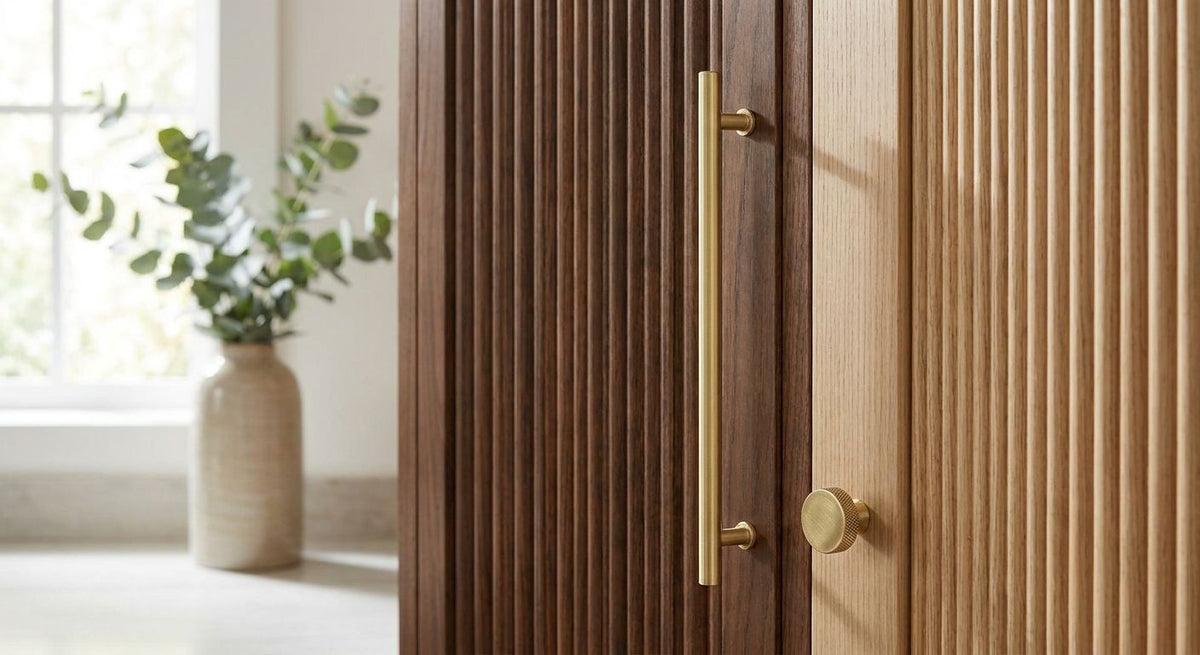
Fluted and reeded cabinet doors turn a flat kitchen or vanity front into a run of vertical grooves, and the wrong pull or knob flattens that texture instead of framing it. This guide names the exact hardware to put on grooved millwork in 2026, what to skip, and how fluted (concave grooves) and reeded (convex ridges) fronts actually change your hardware math.
Shop the finish
Every bronze knob and pull we carry, in one place — filter by size, style, and brand.
Browse Bronze Cabinet Hardware →- Top Knobs' Chareau reeded pull is the safest match for fluted cabinet doors hardware in 2026 — buy it for oak, walnut or painted reeded fronts.
- Skip long appliance-length pull bars with ornate backplates; they compete with fine vertical grooves instead of framing them.
- A plain round knob, like the Portobello Road knob, reads quieter than a pull on tight reed spacing — consider it for narrow stiles.
- Flush tab pulls under 4 inches, like the Top Knobs Mercer Europa, sit cleanest on frameless fluted cabinet doors.
Why this matters
Fluted and reeded millwork is one of the fastest-growing cabinet door styles heading into 2026, and it punishes generic hardware choices in a way flat shaker doors never did. A wide backplate or an oversized bar pull reads as clutter against vertical grooves; a well-placed flush pull or plain knob reads as intentional. Knobs.co's cabinet hardware catalog stocks the pulls, knobs and finishes that hold up against grooved millwork, and free samples let you hold a finish next to your actual door before you commit to a full kitchen's worth.
The stakes are higher on reeded and fluted fronts than on flat ones because every pull sits on top of a pattern that's already doing visual work. Pick wrong and the hardware fights the door instead of finishing it.
Who this is for
This is written for homeowners installing new fluted or reeded cabinet fronts on a kitchen or bathroom vanity, and for designers and contractors specifying hardware across a run of grooved doors where consistency matters more than any single pull. If you're choosing between three knob options for one project, or between forty for a multi-unit remodel, the criteria below hold up either way.
What to look for in fluted and reeded cabinet hardware
Profile height and stand-off
A pull with a deep stand-off casts a shadow that adds a second visual rhythm on top of the grooves, which usually looks busy rather than layered. Flatter, low-profile pulls sit closer to the door face and let the fluting or reeding stay the dominant texture. This matters most on doors with tight, repetitive ridges, where every extra shadow line competes for attention.
Finish warmth versus contrast
Warm finishes — honey bronze, brushed brass, champagne bronze — pick up the grain shadows already present in fluted wood doors and read as continuous with the millwork. Matte black or dark bronze does the opposite: it draws a hard line against the grooves and works better when the fluting is on a painted or MDF door rather than stained wood. Decide this before you order, because switching finish mid-project on a run of ten or twenty doors gets expensive fast.
Backplate footprint
A pull or knob with its own decorative backplate adds a second pattern directly on top of the door's first pattern. On flat shaker doors that layering can look intentional; on fluted or reeded doors it almost always looks crowded. Hardware with no backplate, or a backplate the same width as the pull post, keeps the reeding as the only pattern doing the talking.
Hole spacing against the reed pattern
Reeded and fluted doors have a fixed rhythm of ridges running the height of the door, and pull screws need to land in the flat rail or stile, not straddle a groove. Measure your reed spacing before ordering a specific pull length so the mounting holes fall cleanly between ridges rather than forcing an off-center placement.
Texture continuity: match or go quiet
You have two honest options on a fluted or reeded door: pick hardware with its own subtle ribbing to echo the millwork, or pick something plain and let the door do all the textural work. The mistake is landing in between — a moderately ornate knob that's neither quiet enough to disappear nor textural enough to feel intentional.
Top picks for fluted and reeded cabinet doors
Top Knobs Chareau Reeded Pull, 9-inch — the textural echo. This pull carries its own reeded barrel, so it repeats the door's ridge pattern instead of sitting against it as a flat contrast. The 9-inch length spans a standard drawer front without needing a second pull, and the reeded surface hides fingerprints better than a smooth bar. On a stained oak or walnut reeded door, this is the pick that looks specified rather than default. Verdict: Buy for any project where the door's ridges are the main design statement.
Portobello Road Knob, plain — the safe pick. No backplate, no ornamentation, just a round profile that reads quiet against fluted or reeded stiles. It's the right call when the door itself is the star and you don't want the hardware competing for attention, especially on narrow cabinet doors where a pull's mounting holes would land too close to a groove. Verdict: Buy for narrow stiles and painted fluted fronts.
Top Knobs Mercer Europa Tab Pull, 4-inch — the flush minimalist. At 4 inches, this tab pull is short enough to fit between tight reed spacing without forcing an awkward hole layout, and its flush, squared profile keeps stand-off shadow to a minimum. It leans modern, which pairs best with fluted MDF or painted doors rather than heavily grained wood. Verdict: Consider for frameless, flat-front kitchens with fluted accent panels.


What to avoid
- Long appliance-length pull bars in bright, polished finishes. A 12-inch or longer bar in a mirror-bright gold or chrome reads as a second, competing line against fine vertical grooves. Save bar pulls that long for flat panels.
- Knobs with their own decorative backplate. A rosette or filigree backplate adds a pattern on top of a pattern. It works on plain shaker doors; on reeded or fluted doors it almost always looks busy.
- Mismatched hole spacing. Ordering a pull length before measuring reed spacing is the single most common mistake on this door style, and it forces off-center mounting that's visible from across the room.
Verdict comparison
| Pick | Best for | Profile | Finish direction | Verdict |
|---|---|---|---|---|
| Top Knobs Chareau Reeded Pull, 9-inch | Stained wood reeded doors | Reeded barrel, low stand-off | Warm bronze, brass | Buy |
| Portobello Road Knob, plain | Narrow stiles, painted fluted doors | Round, no backplate | Any — reads quiet | Buy |
| Top Knobs Mercer Europa Tab Pull, 4-inch | Frameless, flat-front kitchens | Flush tab, squared | Cool or warm metals | Consider |
FAQ
What's the best pull for fluted cabinet doors?
A low-profile pull with no backplate, like the Top Knobs Chareau reeded pull, works best because it echoes the door's ridges instead of adding a competing pattern. Flush tab pulls are the next-best option for frameless or painted fluted fronts.
Should cabinet hardware match or contrast with reeded doors?
Either works, but committing fully to one approach matters more than which you pick. A reeded pull that echoes the grooves reads as intentional, and so does a plain knob that stays quiet — a middle-ground ornate knob usually looks like an afterthought.
Is a knob or a pull better for fluted cabinet doors?
Knobs work better on narrow stiles and doors where mounting a longer pull would land too close to a groove. Pulls work better on wider drawer fronts where a 9-inch reeded pull has room to sit centered between ridges.
Can a pull sit directly over a reeded groove?
No — mounting screws need to land in the flat rail or stile between ridges, not straddle a groove. Measure your door's reed spacing before ordering a specific pull length to avoid an off-center hole.
What finish works best with natural wood fluted doors?
Warm finishes like honey bronze, brushed brass, and champagne bronze pick up the same warmth already in stained wood grain. Matte black or dark bronze works better on painted or MDF fluted doors where you want the hardware to contrast rather than blend.
Do fluted cabinet doors need special hinges?
Standard concealed European hinges work on most fluted and reeded doors as long as the boring point falls on a flat section of the stile, not on a groove. Check hinge placement against your specific reed pattern before drilling.
Are reeded and fluted cabinet doors a lasting design choice in 2026?
They've held steady as a kitchen and vanity trend well into 2026 rather than fading after one season, largely because the texture works across traditional and modern kitchens alike. The hardware choice is what dates a project faster than the door style itself.
How do you keep pull spacing consistent across a run of fluted doors?
Use the same pull length and the same hole-center measurement on every door in the run, and confirm that measurement against your narrowest door's reed spacing first. Consistency across ten or twenty doors matters more than optimizing each one individually.
One last thing
The detail that trips up most reeded-door projects isn't the pull at all — it's ordering hardware before confirming reed spacing on the actual doors, not the spec sheet. Doors from different mills cut reeding at slightly different intervals, and a pull that centers perfectly on a sample can land a half-inch off on the real thing. Order a sample, hold it against your actual door, then commit to the full run.


