

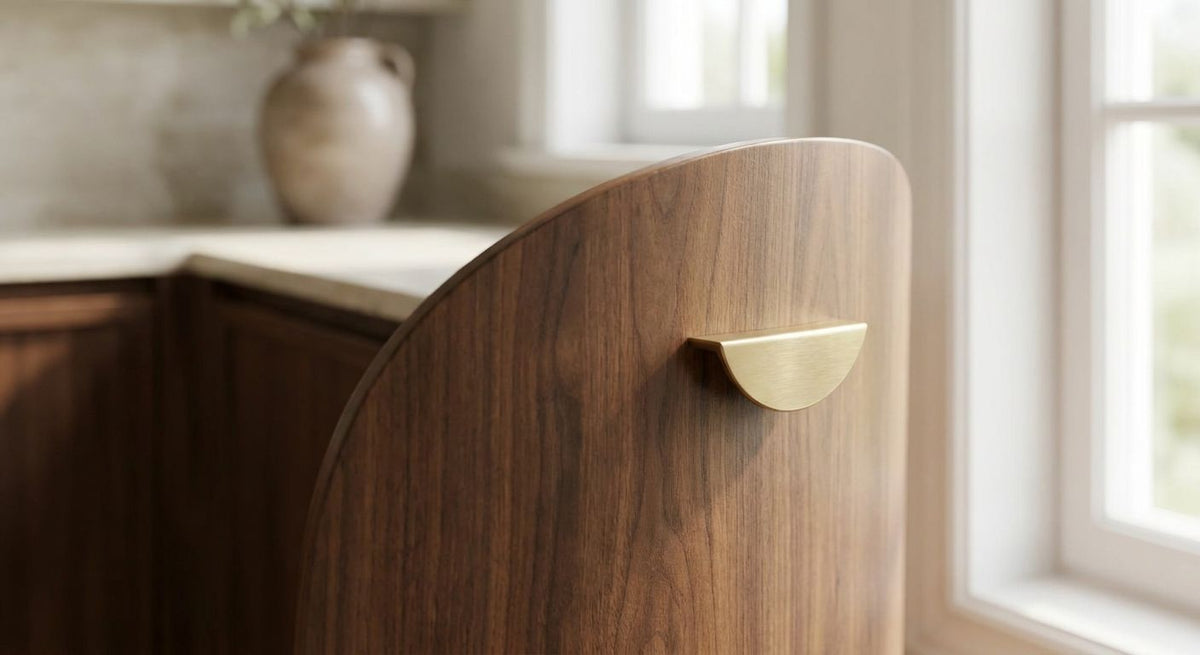
Curved and radius cabinet fronts — bowed doors, bombe drawer faces, arched pantry ends — reject flat hardware the same way a round peg rejects a square hole. This guide breaks down which curved cabinet pulls actually sit flush in 2026 and which ones leave a visible gap the day you install them.
- Curved cabinet pulls need single-point or swivel-post mounts; the Portobello Road Knob Plain is the safe buy for radius fronts in 2026.
- Wire pulls with independent swivel posts, like Berenson's 96mm Advantage pull, flex better on curved cabinet fronts than rigid bars.
- Skip appliance-length bar pulls and mortised cup pulls on curved fronts — both need a flat plane they can't get.
- Knurled bar pulls under 4 inches work on gentle curves only; past a shallow bow they rock and gap.
Why this matters
Most pull hardware is engineered for flat overlay or inset doors. Two mounting screws, a flat backplate or bar resting against a flat surface — that's the entire design assumption behind 90% of cabinet pulls sold today. Put that same bar pull on a bowed, arched, or bombe-front cabinet and the ends lift off the wood while the center bears all the pressure. Over a few months of daily use, that flex loosens screws and cracks finish.
Curved cabinet fronts showed up more in kitchen and bath designs through 2026 as more homeowners moved away from flat-front minimalism toward furniture-style cabinetry. If you're specifying hardware and haven't checked mounting geometry against the door's curve, get a sizing baseline first — choosing the right cabinet knob size covers the measurement basics before you touch a curved front. Knobs.co carries pulls and knobs from dozens of brands, and the mounting geometry, not the finish, is what decides whether a piece works on your radius.
Who this is for
This is for anyone specifying or buying hardware for a curved kitchen island, an arched pantry door, a bombe-front dresser, or any cabinet face with visible bow instead of a dead-flat plane. That covers homeowners doing a single custom piece and interior designers or contractors ordering hardware across a full radius-front kitchen run. If every door in your project is flat overlay, this guide doesn't apply — go straight to standard bar pulls.
What to look for in curved cabinet pulls
Mounting geometry
A single center screw (a knob) never fights a curve because there's only one contact point. A two-screw pull only works if the hardware's feet can independently seat against an uneven plane — which means swivel posts, not a rigid backplate. Check this before finish, before style, before anything else.
Post or leg length
On a bowed door, the center of the curve sits proud or recessed relative to the edges. Pulls with adjustable or independently-seating posts absorb that difference; pulls with a fixed rigid spine do not. A quarter-inch of bow across a 6-inch pull is enough to create a visible rocking motion.
Backplate size
Any backplate larger than roughly 1 to 1.5 inches across starts to fight a curve because it needs full-surface contact to look intentional. Small backplates under a knob, like the kind found on traditional pewter or bronze knobs, tolerate a gentle curve far better than an oversized decorative plate.
Pull length versus curve severity
The tighter the radius, the shorter the pull needs to be. A 3-inch pull rides a gentle bow fine. A 12-inch or 24-inch appliance pull spanning the same curve will show daylight at both ends by the time you step back to look at it.
Finish consistency across knob and pull styles
Most curved-front projects mix knobs on doors with pulls on drawers, so match finish family (satin aluminum, honey bronze, pewter antique) rather than exact hardware line. Knobs.co stocks matching finishes across brands specifically so a curved-door knob and a flat-drawer pull don't clash.
Screw length tolerance
Curved fronts are often thicker at the center than at the edges once you account for the door's core material. Confirm screw length works across that variance before ordering in bulk, especially on a multi-door kitchen.
Top picks for curved and radius cabinet fronts
The safe pick: Portobello Road Knob Plain. Single-screw mount, no backplate to fight the curve, and a compact profile that reads clean on anything from a shallow bow to a tighter bombe front. This is the default answer when a client asks what actually works on curved cabinetry, because a knob physically cannot rock the way a two-point pull can. Verdict: Buy.
The modern flex pick: Berenson Advantage Wire Pull, 96mm center-to-center, satin aluminum. Wire pulls mount on independent swivel posts rather than a rigid spine, so each end seats to the surface on its own instead of bridging a flat plane across the whole span. At 96mm center-to-center, it's short enough to sit comfortably across a gentle-to-moderate curve without visible gapping. Verdict: Buy.
The wildcard: Alno Vita Bella Knurled Bar Pull, 3 inch. Short, cylindrical, knurled-grip body that behaves almost like an oversized knob because of its length. It works on gentle curves and gives a heavier, more tactile feel than a plain knob, but push it onto a tighter radius and the rigid bar starts to rock at the ends. Verdict: Consider — gentle curves only.
“If the pull needs two flat mounting points, it's fighting the curve, not fitting it.”
A traditional knob-with-backplate option, like a 1-1/4 inch pewter antique backplate style, can still work on a very shallow bow — but the larger the decorative plate, the more it needs a flat surface it won't get on a real radius front. Treat backplated knobs as a case-by-case call, not a default, on curved cabinetry in 2026.
What to avoid
- Long bar and appliance pulls (12 inches to 24-plus inches). These are built for flat panels. Stretched across a curve, the center bows toward the door while the ends lift, and no amount of shimming fixes it permanently.
- Cup pulls and mortised pulls. These require a flat mortise cut into the door face. On a curved front, the mortise depth changes across the pull's width, which either weakens the wood or leaves the hardware sitting crooked.
- Oversized decorative backplates. Anything wider than roughly 1.5 inches needs full-surface contact to look right. On a bowed door it creates a visible shadow gap at the plate's edges within the first year.
Curved cabinet pull comparison
| Hardware type | Mount style | Curve tolerance | Key spec | Verdict |
|---|---|---|---|---|
| Portobello Road Knob Plain | Single center screw | Tight radius to bombe fronts | Compact single-point profile | Buy |
| Berenson Advantage Wire Pull | Two swivel posts | Gentle to moderate curve | 96mm center-to-center | Buy |
| Alno Vita Bella Knurled Bar Pull | Rigid short bar | Gentle curve only | 3-inch knurled body | Consider |
| Long bar / appliance pulls | Rigid long bar | Flat fronts only | 12 to 24-plus inches | Skip |
| Cup / mortised pulls | Recessed mortise | Flat fronts only | Requires uniform mortise depth | Skip |
FAQ
What's the best cabinet pull for curved cabinet fronts?
Single-screw knobs are the safest choice for curved cabinet fronts in 2026 because they have one contact point and can't rock across a bow. Wire pulls with independent swivel posts are the best two-point option when a longer pull is required.
Can you put a bar pull on a curved cabinet door?
Short bar pulls under about 4 inches can work on a gentle curve, but anything longer than that will rock or gap at the ends. Appliance-length bar pulls of 12 inches or more should be reserved for flat fronts only.
Are wire pulls good for radius cabinets?
Yes, wire pulls with independently swiveling mounting posts are one of the better two-point options for radius cabinets because each post seats to the surface on its own. A 96mm center-to-center wire pull handles a gentle-to-moderate bow without visible gapping.
Do backplates work on curved cabinet doors?
Small backplates under about 1.5 inches can work on a shallow curve, but larger decorative backplates need a flat surface to sit correctly. On a pronounced bow or bombe front, oversized backplates create a visible shadow gap within months.
How do you measure a curved cabinet front for hardware placement?
Measure the door's flattest point near the intended mounting location, then check screw length against the door's thickness at both the center and edge of the curve. A sizing guide for standard knob dimensions is a useful starting reference before adjusting for curvature.
Is it cheaper to use knobs instead of pulls on curved cabinets?
Knobs and pulls are priced similarly within the same finish and brand tier, so cost isn't usually the deciding factor. The real savings comes from avoiding a full re-order after a rigid pull fails to seat properly on a curved door.
What finish works best for curved cabinet hardware?
Any finish works mechanically since the curve issue is about mounting geometry, not finish. Match the finish family — satin aluminum, honey bronze, pewter antique — across your curved-door knobs and flat-drawer pulls so the hardware reads as one coordinated set.
Why do bar pulls rock on curved cabinet fronts?
Bar pulls have a rigid spine designed to bridge two flat mounting points at a fixed distance. On a curved door, the surface height changes between those two points, so the bar contacts the wood at the center but lifts at the ends.
One last thing
The cheapest fix for a curved-front project isn't a specialty pull — it's switching the whole run to knobs and reserving pulls only for flat drawer faces on the same piece. Most radius-front kitchens built in 2026 mix both for exactly this reason: knobs on the curved doors, standard pulls on the flat drawers below them. It looks intentional, not compromised, and it means one hardware failure mode instead of two.


