

Cabinet Hardware for Olive Green Cabinets: Brighter Than the Doors
Olive and warm brass share the same yellow, so the real risk is sameness, not a clash. Keep the metal brighter than the paint.

The cabinet hardware I specify most often for olive green cabinets is a brass that holds its color: brushed or satin brass, lacquered or PVD rather than bare. Olive already contains what warm metal contains, yellow and brown, so the danger on these doors is not a clash. It is sameness, and the usual advice to match olive with an aged or antique brass walks straight into it. Two things change the answer. If the room carries a stainless range, hood and refrigerator as well as a stainless faucet, brass pulls become the one warm object in a cool kitchen, and a gray metal with warmth in it is the better buy. And if the olive sits under golden oak uppers, brass finishes a sentence those two colors have already started.
Shop the finish
Every olive green knob and pull we carry, in one place — filter by size, style, and brand.
Browse Olive Green Cabinet Hardware →Shop the picks from this guide
In stock at Knobs.co · Free shipping on hardware orders $99+ · 110% price match
-
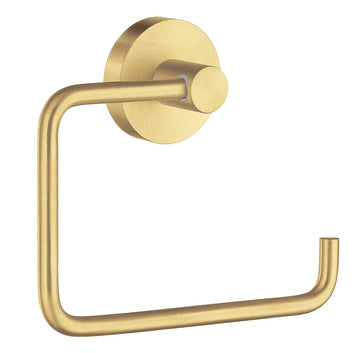 Smedbo
Home Toilet Roll Holder Brushed Brass HV341
Smedbo
Home Toilet Roll Holder Brushed Brass HV341
$126.00
$140.00 -
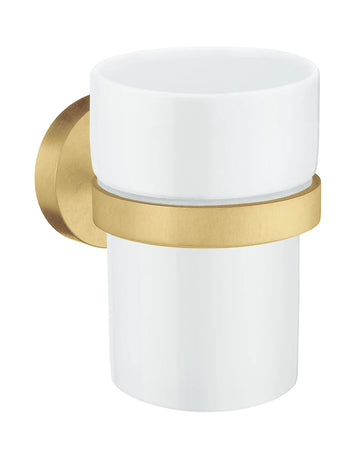 Smedbo
Home Holder With Tumbler Br Brass/Porcelain HV343P
Smedbo
Home Holder With Tumbler Br Brass/Porcelain HV343P
$153.00
$170.00 -
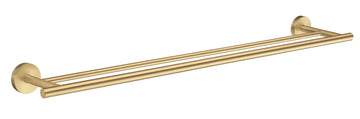 Smedbo
Home Double Towel Rail Brushed Brass HV3364
Smedbo
Home Double Towel Rail Brushed Brass HV3364
$326.70
$363.00 -
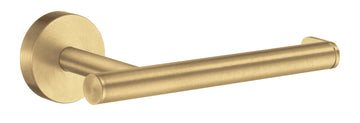 Smedbo
Home Toilet Roll Holder Brushed Brass HV3411
Smedbo
Home Toilet Roll Holder Brushed Brass HV3411
$142.21
$158.00 -
 Century Hardware
Kai 6-5/16 inches (160mm) cc Square Bar PullPolished Nickel
Century Hardware
Kai 6-5/16 inches (160mm) cc Square Bar PullPolished Nickel
$18.00
$20.00 -
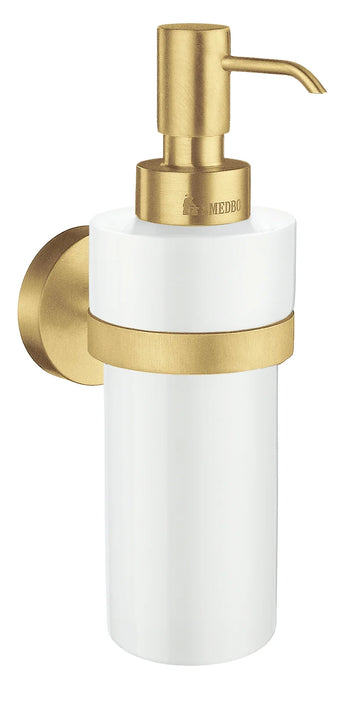 Smedbo
Home Soap Dispenser Br Brass/Porcelain HV369P
Smedbo
Home Soap Dispenser Br Brass/Porcelain HV369P
$307.80
$342.00

Olive is a green with yellow in it, and the yellow is what you are choosing against
Olive is the green I get asked about most, and the question nearly always arrives framed as warm metal versus cool metal, which is the wrong axis for this particular green. Sage is green with gray in it. Forest and hunter are green with blue in them, which is why they sit in a room the way charcoal does and take any metal you hand them. Olive is green with yellow and brown in it, so it behaves less like a neutral than the other dark greens and more like a color with opinions. It gives that color to whatever is screwed onto it.
The standard advice on olive, repeated by nearly every design site that covers the color, is to reach for a warm or aged brass because the undertones match. They do share undertones. That is the risk, not the reason. Put a low, brownish gold against a low, brownish green and the pull stops being hardware and becomes a slightly shinier patch of door. The fix is not to swap sides and go cool. It is to keep the warmth and take the metal up in brightness, so brushed brass separates from the paint instead of settling into it. In a consultation I tape the sample to a door and then send the homeowner to the far side of the room, because the mistake gets made at arm's length and shows up at ten feet. If you can find the pull without hunting for it, you have enough separation. If you cannot, go brighter or go longer before you go cooler.
Count the stainless in the room before you count the greens
Hardware normally gets chosen to agree with the faucet, and that is a sound instinct. On olive it is sound and incomplete, because a faucet is rarely the only cool metal in the room. Count what is already there and how much surface it covers. A lone stainless faucet at the sink is one object at eye level, and brass hardware next to it reads as a mix nobody questions. A stainless range, a stainless hood, a stainless refrigerator and a stainless faucet are four cool objects with real area, and three of them stand directly against the base cabinets, which is where olive usually lives.
In that kitchen I move people off brass and onto pewter. Pewter is a gray with warmth in it, so it does not go blue against a yellow green the way chrome does, and it sits closer to the appliances than brass ever will. Brushed nickel does the same job a little brighter. What either one costs you is the glow that made you want olive cabinets in the first place; a gray metal keeps olive looking like a color choice rather than a whole room temperature. That is a real loss and worth it when four stainless boxes are outvoting you.
Bare brass does not stay where you bought it
Unlacquered brass is raw brass with nothing over it, and handling darkens it. On most cabinet colors that is the whole point of the finish and the reason to pay for it. On olive it is a slow move in the wrong direction, because the pull you picked for being brighter than the doors spends its first few years getting closer to them. I have no argument with the finish itself, and I have specified plenty of it. On olive I want it bought with open eyes: start brighter and larger than you otherwise would, and expect the kitchen to read differently in year three.
If you want the hardware to look in five years the way it looks the week it arrives, buy a coated brass. PVD is the most wear-resistant of the plating methods; lacquer holds its color until it wears through at the contact points, which on a kitchen means the drawer bank under the cooktop first. Finish names are not standardized between manufacturers, so the satin brass on one site and the brushed brass on the next can be the same color, and two pulls sold under the same name can be a shade apart. Get it down to two candidates, then try a sample first, refunded with your full order.
Olive is usually half a kitchen, so the pull has to work on two colors
Olive rarely shows up as an entire kitchen. It arrives on the base run and the island with white, cream or wood above, and that makes the hardware answer to two colors at once. Brass on olive below and brass on a warm white above is easy, and the white does the separating that the olive will not. Olive with black uppers or a black hood is the one case where I stop arguing for brass: black and olive already carry the room, and a warm silver keeps the whole thing from tipping into costume.
The stack that gets people into trouble is olive below, golden or honey oak above, antique brass on both. Each decision is defensible alone. Together they are a single period, and the eye reads them as one thing rather than three. If the oak is staying, break the chain at the hardware: a brass with more brightness and less brown in it, or a dark bronze that reads as a shadow line rather than as another wood tone. Polished chrome is the second combination I steer people away from here; a blue-white mirror next to a yellow green pushes the cabinets toward army green, and the doors go duller at exactly the moment the hardware goes brighter.
Olive moves more between day and night than almost any cabinet color
Yellow-based colors shift hard with the light, and olive is yellow-based. Warm LEDs around 2700 K pull olive toward khaki and brown and push brass toward orange, so a pairing that looked separated at noon can collapse into one warm smear at dinner. Cool light at 4000 K and above does the opposite: the olive grays off and gets greener, and brass picks up a green cast of its own. Both effects run in the same direction, which is why olive punishes a finish chosen from a photograph.
So look at the samples after dark, taped to a door at the height the pull will sit, with the room lit the way it is lit while dinner is being made. Leave them up for two evenings. I have watched more olive kitchens get decided by that second evening than by anything said in a consultation, and the finish that wins is almost never the one people walked in holding.
What color hardware for green cabinets?
Sort the green by what is mixed into it rather than by its name. Yellow-based greens like olive and moss take warm metal, kept brighter than the door. Blue-based greens like forest and hunter behave as neutrals and take black, bronze or nickel without argument. Gray-based greens like sage sit between the two and are the one family where brushed nickel is a genuine first choice rather than a fallback. Our guide to hardware for green cabinets goes through the darker greens in more detail.
Do green cabinet knobs work on olive doors?
Green hardware exists mostly in glass knobs and hand-painted ceramic rather than in metal finishes, and on olive doors it asks two greens to agree, which they rarely do. A green knob is a match, and a near-match is worse than a contrast. The green knobs I do specify go on white, cream or wood cabinets in the same room, on a pantry door, or on one bank of drawers in a laundry, where the green knob is the only green in the run and the olive stays across the room.
Shop Brushed Brass Cabinet Hardware
-
 Home Toilet Roll Holder Brushed Brass HV341
$126.00
Home Toilet Roll Holder Brushed Brass HV341
$126.00
-
 Home Holder With Tumbler Br Brass/Porcelain HV343P
$153.00
Home Holder With Tumbler Br Brass/Porcelain HV343P
$153.00
-
 Home Double Towel Rail Brushed Brass HV3364
$326.70
Home Double Towel Rail Brushed Brass HV3364
$326.70
-
 Home Toilet Roll Holder Brushed Brass HV3411
$142.21
Home Toilet Roll Holder Brushed Brass HV3411
$142.21
-
 Kai 6-5/16 inches (160mm) cc Square Bar Pull
$18.00
Kai 6-5/16 inches (160mm) cc Square Bar Pull
$18.00
-
 Home Soap Dispenser Br Brass/Porcelain HV369P
$307.80
Home Soap Dispenser Br Brass/Porcelain HV369P
$307.80
-
 Home Holder With Soap Dish Br Brass/Porcelain HV342P
$153.00
Home Holder With Soap Dish Br Brass/Porcelain HV342P
$153.00
-
 Kai 7-9/16 inches (192mm) cc Square Bar Pull
$21.60
Kai 7-9/16 inches (192mm) cc Square Bar Pull
$21.60


Browse all 23 in Brushed Brass Cabinet Hardware → Cabinet knobs Cabinet pulls & handles