

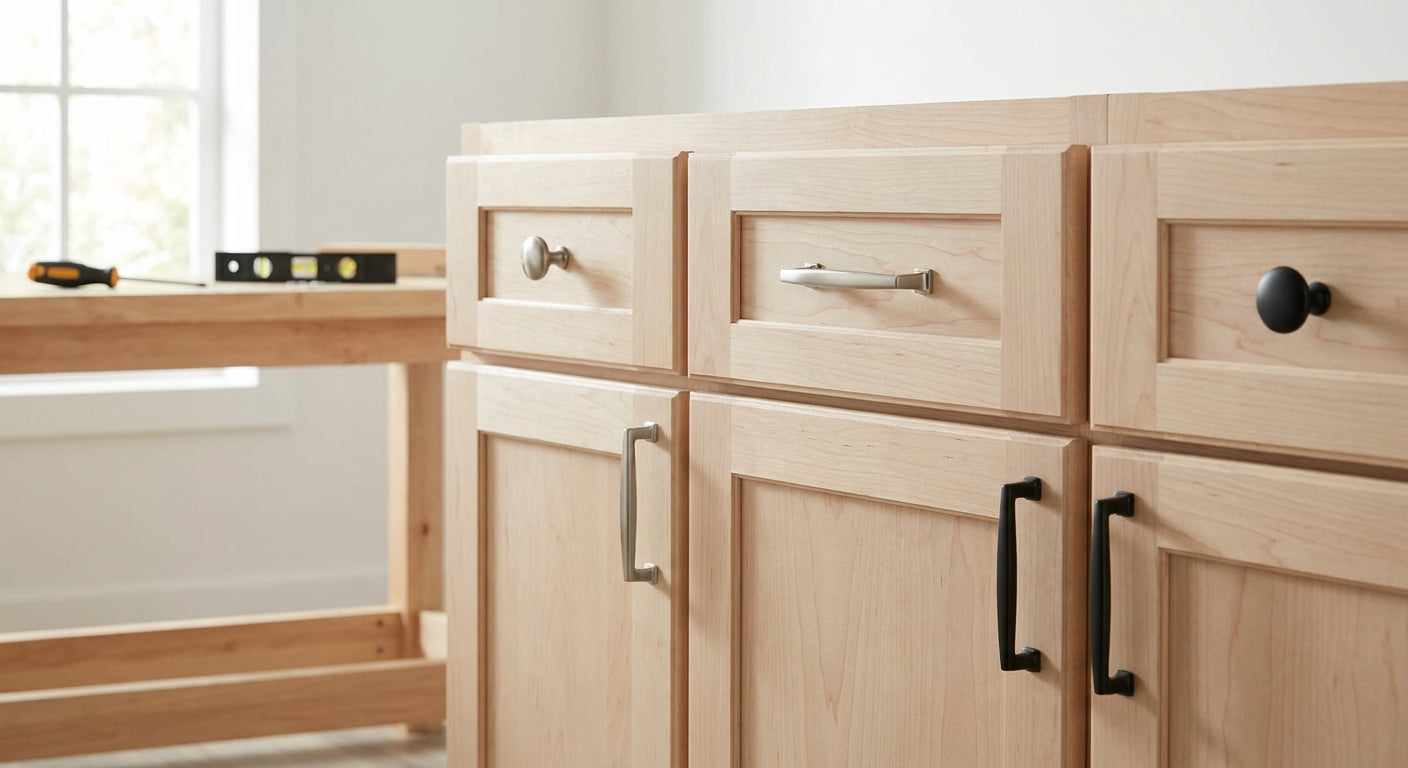
RTA (ready-to-assemble) cabinets ship as bare boxes with plain doors and drawer fronts — no knobs, no pulls, no hinges pre-installed — which means every RTA kitchen or vanity project needs a hardware plan built around thinner panels and DIY installation. This guide breaks down what actually works on RTA cabinet doors versus what looks fine in a photo and fails on install day.
- Elements Torino 4-inch bar pull is the safe budget buy for flat-pack kitchens in 2026 — Buy.
- Screw length is the #1 failure point on RTA cabinet hardware; most RTA doors run 5/8-inch thick.
- Amerock Status 5-inch pull handles painted RTA doors without stripping thin particleboard threads — Buy.
- Skip long-shank knobs sold in bulk multi-packs; they punch through thin RTA door panels.
Shop the picks from this guide
In stock at Knobs.co · Free shipping on hardware orders $99+ · 110% price match
-
 Amerock
Edona 1-1/4'' diam Cabinet Knob BP53005Polished Chrome
Amerock
Edona 1-1/4'' diam Cabinet Knob BP53005Polished Chrome
$3.21
$3.77 -
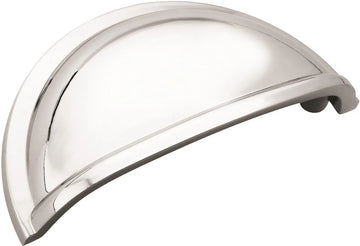 Amerock
Cup Pulls 3'' cc Cabinet Cup Pull BP53010Polished Chrome
Amerock
Cup Pulls 3'' cc Cabinet Cup Pull BP53010Polished Chrome
$4.61
$5.42 -
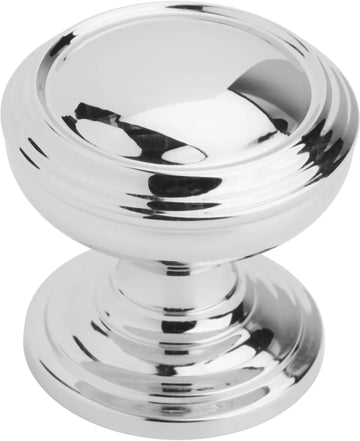 Amerock
Revitalize 1-1/4'' diam Cabinet Knob BP55342Polished Chrome
Amerock
Revitalize 1-1/4'' diam Cabinet Knob BP55342Polished Chrome
$6.42
$7.55 -
 Amerock
Edge Pull 5-1/16'' cc Cabinet Pull BP36575Polished Chrome
Amerock
Edge Pull 5-1/16'' cc Cabinet Pull BP36575Polished Chrome
$5.83
$6.85 -
 Amerock
Ravino 1-1/4'' diam Cabinet Knob BP53012Polished Chrome
Amerock
Ravino 1-1/4'' diam Cabinet Knob BP53012Polished Chrome
$2.79
$3.28 -
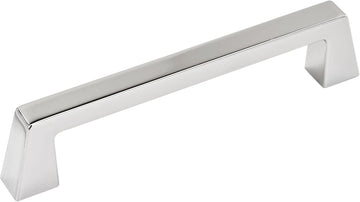 Amerock
Blackrock 5-1/16'' cc Cabinet Pull BP55277Polished Chrome
Amerock
Blackrock 5-1/16'' cc Cabinet Pull BP55277Polished Chrome
$9.63
$11.32


Why this matters
RTA cabinets cut labor cost by shipping flat and letting the buyer assemble the box, but that savings disappears fast if you order the wrong RTA cabinet hardware and end up re-drilling forty doors. Panel thickness on RTA lines runs thinner than face-frame stock — typically 5/8-inch versus 3/4-inch or more on framed cabinetry — so a screw that's perfect for a custom kitchen can blow straight through an RTA door front. Knobs.co has fielded this exact question from contractors running multi-unit RTA installs for years: get the screw length and backplate sizing right before you order color and finish.
Who this is for
This is written for the DIY homeowner assembling a flat-pack kitchen from a box kit, the contractor stocking hardware for a spec-built rental unit, and the small-scale remodeler pricing out 30-40 doors and drawers at once. If you're choosing hardware for custom face-frame cabinetry with solid 3/4-inch doors, most of this doesn't apply — go straight to a standard pull sizing guide instead. RTA buyers care about three things above design: screw compatibility, per-door cost at volume, and finish consistency across a full kitchen order.
What to look for in cabinet hardware for RTA cabinets
Screw length matched to panel thickness
RTA doors and drawer fronts commonly measure 5/8-inch thick, noticeably thinner than the 3/4-inch-plus stock used in custom cabinetry. A standard 1-inch screw meant for face-frame doors will punch through the front finish on a thin RTA panel, leaving a visible tip or a cracked edge. Always confirm screw length before ordering — this single detail causes more return requests than finish color ever does.
Pre-drilled hole compatibility
Some RTA lines ship doors with no holes at all, others pre-drill for a specific center-to-center spacing that won't match every pull. Check your RTA cabinet line's spec sheet against the CC (center-to-center) measurement on the cabinet pulls for RTA-ready-to-assemble cabinets you're considering before you commit to a full order.
Finish consistency across a full kitchen
RTA doors arrive plain, so you're sourcing every knob, pull, and hinge from scratch — order enough from one production run to avoid finish drift between the first 20 pulls and the last 20. Champagne bronze, honey bronze, and brushed nickel finishes can shift subtly between manufacturing batches, and a mismatched kitchen is obvious under cabinet lighting.
Cost per door at volume
A 30-door RTA kitchen adds up fast even at a few dollars per pull, so price-per-unit at the quantity you actually need matters more than a single flashy SKU. Budget lines exist specifically for this math — buying 40 identical bar pulls from a value tier costs meaningfully less than 40 designer pulls with the same function.
Grip style for daily-use doors
Bar pulls and cup pulls handle daily kitchen traffic better than small knobs on heavy RTA cabinet doors, especially on pantry and base cabinets that see constant use. A knob under 1.5 inches on a 30-inch-wide RTA door looks undersized and gets less secure grip over years of use.


Top picks for RTA cabinet hardware
The safe pick: Elements Torino 4-inch CC bar pull
This is a value-tier bar pull built for exactly this scenario — high door count, budget math, standard 4-inch center-to-center spacing that lines up with most RTA pre-drill patterns. It's a matte black bar pull with a simple bar profile that reads clean on flat-front RTA doors without needing a backplate. At 4-inch CC, it fits the drilling most RTA manufacturers already use, which saves you a redrill step. Buy — this is the pull to standardize a 30-door RTA kitchen on if budget is the deciding factor. Elements Torino 4-inch bar pull
The upgrade pick: Amerock Status pull
Step up from bare-bones bar pulls to a pull with more finish depth and a slightly heavier feel in hand, still sized to work on thin RTA panels without a backplate. The 5-1/16-inch CC spacing is wide enough to feel substantial on a 24-inch base cabinet door but not so wide it forces a backplate purchase. Buy for a painted RTA kitchen where you want the hardware to read as intentional, not an afterthought. Amerock Status 5-inch pull
The designer pick: Top Knobs Grace Riverside pull
This is the pull to use when the RTA cabinet box is the budget compromise but the hardware is where you spend to make the kitchen look custom. At 6-5/16-inch CC, it reads as a full-size pull on wider drawer fronts and holds up visually next to solid-wood cabinetry in the same room. Consider — it costs more per unit than the value-tier options, so run the per-door math before ordering 30 of them. Top Knobs Grace Riverside pull
The peer favorite: Belwith Keeler Berkshire pull
Contractors doing repeat RTA installs for rental turnovers gravitate to the Berkshire line in champagne bronze because it holds finish consistency well across large reorders — a real issue when you're buying hardware for unit after unit over months. It comes in multiple CC spacings across the collection, which makes matching drawer and door sizes easier on one order. Buy for property managers and contractors running the same RTA line across multiple units.
The one to skip: bulk unbranded knobs with long shanks
Multi-packs of unbranded knobs sold purely on low price often use a shank length built for 3/4-inch-plus doors, and that length is wrong for a 5/8-inch RTA panel — the screw either bottoms out loose or pokes through the door face. Skip these regardless of price; the failure rate on thin RTA doors isn't worth the savings.
“If the screw doesn't leave clearance behind a 5/8-inch RTA door panel, it's the wrong screw no matter how good the pull looks.”
What to avoid
- Oversized bar pulls that assume a backplate. Many RTA doors have no backplate drilling pattern, and retrofitting one adds a step most RTA buyers don't budget for.
- Mixed finish lots across a large order. Ordering 15 pulls now and 15 more in three months risks a visible finish shift, especially in bronze and brass tones.
- Decorative knobs with shanks over an inch. On a 5/8-inch RTA door, anything over roughly 3/4-inch of screw length risks punching through the front face.
Verdict comparison
| Pick | CC spacing | Best for | 2026 verdict |
|---|---|---|---|
| Elements Torino bar pull | 4 inch | Budget RTA kitchens, high door count | Buy |
| Amerock Status pull | 5-1/16 inch | Painted RTA doors, mid-range budget | Buy |
| Top Knobs Grace Riverside | 6-5/16 inch | Statement drawers, designer look | Consider |
| Belwith Keeler Berkshire | Multiple | Repeat contractor/property manager orders | Buy |
| Unbranded long-shank knobs | Varies | Nothing on thin RTA doors | Skip |
FAQ
What is RTA cabinet hardware?
RTA cabinet hardware refers to knobs, pulls, and hinges sourced separately to finish ready-to-assemble cabinets, which ship without any hardware installed. Fit depends on matching screw length and CC spacing to the thinner RTA door panels, typically 5/8-inch thick.
Is RTA cabinet hardware different from regular cabinet hardware?
The hardware itself isn't a separate category, but RTA doors are thinner than most custom cabinetry, so screw length and backplate needs differ. A pull rated for a 3/4-inch face-frame door can be the wrong screw length for a 5/8-inch RTA panel.
What screw length do RTA cabinets need?
Most RTA doors run 5/8-inch thick, so screws need to be short enough to seat fully without punching through the finished front. Always check the specific RTA door thickness before ordering hardware in bulk.
Can you install cabinet pulls on RTA cabinets without pre-drilled holes?
Yes, a drill template or jig marks consistent hole spacing across every blank RTA door in a run. This keeps CC spacing identical across a full kitchen even when doors ship with zero factory drilling.
How much does RTA cabinet hardware cost per door in 2026?
Budget-tier bar pulls run a few dollars each at volume, while designer finishes cost noticeably more per unit. Multiply per-unit cost by full door and drawer count before choosing a tier, since a 30-40 door kitchen adds up fast.
What's the best pull for thin RTA cabinet doors?
The Elements Torino 4-inch bar pull and the Amerock Status pull both work well on thin RTA doors because their CC spacing matches common RTA pre-drill patterns without requiring a backplate.
Do RTA cabinets come with hardware installed?
No, RTA cabinets ship with plain doors and drawer fronts and no hardware attached. Buyers source and install knobs, pulls, and hinges separately, which is why matching screw length to panel thickness matters so much.
How do you keep hardware finish consistent across an RTA kitchen?
Order the full hardware count for the kitchen in one purchase from one production run rather than reordering in batches. Finishes like champagne bronze and brushed nickel can shift subtly between manufacturing runs.
One last thing
The detail RTA buyers miss most in 2026 isn't finish or style — it's that a screw built for 3/4-inch cabinetry doesn't belong anywhere near a 5/8-inch RTA door front. Confirm door thickness first, pick CC spacing second, and finish color last; reversing that order is how kitchens end up with forty mismatched or damaged doors.


