

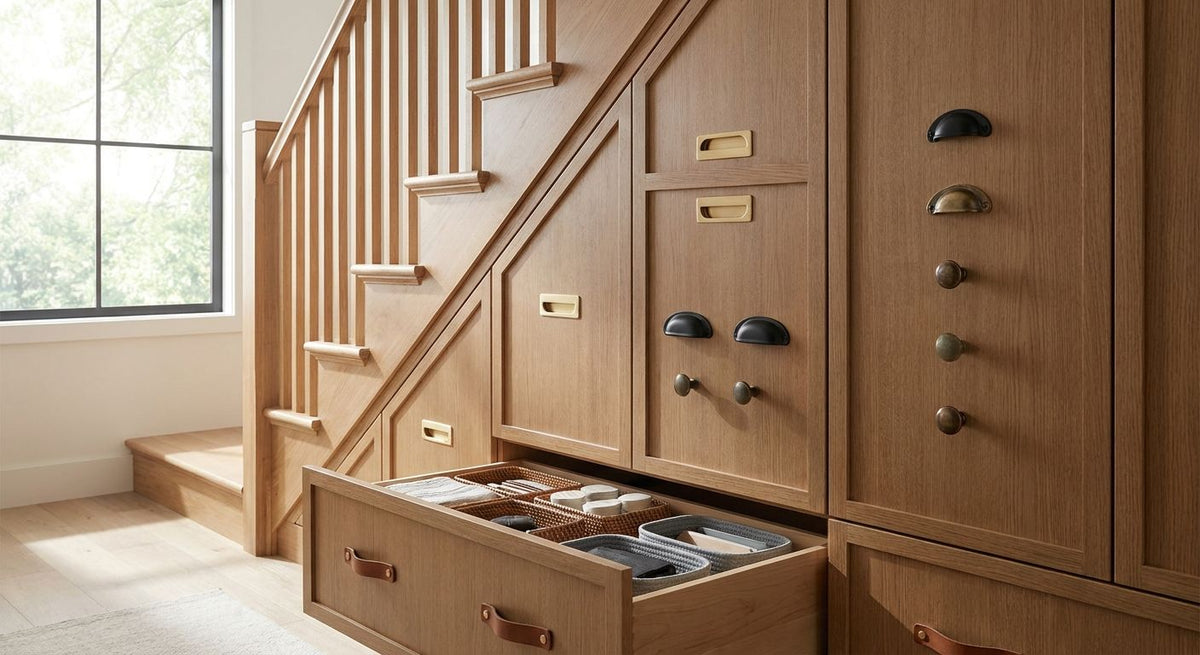
Under-stairs storage cabinet hardware is chosen to solve three problems regular kitchen hardware ignores: low headroom, angled or triangular doors, and deep cavities that taper toward the stair stringer. Get the hinge, pull, and organizer choice right and a dead triangle under the staircase turns into real, usable storage in 2026 instead of a dust trap behind a door nobody opens.
- Flush or recessed pulls beat protruding knobs on doors under 24 inches tall — go flush for low-clearance under-stairs cabinets.
- Concealed European hinges with adjustable cup angles handle triangular and angled doors; standard butt hinges do not.
- Rev-A-Shelf pull-out organizers reach the back of a tapering cabinet that a swing door can't clear, running $200 to $880 depending on width.
- Match hardware finish to the stair trim and baseboard next to it, not to a kitchen trend three rooms away.
Why cabinet hardware for under stairs storage is different
A kitchen cabinet door is a rectangle. An under-stairs cabinet door usually isn't. The top edge follows the slope of the staircase above it, which means the door is often a trapezoid or a triangle, and the cabinet box behind it gets shallower as it goes back.
That geometry changes three decisions at once: where a hinge cup can physically sit, how much swing clearance a pull needs, and whether a hinged door is even the right access method for the back third of the cabinet. Standard cabinet hardware buying advice assumes uniform door height and full-depth boxes. Under-stairs storage in 2026 rarely gives you either.
For smaller or oddly shaped rooms generally, the same low-clearance logic applies — see cabinet hardware for tiny house and small space kitchens for the broader pattern before you buy for the stair triangle specifically.
Step 1: Measure every door on the run, not just the tallest one
Under-stairs cabinet runs almost never have identical doors. The door closest to the wall might be 34 inches tall; the one at the low end of the stringer might be 11 inches. Hardware bought for one size gets crammed onto all of them, which is where clearance problems start.
- Measure height, width, and top-edge angle on every individual door, not an average
- Note stud or joist locations behind the drywall if you're adding a pull-out system that needs support
- Record swing clearance to the nearest wall, tread, or adjacent door
- Mark the shortest door in the run first — it dictates your hardware ceiling
- Photograph each door with a tape measure in frame so you're not re-measuring later
Step 2: Choose hinges rated for angled and low doors
A standard face-frame butt hinge assumes a rectangular door meeting a rectangular frame at 90 degrees. Under-stairs doors frequently don't meet the frame square at the top, which is exactly what a concealed European-style hinge with an adjustable cup angle is built to correct.
- Use hinges with 3-way adjustment (height, depth, and side) so a slightly out-of-square door still closes flush
- Confirm the hinge's opening angle clears the stair stringer before the door hits full swing
- For doors under 15 inches wide, pick a hinge rated for lighter doors — full-size hinges can overpower a small triangular panel and warp it over time
- Drill new hinge holes with a template rather than eyeballing them; angled doors punish measurement error more than square ones do
- Check how to choose the right cabinet hinge for your cabinets before ordering if this is your first angled-door install
Step 3: Size knobs and pulls for tight clearance
A 5-inch bar pull looks proportional on a 30-inch kitchen wall cabinet. On a 14-inch triangular door tucked under a staircase, the same pull can hit the adjacent baseboard or stair skirt every time the door opens.
- On doors under 18 inches tall, favor a single knob over a bar pull — less projection, less collision risk
- If you want a pull, measure projection (how far it sticks out) against actual swing clearance, not just door width
- Recessed or flush pulls solve clearance problems outright on the narrowest doors, at the cost of a slightly higher unit price
- Keep pull placement consistent across the run even when door heights differ — align to a common horizontal line, not a percentage of each door's height
- Reference how to choose the right cabinet knob size if the run mixes door sizes and you need one sizing rule that works across all of them
Step 4: Add pull-out storage for the deep, tapering interior
A hinged door only gives you access to what your arm can reach. In an under-stairs cabinet, the back third of the box is often 6 to 10 inches deep and completely out of reach through a swinging door — that space gets written off as dead space in most builds.
The manual fix is a shallow shelf you slide out by hand, but a soft-close pull-out organizer solves it with less friction on daily use.
- Measure the narrowest point of the cabinet opening before ordering any pull-out system — most are built for a fixed cavity width
- Between-cabinet wall filler pull-outs work well for the thin sliver next to the stringer that a full drawer can't fit into
- Base cabinet organizers with soft-close glides reach further back than a hand-pulled shelf and don't require you to crouch and dig
- Stainless or container-based organizers keep loose items contained instead of sliding to the back of the taper
- Confirm weight rating if you're storing anything heavier than pantry goods — small-vehicle organizers aren't rated for cookware


Step 5: Match finish to the stair trim and baseboard, not the kitchen
Under-stairs cabinets sit next to stringers, risers, and baseboard — not next to a range hood or a faucet. Matching hardware finish to a kitchen trend three rooms away reads as mismatched the moment you stand in the hallway.
- Pull a paint chip or trim sample from the actual staircase before ordering finish
- Warm wood trim generally reads better with brass, bronze, or pewter tones than with cold chrome
- Painted white or gray millwork pairs cleanly with matte black, satin nickel, or brushed nickel
- Order a sample of the exact finish before committing to a full run — under-stairs lighting is often dimmer than kitchen lighting and finishes look different under it
- See how to choose cabinet hardware finish for the full decision tree if you're choosing for the whole staircase run at once
Step 6: Order extra hardware for irregular door counts
Under-stairs storage runs rarely land on a clean number of identical doors. A five-door run might need five different hinge counts because door heights vary, and a dropped screw or a stripped pilot hole on a custom-angle door is harder to fix mid-project than on a standard cabinet.
- Order 10-15% extra screws and hinge hardware beyond the exact door count
- Buy one spare pull or knob per finish in case a piece is dropped or damaged during install
- Keep the receipt and SKU list on hand if you need to reorder a matching finish months later
- Confirm return policy on unopened hardware before ordering the full run, since custom finishes can be slow to restock
Comparison: hardware options for under-stairs cabinets
| Option | Best for | Starting price | Key limitation |
|---|---|---|---|
| Accent knob (crystal quartz style) | Small triangular doors under 15 inches wide, decorative accent | $17.61 | Decorative only, not built for daily heavy-pull use |
| Concealed hinge drill template kit | DIYers drilling new hinge holes on odd-angle doors | $27.20 | Template only — you still need to buy the hinge separately |
| Pull-out wall filler (3 in. width) | Narrow gaps beside the stair stringer that a drawer can't fit | $200.70 | Fixed 3-inch cavity width, won't fit wider or narrower gaps |
| Base cabinet organizer with soft-close | Deep, angled base cabinets that need full-reach access | $880.20 | Needs a minimum 8-inch cabinet opening to install |
The pull-out wall filler or base cabinet organizer wins for anything deeper than 24 inches — a hinged door alone leaves that space effectively unreachable.
Common mistakes with cabinet hardware for under stairs storage
- Sizing hardware off the tallest door in the run. A 5-inch pull that clears the 34-inch door will collide with the stringer on the 14-inch door three feet down the wall.
- Using standard butt hinges on angled doors. They can't correct for an out-of-square top edge, and the door binds within months.
- Skipping pull-out storage entirely. A swing door alone leaves the back third of a tapering cabinet functionally unreachable — it becomes storage for things you forget you own.
- Matching finish to the kitchen instead of the stairs. Under-stairs hardware sits against baseboard and stair trim, and a mismatched finish is more visible there than in a kitchen full of competing finishes.
- Under-ordering hardware. Irregular door counts mean irregular hinge and screw counts — running short mid-install on a custom-angle door is a bigger delay than running short on a standard one.
FAQ
What's the best cabinet hardware for under stairs storage?
Flush or low-profile pulls paired with adjustable concealed hinges work best for under-stairs storage in 2026, since they handle both the low door height and the angled top edge that standard kitchen hardware isn't built for.
Do under-stairs cabinets need special hinges?
Yes, in most cases. Doors with an angled or trapezoidal top edge need a concealed hinge with 3-way adjustment to close flush; a standard butt hinge assumes a square door and won't correct for the slope.
Can I use regular knobs on angled cabinet doors?
Regular knobs work fine on angled doors as long as the door has enough surface area to mount one without hitting an edge. The angle affects hinge choice far more than knob choice.
How much clearance do I need for pulls near a stair tread?
Measure the door's actual swing clearance to the nearest tread, wall, or adjacent door before choosing pull projection — a pull that sticks out more than the available clearance will hit an obstruction every time the door opens.
Are pull-out organizers worth it for under-stairs cabinets?
For cabinets deeper than about 24 inches, yes. A hinged door alone can't reach the back of a tapering cabinet, so a pull-out or soft-close organizer is the difference between usable storage and a space you forget exists.
What finish works best for under-stairs storage hardware?
Match the finish to the stair trim and baseboard next to the cabinet, not to a separate room's hardware. Warm wood trim generally pairs with brass or bronze tones; painted trim pairs with matte black or satin nickel.
How do I measure for hardware on a triangular door?
Measure height, width, and top-edge angle on each individual door in the run, since under-stairs doors are rarely uniform. Use the shortest, narrowest door in the run to set your hardware size ceiling.
Is soft-close hardware necessary for under-stairs cabinets?
It's not required, but soft-close hinges and pull-out glides reduce slamming in a space that often sits near a hallway or living area where door noise carries more than it would in a kitchen.
One last thing
The top edge of an under-stairs door is almost never a straight, symmetrical angle — it follows the actual pitch of the staircase above it, which can vary by a degree or two even across doors that look identical from a few feet away. Measure the angle on each door individually before ordering hinges in bulk; a jig or template built for one angle rarely transfers cleanly to the next door down the run in 2026 remodels.


