

Cabinet Hardware for Walnut Cabinets: Brass Wins, and Black Is Not the Contrast You Think
Walnut's undertone is purple-gray rather than red, which rules out the copper-toned finishes and makes matte black far quieter on it than anyone expects.

Choose cabinet hardware for walnut cabinets in a satin or brushed brass, kept matte rather than polished. Walnut is chocolate brown with a purple-gray undertone, so a clean warm yellow gives it a gap in both color and lightness without putting red next to a wood that has none of its own. One condition overrides that, and the condition is light. Where the run takes direct sun the wood will pale over the years while the metal stays put, and matte black, which barely registers as contrast on fresh walnut, slowly turns into the sharper choice. Buy for the kitchen you will have in five years.
Shop the picks from this guide
In stock at Knobs.co · Free shipping on hardware orders $99+ · 110% price match
-
 Smedbo
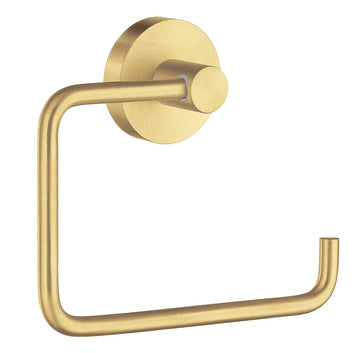
Home Toilet Roll Holder Brushed Brass HV341
Smedbo
Home Toilet Roll Holder Brushed Brass HV341
$126.00
$140.00 -
 Smedbo
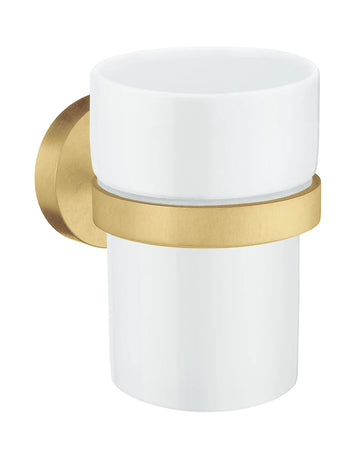
Home Holder With Tumbler Br Brass/Porcelain HV343P
Smedbo
Home Holder With Tumbler Br Brass/Porcelain HV343P
$153.00
$170.00 -
 Smedbo
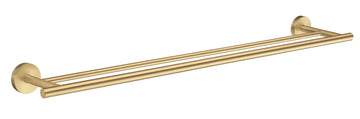
Home Double Towel Rail Brushed Brass HV3364
Smedbo
Home Double Towel Rail Brushed Brass HV3364
$326.70
$363.00 -
 Smedbo
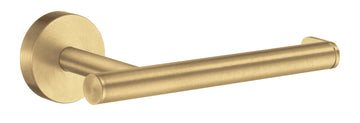
Home Toilet Roll Holder Brushed Brass HV3411
Smedbo
Home Toilet Roll Holder Brushed Brass HV3411
$142.21
$158.00 -
 Century Hardware
Kai 6-5/16 inches (160mm) cc Square Bar PullPolished Nickel
Century Hardware
Kai 6-5/16 inches (160mm) cc Square Bar PullPolished Nickel
$18.00
$20.00 -
 Smedbo
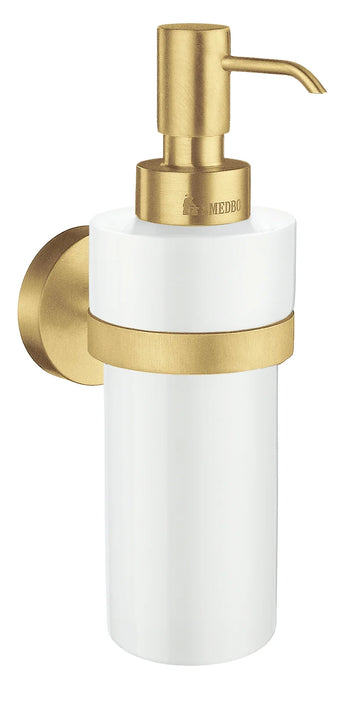
Home Soap Dispenser Br Brass/Porcelain HV369P
Smedbo
Home Soap Dispenser Br Brass/Porcelain HV369P
$307.80
$342.00

Why cabinet hardware for walnut cabinets should carry no red
Walnut is not a red wood. Cherry is red, oak leans orange-gold, mahogany is red-brown, and walnut sits apart from all of them as a cool chocolate with purple and gray running underneath. Most guides file it under warm dark woods and hand it the same finishes they would hand cherry, which is where I watch this go wrong.
Take oil-rubbed bronze, the clearest case. Most versions of it are living finishes: a near-black brown that rubs back where hands land to reveal copper, and copper is red. Against a purple-gray brown that red has nothing to agree with, so what you get is not warmth but a pull that looks faintly dirty. Venetian bronze carries more visible copper still and arrives there sooner. An antique brass with a red cast lands in the same place.
What works instead is brass with a clean yellow in it, satin or brushed brass, names manufacturers swap anyway. Either one sets a warm yellow against a cool brown, which is a proper opposition rather than two browns negotiating. Champagne bronze is the quieter version, gentler and less yellow, and it is what I reach for when there is a gold faucet in the room to answer to.
Nickel is the other defensible pick, and it behaves oddly here. Brushed nickel is a warm-toned silver everywhere else, but set against walnut's gray undertone it reads cooler than usual and the pairing goes quiet and technical rather than warm. In a galley with stainless appliances that is the point. Beside a wood floor it can look borrowed from another room.
Matte black does not contrast with walnut the way everyone says
The consensus across the top results makes matte black the high-contrast modern pick. On white cabinets that is true. On walnut it is close to backwards. Contrast is a difference in lightness, and fresh walnut is already dark. Black is darker, but not by enough for the eye to separate the two across a room, and after sunset the pulls stop registering as objects and turn into things you locate by touch.
None of which rules it out. I still specify it, just deliberately. There is a genuine brief in which hardware should disappear and the grain should carry the whole wall, and black does that on walnut better than anything else can. If that is the intention, buy on grip and proportion rather than on looks, since you will use these far more than you will see them. Black also earns its keep when there is already black in the room, in the window frames, the faucet or a steel shelf, so the hardware joins something rather than starting it.
Match the sheen before you match the color
Walnut arrives on two very different surfaces, and the rules change with them. Hardwax oil and flat lacquer leave the wood dead matte with the grain open enough to feel. A satin lacquer or a gloss veneer gives you something that throws light back. The mismatch I run into most on walnut is a mirror-polished pull on flat oiled wood, where the shine has nothing in the room to answer to and sits on the door like a bright accident. Brushed and satin metals belong on matte wood; polished nickel and polished brass belong on a lacquered walnut that is already reflecting something.
There is a second reason to look at sheen. Oiled walnut keeps moving: it darkens where hands touch it, drinks in oil, gets wiped and re-oiled. Bare unlacquered brass behaves the same way, darkening with handling and going uneven, so on oiled walnut the two age in step and the kitchen still hangs together in year five. Lacquered and PVD brass hold their color exactly where you bought them while the wood shifts underneath. Neither is wrong. Only one of them is a decision most people know they are making.
The doors in front of the window will be a different color in five years
Walnut is one of the few cabinet woods that gets lighter with age. Ultraviolet light breaks down lignin at the wood surface and the chocolate drifts toward a pale honey brown. It moves faster in direct sun, which means it does not move evenly: the bank of doors beside a south-facing window pales while the pantry two steps away stays dark, and what I hear about is a mismatch between two runs bought on the same day.
For hardware this only matters in one direction. Brass and walnut start far apart in lightness and drift toward each other, so a brass kitchen softens over the years and eventually reads tone on tone. Black starts nearly invisible and gains definition as the wood pales. With a wall of glass in the room I weight the decision toward black, or toward a darker aged brass that keeps a gap. In an interior kitchen with modest daylight, brass holds its relationship for a long time.
On a slab door, how much hardware shows matters more than which finish
Walnut kitchens going in now are mostly flat slab doors in veneer, and that veneer is normally sequenced across the run so the grain carries from one door to the next as a single figure. That continuity is the reason to own walnut. A row of chunky pulls cuts it into segments and the wood you paid for turns into background, which is why the question I ask first is how much hardware you want to see at all.
Three ways down from there. A long thin bar pull mounted along the grain adds a line rather than a block and stays comfortable for everyone in the house. Tab and edge pulls sit at the top of a drawer front and leave the face clear. Push latches and routed finger pulls take the metal off the door entirely, at which point every finish decision above stops applying. Mid-century walnut, where the wood has the longest history, runs to its own shapes and proportions, and we treat those separately in mid-century modern hardware for walnut cabinets.
Name the cost before committing. Edge and tab pulls want a hooked grip and some strength, which is worth a thought for children and for anyone with a sore hand, and they gather finger oil along the top edge of the drawer front where it shows on oiled wood. Push latches fail toward an open door and need adjusting now and then. A bar pull is the one nobody in the house complains about.
Size it by the drawer rather than the door. Pull centers, meaning the gap between the screw holes rather than the overall length, want to land near one third of the width of the drawer, up to about a 24 in front. Wider than that, go longer or fit two. The spacings you will meet most often are 128 mm, which is 5 in, then 160 mm and 192 mm, and slab doors carry the long end better than framed doors do.
Check two things before the drill comes out
Two things I check on any veneered slab front. Tearout on veneer exposes a pale substrate underneath, so a chip at the hole is not a scratch you can oil away; back the exit face with a clamped offcut and let a brad point cut the fibers rather than shove them. Then measure the door. Hardware screws come in 8-32 thread and the one in the box is usually cut for three quarters of an inch, while contemporary slab doors often run thicker and a drawer with a separate applied front adds another layer again, so buy screw length to suit rather than finding out with the kitchen in pieces.
Then the finish itself. Get down to two and send for a sample of both; the cost comes back on your full order. Hold them against a door that gets sun and a door that does not, because on walnut those are already slightly different woods. Judge them in the evening as well as at noon, since warm bulbs drag brass orange and close the gap between black hardware and dark wood almost to nothing.
Shop Brushed Brass Cabinet Hardware
-
 Home Toilet Roll Holder Brushed Brass HV341
$126.00
Home Toilet Roll Holder Brushed Brass HV341
$126.00
-
 Home Holder With Tumbler Br Brass/Porcelain HV343P
$153.00
Home Holder With Tumbler Br Brass/Porcelain HV343P
$153.00
-
 Home Double Towel Rail Brushed Brass HV3364
$326.70
Home Double Towel Rail Brushed Brass HV3364
$326.70
-
 Home Toilet Roll Holder Brushed Brass HV3411
$142.21
Home Toilet Roll Holder Brushed Brass HV3411
$142.21
-
 Kai 6-5/16 inches (160mm) cc Square Bar Pull
$18.00
Kai 6-5/16 inches (160mm) cc Square Bar Pull
$18.00
-
 Home Soap Dispenser Br Brass/Porcelain HV369P
$307.80
Home Soap Dispenser Br Brass/Porcelain HV369P
$307.80
-
 Home Holder With Soap Dish Br Brass/Porcelain HV342P
$153.00
Home Holder With Soap Dish Br Brass/Porcelain HV342P
$153.00
-
 Kai 7-9/16 inches (192mm) cc Square Bar Pull
$21.60
Kai 7-9/16 inches (192mm) cc Square Bar Pull
$21.60


Browse all 23 in Brushed Brass Cabinet Hardware → Cabinet knobs Cabinet pulls & handles