

Mid Century Modern Hardware for Walnut Cabinets 2026
Best mid century modern cabinet hardware walnut pairings in 2026: brushed nickel, satin brass, and matte black pulls ranked with verdicts. No chrome, no backplates.

Walnut cabinets already do the heavy lifting — the grain is warm, the tone is rich, and the wood reads expensive without trying. The hardware you bolt on can either reinforce that or kill it. This guide covers exactly which mid century modern cabinet hardware finishes, profiles, and pull lengths work on walnut, and which ones fight the wood instead of finishing it.
TL;DR: For walnut cabinets in 2026, brushed nickel and satin brass are the two finishes that reliably land with mid century modern hardware. Matte black works in high-contrast applications but competes with walnut's depth if overused. Bar pulls in the 3–5 inch center-to-center range are the category workhorse. Knobs.co carries 50,000+ SKUs across all three finishes in the mid century modern style collection. Skip chrome — it reads contemporary, not MCM — and avoid anything ornate.
Shop the picks from this guide
In stock at Knobs.co · Free shipping on hardware orders $99+ · 110% price match
-
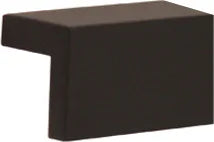 Alno
Alno A960 Tab 1 1/2'' CC Brass Cabinet PullBronze / 3/4''
Alno
Alno A960 Tab 1 1/2'' CC Brass Cabinet PullBronze / 3/4''
$16.16
$17.95 -
 Alno
Contemporary I Bath Towel Bar A8320Bronze / 12''
Alno
Contemporary I Bath Towel Bar A8320Bronze / 12''
$121.46
$134.95 -
 Alno
Contemporary I Bath Tissue Holder A8360Bronze
Alno
Contemporary I Bath Tissue Holder A8360Bronze
$121.46
$134.95 -
 Alno
Swarovski Crystal 4'' Crystal Pull C211-4Bronze
Alno
Swarovski Crystal 4'' Crystal Pull C211-4Bronze
$58.46
$64.95 -
 Century Hardware
Lisbon /Yaletown 1-3/16'' Diameter KnobSatin Nickel
Century Hardware
Lisbon /Yaletown 1-3/16'' Diameter KnobSatin Nickel
$6.30
$7.00 -
 Du Verre
Pomegranate Pull 8 5/8'' C-P15Oil Rubbed Bronze
Du Verre
Pomegranate Pull 8 5/8'' C-P15Oil Rubbed Bronze
$56.16
$62.40


Why this pairing matters in 2026
Mid century modern design peaked in residential interiors between 1945 and 1969. Today's revival is not nostalgia — it's a design language that holds up because its rules are simple: flat fronts, tapered legs, warm wood tones, and restrained metal accents. Walnut is the wood most associated with that era because of its natural warmth and tight, readable grain. Choosing hardware that conflicts with those principles — shiny chrome, decorative casting, ornate cup pulls — undercuts the whole room. The hardware decision on walnut cabinets is a finish decision as much as a style decision.
Who this guide is for
This is written for homeowners and trade professionals specifying hardware for walnut cabinet boxes — kitchens, bathroom vanities, built-ins, or freestanding credenzas. If you are a designer on a time-sensitive project or a homeowner who bought walnut flat-front cabinets and now needs to nail the hardware spec, this covers the criteria, the picks, and the traps.
What to look for in mid century modern hardware for walnut cabinets
Finish compatibility with warm wood tones
Walnut sits in the warm-brown spectrum. Finishes that also read warm — satin brass, antique brass, brushed gold — create a monochromatic, period-accurate result. Finishes with cool undertones — brushed nickel, matte black — create deliberate contrast. Both work. The mistake is choosing a finish with no clear relationship to the wood tone: polished chrome is too reflective and reads contemporary; oil-rubbed bronze can look heavy against walnut's already-dark grain.
Pull profile and MCM silhouette
Mid century modern hardware is architecturally minimal. The right profiles are: cylindrical bar pulls, tapered bar pulls, wire pulls, and simple round knobs. Anything with a backplate, decorative casting, bin-cup shape, or arched bail is period-wrong for this application. The profile should feel like it belongs on a Eames storage unit or a Lane credenza — clean, linear, intentional.
Center-to-center sizing relative to door width
For typical 12–18 inch wide drawer fronts, a 3 inch (76mm) center-to-center bar pull is proportional. For 24–36 inch wide doors or large drawer banks, step up to 5 or 6.25 inch (128–160mm) centers. Undersizing pulls on wide walnut panels makes the hardware disappear and the door look unfinished. Oversizing on a narrow drawer front makes the hardware the focal point — wrong priority.
Material and build quality
Die-cast zinc pulls corrode at the base plate over time in high-humidity applications like kitchens and bathrooms. Solid brass or stainless steel construction holds finish longer. In 2026, trade professionals almost universally spec solid brass or stainless cores — ask for that specification before ordering in volume.
Screw depth and cabinet face compatibility
Walnut flat-front cabinets are typically frameless (European-style) with a thinner door panel than face-frame construction. Standard machine screws at #8-32 thread work across most hardware, but pull length affects the screw post depth you need. Verify the cabinet door panel thickness before ordering pulls with posts under 1 inch — too short and the pull rocks; too long and the screw strips from the back.
Trade pricing and volume availability
For designers or contractors specifying hardware across 20, 40, or 80 doors, in-stock depth matters more than unit price. Confirm that the SKU you spec has volume available at time of order. Knobs.co stocks 50,000+ SKUs and serves both homeowners and trade accounts, which keeps availability consistent even for mid-project reorders.
Top picks for walnut cabinets in 2026
The safe pick — brushed nickel bar pull, 8-13/16 inch
The Top Knobs Amwell Bar Pull at 8-13/16 inch center-to-center is the most straightforward spec for large walnut drawer fronts or pantry door hardware. Brushed nickel sits cool against walnut's warmth without fighting it — the contrast is intentional and reads modern. The cylindrical profile is period-accurate for MCM. Solid construction with a #8-32 machine screw post. Verdict: Buy — no edge case that makes this the wrong call on walnut flat-fronts.
The finish-forward pick — matte black collection
Matte black on walnut is a higher-contrast play. The wood's warm brown and the flat-black metal create a two-tone graphic that reads well in kitchens with stone countertops or white walls. The risk: if every material in the space is already dark (walnut lowers, dark tile, dark stone), matte black hardware competes rather than accents. Use it when there is at least one light surface in the room to take the contrast. Verdict: Consider — strong in the right room context, wrong in an all-dark spec.
Browse the matte black finish collection for profiles that match MCM silhouettes.
The classic MCM pick — brushed nickel collection
Brushed nickel is the most period-authentic finish for mid century modern hardware when you trace actual production-era pieces. The brushed texture diffuses reflection, keeping the hardware quiet on the door face rather than drawing the eye. It pairs with walnut at any scale — single knob on a cabinet door, full-length appliance pull on a refrigerator panel. Verdict: Buy — the default correct answer for MCM walnut hardware in 2026.
Full inventory at the brushed nickel finish collection.
The appliance-panel pick — appliance pulls
Walnut appliance panels on integrated refrigerators or dishwashers need hardware that scales up. Standard 3–5 inch pulls look proportionally wrong at 24–36 inches of panel face. Dedicated appliance pulls run 12–18 inches and maintain the MCM bar-pull silhouette at that size. Verdict: Buy — non-negotiable for integrated appliance panels; skip for door hardware.
See the full appliance pulls category.
What to avoid on walnut cabinets
- Polished chrome. The mirror finish reads contemporary and industrial, not MCM. It also clashes with walnut's warm undertone at the color temperature level — the two tones visually argue.
- Backplate hardware. Any pull or knob that requires a decorative backplate adds an ornamental layer that MCM design explicitly rejects. It also visually shrinks the door face, which fights walnut's natural presence.
- Bin cup pulls and bail pulls. These are Shaker and traditional, not MCM. They are the most common misidentification error when homeowners shop by "simple hardware" rather than by style. A bin pull on a walnut flat-front signals style confusion immediately.
Comparison: hardware finishes on walnut flat-front cabinets
| Finish | MCM accuracy | Walnut compatibility | Best application | 2026 verdict |
|---|---|---|---|---|
| Brushed nickel | High | High — cool contrast | Kitchen, vanity, built-in | Buy |
| Satin brass | High | High — warm match | MCM-forward kitchens | Buy |
| Matte black | Medium | Medium — high contrast | Light-counter kitchens | Consider |
| Polished chrome | Low | Low — color conflict | Avoid on walnut | Skip |
| Oil-rubbed bronze | Low | Medium | Traditional, not MCM | Skip |
FAQ
What finish hardware looks best on walnut cabinets in 2026? Brushed nickel and satin brass are the two finishes that work consistently on walnut. Brushed nickel creates deliberate cool-warm contrast; satin brass leans into walnut's warmth for a monochromatic MCM look. Both are correct. Chrome and oil-rubbed bronze are wrong for this application.
Is matte black hardware good for walnut cabinets? Matte black works on walnut when there is at least one light surface in the room — white walls, light stone, or light tile — to balance the contrast. In an all-dark room, matte black on walnut loses the contrast effect and makes the hardware invisible.
What size pull should I use on walnut cabinet doors? For drawer fronts 12–18 inches wide, use 3 inch (76mm) center-to-center pulls. For drawer fronts 24–36 inches wide or for pantry doors, use 5–6.25 inch (128–160mm) centers. Appliance panels need dedicated 12–18 inch appliance pulls to stay proportional.
Can I mix knobs and pulls on walnut cabinets? Yes. The standard mix is knobs on doors and bar pulls on drawers. Keep the finish consistent across the room — mixing brushed nickel knobs with satin brass pulls reads as an error, not a design choice, unless there is a deliberate two-finish strategy with clear visual logic.
What hardware style is mid century modern? Mid century modern hardware is characterized by cylindrical or tapered bar pulls, wire pulls, and simple round knobs — all without backplates, decorative casting, or ornate detailing. The silhouette is linear and restrained. Bin pulls, bail pulls, and anything with a Victorian or Shaker profile is not MCM.
How do I know if a pull is MCM or just "minimalist"? MCM hardware references the 1945–1969 production aesthetic: tapered ends on bar pulls, solid cylindrical profiles, warm or neutral metals, no applied ornamentation. "Minimalist" is a broader category that includes contemporary and Scandinavian styles. If the pull has square-cut ends with no taper, it reads contemporary. If it has a slight taper or rounded terminal, it reads MCM.
Are solid brass pulls worth the price premium on walnut cabinets? For kitchen and bathroom applications, yes. Solid brass resists corrosion at the base and holds plated finishes longer than die-cast zinc. On walnut cabinets that represent a significant material investment, matching that quality in the hardware is the correct call. For dry applications like a home office built-in, the premium is less critical.
Do I need special screws for walnut flat-front cabinet doors? Standard #8-32 machine screws work for most hardware. The critical variable is post length relative to door panel thickness. Walnut flat-front (frameless) doors are typically 5/8 to 3/4 inch thick. Confirm post length on any pull you order and match it to your door spec before ordering in volume.
One last thing
Walnut was the single most specified wood species in American residential cabinetry between 1955 and 1970 — not oak, not maple. It was the MCM wood. Specifying mid century modern hardware on walnut cabinets in 2026 is not a trend decision; it's returning a material to its original design context. Get the finish right, keep the profile minimal, and the hardware will read like it was always supposed to be there.
Related guides
- Brushed nickel pulls for kitchen renovations
- Matte black cabinet pulls for white kitchens
- How to mix brushed nickel hardware across rooms
Shop Satin Brass Cabinet Hardware
-
 Crystalline Cracked Glass Cabinet Knob CRLCG
$12.80
Crystalline Cracked Glass Cabinet Knob CRLCG
$12.80
-
 City Lights Cylinder Glass Knob, 7/8'' dia
$41.72
City Lights Cylinder Glass Knob, 7/8'' dia
$41.72
-
 Crimson Red Cracked Glass Cabinet Knob CRDCG
$12.80
Crimson Red Cracked Glass Cabinet Knob CRDCG
$12.80
-
 Colonial Pull, 4'' cc
$26.89
Colonial Pull, 4'' cc
$26.89
-
 Atherton Hammered Knob, Knurled Edge, 1-1/4'' dia
$63.05
Atherton Hammered Knob, Knurled Edge, 1-1/4'' dia
$63.05
-
 Mellow Yellow Cracked Glass Cabinet Knob MEYCG
$12.80
Mellow Yellow Cracked Glass Cabinet Knob MEYCG
$12.80
-
 Cobalt Blue Cracked Glass Cabinet Knob COBCG
$12.80
Cobalt Blue Cracked Glass Cabinet Knob COBCG
$12.80
-
 Caribbean Blue Cracked Glass Cabinet Knob CABCG
$12.80
Caribbean Blue Cracked Glass Cabinet Knob CABCG
$12.80


Browse all 450 in Satin Brass Cabinet Hardware → Cabinet knobs Cabinet pulls & handles