

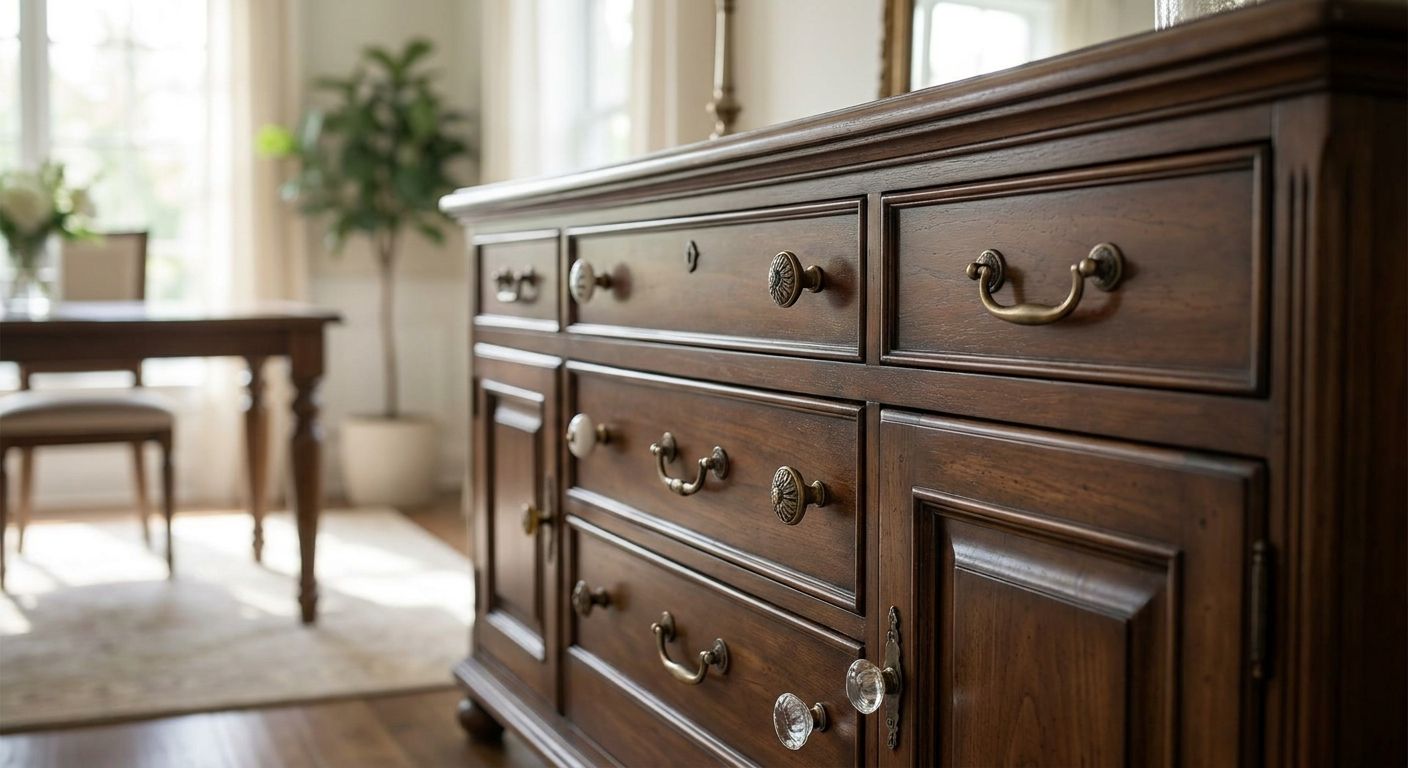
Cabinet knobs for buffet and sideboard furniture are hardware fittings sized and finished for freestanding dining room pieces, not built-in kitchen cabinetry — which means the hole spacing, screw length, and finish palette you need are often different from what a kitchen remodel calls for. A sideboard sits at eye level next to your dining table, so a hardware mismatch shows immediately in a way a cabinet three feet off the floor never does.
- Cabinet knobs for buffet furniture must match existing hole spacing — most vintage sideboards use single-hole knobs spaced 1-1/4 to 1-3/8 inches apart.
- Backplates hide old or mismatched holes without redrilling solid wood doors, the fastest fix for inherited or thrifted sideboards.
- Round knobs in brass, pewter, or ceramic finish traditional buffets best; long bar pulls scaled for kitchens overwhelm most sideboard drawers.
- Order free samples before buying a full set — finish reads differently under dining room lighting than under store lighting.
- Knobs.co stocks 50,000+ SKUs with a 110% price match guarantee, useful when matching an odd finish across a whole buffet.
Why cabinet knobs matter for buffet and sideboard owners
A sideboard or buffet is furniture, not infrastructure — it gets chosen for how it looks in a room, and hardware is the detail that either finishes that look or undercuts it. Unlike kitchen cabinets, which get replaced wholesale during a remodel, a buffet is usually inherited, refinished, or bought secondhand with its original holes already drilled.
That changes the buying problem. You're not picking hardware for a blank slate — you're matching an existing hole pattern, an existing wood tone, and often existing metal accents on a chandelier, mirror frame, or dining chair set nearby. Knobs.co sees this pattern constantly in orders for china cabinets, curio cabinets, and sideboards, where the finish has to read correctly under dining room lighting, not showroom fluorescents.
How to choose cabinet knobs for buffet furniture
Measure your existing hole spacing before you shop
Most buffets built before the 1980s use a single predrilled hole per knob, spaced differently than modern kitchen hardware. Skip this step and you'll end up filling and redrilling solid wood.
- Measure center-to-center spacing on any existing hardware with a tape measure, not a guess.
- Note whether the piece uses one hole (knob) or two holes (pull) per drawer.
- Check door and drawer front thickness — solid wood buffet fronts often run 3/4" to 1" thick, thicker than typical kitchen cabinet doors.
- If the piece is inherited or thrifted, pull the existing hardware and look for witness marks from a prior style.
- Confirm whether backplates were used originally; they hide a different hole pattern than the knob alone.
Match the finish to your dining room's other metal accents
Dining rooms carry more decorative metal than kitchens — chandeliers, mirror frames, candlesticks — and buffet hardware reads best when it echoes one of those tones rather than matching the kitchen down the hall.
- Satin brass or 24k gold finishes suit formal dining rooms with warm-toned lighting.
- Antique pewter and weathered bronze finishes suit traditional and farmhouse-adjacent pieces.
- A profile like the Portobello Road knob works as a simple traditional option that doesn't compete with an ornate buffet silhouette.
- Glass or ceramic knobs suit cottage-style or painted sideboards better than polished metal.
- Avoid pairing a brushed-nickel kitchen finish with a mahogany buffet unless the rest of the room's metal already matches.
Size the knob to the piece's scale
Buffet and sideboard drawers run wider than typical kitchen drawers — often 18 to 36 inches — which changes what size hardware looks proportional.
- Round knobs between 1-1/4" and 1-3/8" diameter suit most traditional buffet drawers.
- Oversized sideboards (over 60" wide) can carry a 1-1/2"+ knob without looking undersized.
- Pulls with 3" to 5" center-to-center spacing suit narrow drawers under 18" wide.
- Bar pulls at 8" to 12" centers suit wide, flat-front cabinet doors on modern sideboards.
- Avoid a knob under 1" on a drawer front wider than 24" — it reads too small for the piece.
Decide between knobs, pulls, and cup pulls for sideboard doors
The hardware type should follow the door style, not personal preference alone.
- Knobs suit narrow cabinet doors and most drawer fronts under 24" wide.
- Bar pulls suit wide, flat-front drawers and doors, especially on contemporary sideboards.
- Cup or bin pulls suit farmhouse-style pieces and read out of place on formal mahogany buffets.
- Solid wood doors over 3/4" thick handle the leverage of a bar pull better than thin veneer panels.
- Mixed hardware (knobs on doors, pulls on drawers) is common on multi-function sideboards with both storage types.
Cover old or mismatched holes with a backplate
A backplate is the fastest fix when a piece's existing holes don't match the hardware you want, and it avoids filling and refinishing solid wood.
- A backplate covers a wider or different hole pattern than the knob alone requires.
- Match the backplate finish exactly to the knob finish — a mismatch reads worse than no backplate at all.
- Oval and rectangular backplates suit traditional buffets; round backplates suit more contemporary pieces.
- Check the backplate guide before ordering if the piece has an unusual hole spacing.
- Backplates also protect painted or refinished wood from wear around the screw hole over time.
Order samples before buying a full set
Dining room lighting is warmer and lower than kitchen lighting in most homes, and finishes that look right on a screen or in a store don't always hold up once installed.
- Order a free sample of the exact finish before committing to a full set for a multi-drawer buffet.
- Hold the sample against the piece under the room's actual evening lighting, not daylight alone.
- Compare the sample against existing metal accents in the room — mirror frame, light fixture, chair nailheads.
- Check the weight and feel in hand; a lightweight knob can feel cheap on a heavy antique piece.
- Confirm the return or exchange window before ordering enough hardware for a full sideboard in 2026.
Install with the correct screw length for solid wood doors
Solid buffet doors are often thicker than the kitchen cabinet doors most hardware screws are sized for by default.
- Measure door or drawer front thickness before ordering — anything over 3/4" may need a longer screw than what ships standard.
- Use a jig or template for consistent spacing across multiple drawers on the same piece.
- Predrill pilot holes on solid wood to avoid splitting, especially near drawer edges.
- Countersink slightly on antique pieces with softened or worn wood around the original hole.
- Test-fit one knob before drilling the full set, particularly on a piece you can't easily patch.
Comparison: hardware options for buffet and sideboard furniture
| Option | Best for | Key limitation | Verdict |
|---|---|---|---|
| Round knob (single-hole) | Traditional buffets already drilled for one screw | Limited grip on heavy doors over 30 lbs | Buy |
| Bar pull | Wide flat-front sideboard drawers | Needs a two-hole redrill on antique single-hole pieces | Buy for modern pieces, Hold for antiques |
| Cup or bin pull | Farmhouse-style sideboards | Looks out of place on formal mahogany buffets | Buy for farmhouse only |
| Knob + backplate | Covering old or mismatched holes | Backplate must match knob finish exactly or it reads mismatched | Buy |
| Glass or ceramic knob | Cottage or vintage-painted sideboards | More fragile than metal on daily-use drawers | Hold for high-traffic drawers |
The fastest fix for a buffet with mismatched or damaged holes is a knob-and-backplate pairing — it's the one option on this table that solves a problem instead of just adding style.
Common mistakes buffet and sideboard owners make
- Scaling kitchen-size bar pulls onto narrow drawers. A 12" bar pull built for a kitchen island crowds the edges of an 18" sideboard drawer front.
- Skipping the hole-spacing measurement on an inherited piece. This leads to filling and redrilling solid wood that could have been avoided with a five-minute check.
- Matching the kitchen finish instead of the dining room. A buffet sits next to a chandelier and mirror frame, not next to kitchen faucets — match the room it's actually in.
- Ordering a full set without a sample first. Finish that looks warm gold on a screen can read yellow-brass once it's under the dining room's evening light.
- Using standard screw lengths on thick solid wood doors. Buffet fronts over 3/4" thick often need a longer screw than the one that ships in the box.
FAQ
What's the best cabinet knob size for a buffet or sideboard?
Most traditional buffet drawers take a round knob between 1-1/4" and 1-3/8" in diameter. Oversized sideboards over 60" wide can carry a larger 1-1/2"+ knob without looking undersized.
Should I use knobs or pulls on a sideboard?
Knobs suit narrow cabinet doors and drawer fronts under 24" wide, while bar pulls suit wide, flat-front drawers on contemporary sideboards. Many pieces mix both, using knobs on doors and pulls on wider drawers.
How do I match hole spacing on an antique buffet?
Measure the center-to-center distance on the existing hardware before ordering anything new. Most pre-1980s buffets use a single-hole pattern, which limits you to knobs unless you're willing to redrill for a pull.
Can I cover old cabinet hardware holes without redrilling?
Yes — a backplate behind the knob covers a wider or mismatched hole pattern without filling or refinishing the wood. Match the backplate finish exactly to the knob to avoid a mismatched look.
What finish works best for a traditional dining room buffet?
Antique pewter, weathered bronze, and satin brass all suit traditional dining rooms with warm lighting. Pick the finish that echoes an existing metal accent in the room, like a mirror frame or chandelier, rather than matching the kitchen.
How much does it cost to replace buffet hardware in 2026?
Cost depends on finish, material, and how many drawers and doors the piece has. Knobs.co stocks 50,000+ SKUs across price points with a 110% price match guarantee, so check current pricing for the specific finish you want.
Do backplates work on solid wood buffet doors?
Yes, backplates work on solid wood as well as veneer, and they're often the better choice on solid wood specifically because they avoid a second round of drilling and refinishing.
Is it better to buy samples before ordering a full set for a buffet?
Yes — dining room lighting is warmer and lower than most kitchens, and a finish that looks right on screen doesn't always hold up in the room. Ordering one free sample before committing to a full set avoids an expensive reorder.
One last thing
Most inherited buffets and sideboards still carry their original single-hole pattern from decades ago, spaced at that same 1-1/4" to 1-3/8" standard — measure before you fall for a bar pull that needs two holes, because the redrill is the part nobody budgets for. A knob and backplate combination is the safest starting point for any piece you didn't buy new, since it solves the hole-mismatch problem before it becomes one.


