

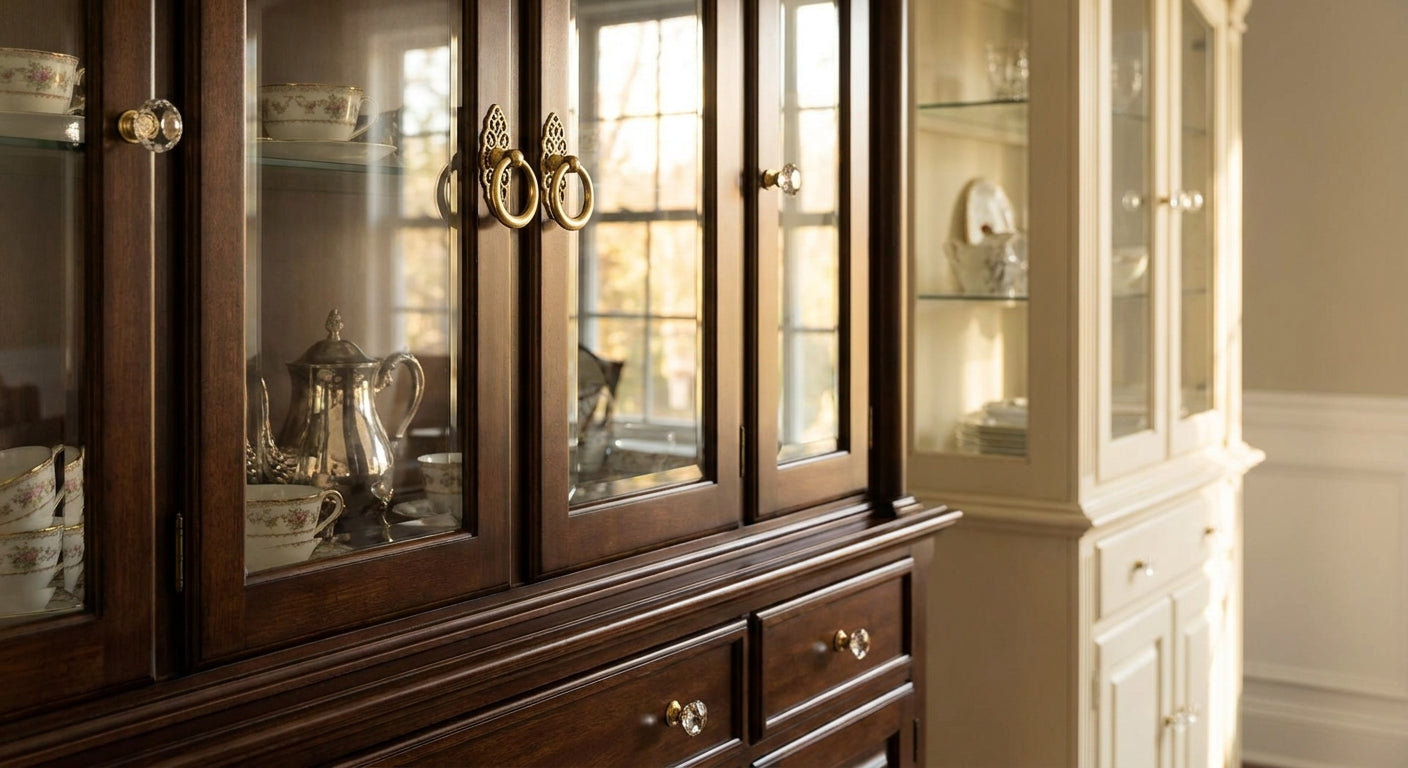
China cabinets and curio cabinets aren't kitchen cabinets, and hardware sized for a 24-inch shaker door looks wrong — or physically won't sit right — on a narrow glass-front stile. This guide covers what actually fits china cabinet and curio cabinet doors in 2026, with specific knobs worth buying and a few that look right in a photo but fail on the door.
- Schaub and Company 704-PN polished nickel knob fits narrow china cabinet stiles at 1-1/2 inch — Buy.
- Britannia Victoria pewter antique knob suits antique-correct restorations with a 1-1/4 inch backplate — Buy.
- Skip appliance-scale bar pulls on curio cabinet glass doors; anything over 5 inches stresses thin mullions.
- Cabinet hardware for china cabinets should weigh less and sit smaller than kitchen hardware — match the knob to stile width first, finish second.
Shop the picks from this guide
In stock at Knobs.co · Free shipping on hardware orders $99+ · 110% price match
-
 Alno
Alno A1032 1'' Brass Cabinet KnobPolished Brass
Alno
Alno A1032 1'' Brass Cabinet KnobPolished Brass
$13.46
$14.95 -
 Alno
Alno A726 Charlie's 3 1/2'' CC Cabinet PullAntique English / 3''
Alno
Alno A726 Charlie's 3 1/2'' CC Cabinet PullAntique English / 3''
$24.26
$26.95 -
 Alno
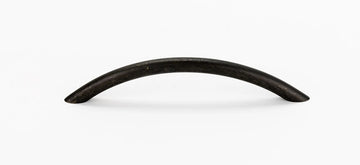
Alno A1298 128mm 5'' CC Brass Cabinet PullBarcelona
Alno
Alno A1298 128mm 5'' CC Brass Cabinet PullBarcelona
$19.76
$21.95 -
 Alno
Alno A1033 1 1/8'' Brass Cabinet KnobPolished Brass
Alno
Alno A1033 1 1/8'' Brass Cabinet KnobPolished Brass
$18.86
$20.95 -
 Alno
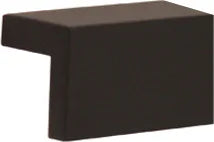
Alno A960 Tab 1 1/2'' CC Brass Cabinet PullBronze / 3/4''
Alno
Alno A960 Tab 1 1/2'' CC Brass Cabinet PullBronze / 3/4''
$16.16
$17.95 -
 Alno
Alno A1145 1 1/4'' Brass Cabinet KnobBarcelona
Alno
Alno A1145 1 1/4'' Brass Cabinet KnobBarcelona
$17.96
$19.95


Why this matters
A china cabinet or curio cabinet is display furniture, not a daily-use workhorse like a kitchen bank of drawers. The door gets opened a handful of times a week, the glass panels are thin, and the stiles framing them are often narrower than a standard kitchen cabinet door. Hardware picked for kitchen scale — big bar pulls, appliance pulls, anything over 5 inches — either overhangs the stile or looks disproportionate against the glass.
Get the size and finish wrong on a china cabinet and you notice it every time you walk past. Get it wrong on an antique piece and you can devalue it. That's the real stakes here in 2026: this isn't about durability testing, it's about proportion and finish matching.
Who this is for
This guide is for homeowners restoring a china cabinet, curio cabinet, hutch, or built-in display case — pieces with glass-front doors, narrow face frames, and usually one or two small drawers underneath. If you're also outfitting a full kitchen remodel, Knobs.co stocks over 50,000 SKUs of cabinet hardware for that job too, but the sizing rules on this page are specific to display and curio-style furniture, not kitchen cabinetry.
What to look for in cabinet hardware for china cabinets
Backplate size that clears narrow stiles
Most china cabinet doors have stiles between 1-1/4 and 2 inches wide, noticeably narrower than the 2-1/2 to 3-inch stiles common on kitchen cabinets. A knob with a 1-1/2-inch backplate or smaller centers cleanly on that stile; anything bigger crowds the glass edge or forces off-center placement, which reads as a mistake even to a non-designer's eye.
Finish that reads as furniture-grade, not kitchen-grade
Polished nickel, pewter, and polished brass finishes historically pair with formal and traditional furniture pieces, while brushed and matte finishes read more casual and kitchen-oriented. A china cabinet built in a traditional or Victorian style loses its character fast if you drop a matte black modern pull on it.
Knob vs. pull for glass-front doors
Single knobs are the default for china cabinet doors because they need only one clean mounting point near the edge of a narrow stile. Bar pulls need two mounting holes spaced across the stile width, and on anything under 2 inches wide that spacing simply doesn't exist without drilling dangerously close to the glass rebate.
Screw length and weight for thin panels
Curio cabinet doors and glass-front china cabinet panels are typically thinner than solid kitchen cabinet doors — often 5/8 to 3/4 inch versus the 3/4 to 7/8 inch standard on kitchen doors. A knob designed with a long kitchen-cabinet screw will either bottom out or protrude through the back of the panel; check screw length before you order, not after.
Matching drawer hardware to the door knobs
Most china cabinets pair one or two small drawers with a bank of glass doors above. Buying a knob for the doors and a mismatched pull for the drawers is the single most common finish error on these pieces — pick one finish family and one hardware line for the whole cabinet front.
Top picks for china cabinets and curio cabinets
The safe pick: Schaub and Company 704-PN Traditional Round Knob, Polished Nickel, 1-1/2" dia. A 1-1/2-inch diameter clears narrow stiles without crowding the glass, and polished nickel reads formal without looking dated. This is the knob to default to when the cabinet style is ambiguous — traditional enough for a Victorian curio, restrained enough for a transitional dining room hutch. Verdict: Buy.
The antique-correct pick: Britannia Victoria Knob, 1-1/4" Backplate, Pewter Antique. Pewter antique is the finish that matches original hardware on late-19th and early-20th century china cabinets, and the 1-1/4-inch backplate is smaller than most modern knob lines. If you're restoring a piece that already has period-correct hinges, this keeps the whole door consistent. Verdict: Buy.
The formal upgrade: Edgar Berebi Glendale Knob, Polished Gold finish. Edgar Berebi hardware runs decorative and detailed rather than plain, which suits a formal dining room china cabinet meant to be looked at, not just used. Polished gold is a commitment finish — confirm it matches other gold-toned fixtures in the room before you order more than one for a sample check. Verdict: Consider.
The transitional pick: Top Knobs Chareau Reeded Knob, 1-1/4", Honey Bronze. The reeded texture reads more contemporary-traditional than the fully ornate options above, which works if the china cabinet sits in a room with mixed-era furniture. Honey bronze is warmer than pewter or nickel and pairs well with wood tones rather than painted finishes. Verdict: Consider.
The brass alternative: Schaub and Company 711-03 Traditional Knob, Round, Polished Brass, 1-1/4" dia. Polished brass has cycled back into favor for formal furniture pieces after a decade of matte and black finishes dominating kitchens. At 1-1/4 inches it's on the smaller end, which is right for curio doors but tight if you're trying to cover an existing larger mounting hole. Verdict: Consider — check your existing hole size first.
For a more decorative option that leans into the display-case nature of a curio cabinet, natural stone knobs work well against glass and dark wood:


Both crystal quartz knobs weigh more than a standard metal knob, so confirm your door panel thickness before committing to more than one or two doors' worth.
What to avoid
- Appliance pulls and long bar pulls on glass doors. Anything designed for a 12- to 18-inch appliance front needs two widely spaced mounting holes that don't exist on a narrow curio stile — and visually, a 12-inch pull on an 18-inch glass door looks borrowed from a different piece of furniture entirely.
- Oversized decorative knobs on thin panels. A heavy resin or crystal knob that looks fine on a solid kitchen door can pull loose over time on a 5/8-inch curio panel if the screw doesn't have enough material to bite into.
- Mixing matte black or brushed steel with a traditional cabinet body. These finishes read as modern-kitchen by association in 2026, and they clash hard against carved wood, mullioned glass, or a piece with any age to it.
If you're restoring an actual antique rather than a reproduction, the finish-matching stakes are higher — a separate guide covers picking cabinet knobs specifically for antique dresser restoration, and the same logic applies to china cabinets built in the same era.
Verdict comparison
| Product | Size | Finish | Best for | Verdict |
|---|---|---|---|---|
| Schaub and Company 704-PN | 1-1/2" dia | Polished nickel | Ambiguous or transitional styles | Buy |
| Britannia Victoria Knob | 1-1/4" backplate | Pewter antique | Period-correct restorations | Buy |
| Edgar Berebi Glendale | Standard knob | Polished gold | Formal dining rooms | Consider |
| Top Knobs Chareau Reeded | 1-1/4" | Honey bronze | Transitional mixed-era rooms | Consider |
| Schaub and Company 711-03 | 1-1/4" dia | Polished brass | Matching existing brass fixtures | Consider |
FAQ
What size knob fits a china cabinet door?
A 1-1/4 to 1-1/2 inch diameter knob fits most china cabinet doors in 2026 because the stiles framing the glass are typically narrower than kitchen cabinet stiles. Anything larger than 1-1/2 inches tends to crowd the glass edge.
Should I use knobs or pulls on a curio cabinet?
Use knobs on curio cabinet glass doors in nearly every case. Bar pulls need two mounting holes spaced wider than most curio stiles allow, while a single knob mounts cleanly near the stile edge.
Is polished nickel or pewter better for a traditional china cabinet?
Pewter antique finish suits pieces built in a period style or actual antiques, while polished nickel works across a wider range of traditional and transitional cabinets. Neither is objectively better — match it to the era of the piece.
How much does cabinet hardware for china cabinets cost?
Traditional metal knobs in the sizes covered here generally run in the same range as standard cabinet knobs, with decorative options like crystal quartz knobs priced higher per piece. Check current pricing on Knobs.co for exact figures by finish and line.
What screw length do I need for a curio cabinet door?
Curio and china cabinet doors typically run 5/8 to 3/4 inch thick, thinner than the 3/4 to 7/8 inch standard on kitchen doors. Measure your panel before ordering, since a screw sized for kitchen doors will often be too long.
Can I mix finishes between the door knobs and drawer pulls on a china cabinet?
No — mismatched finishes between doors and drawers are the most common styling error on china cabinets. Pick one finish family for the entire cabinet front, doors and drawers included.
Are crystal or stone knobs durable enough for daily use?
Crystal quartz knobs work fine on cabinets opened occasionally, like most china cabinets, but they weigh more than standard metal knobs and need adequate panel thickness to mount securely long term.
What's the difference between hardware for kitchen cabinets and china cabinets?
Kitchen cabinet hardware is sized for daily use and wider stiles, running 3 to 12 inches for pulls. China cabinet hardware skews smaller and lighter, usually single knobs under 1-1/2 inches, because the doors are narrower and opened far less often.
One last thing
The detail most people skip: measure the stile width before you shop, not the door glass. A china cabinet with a 1-3/8-inch stile and a 1-1/2-inch knob still leaves an eighth-inch of clearance on each side — tight but workable. Drop that knob to 1-3/4 inches and you're drilling into the glass rebate. Order a sample from Knobs.co before committing to a full set; on a piece this visible, a five-dollar sample beats a returned box of ten mismatched knobs.


