

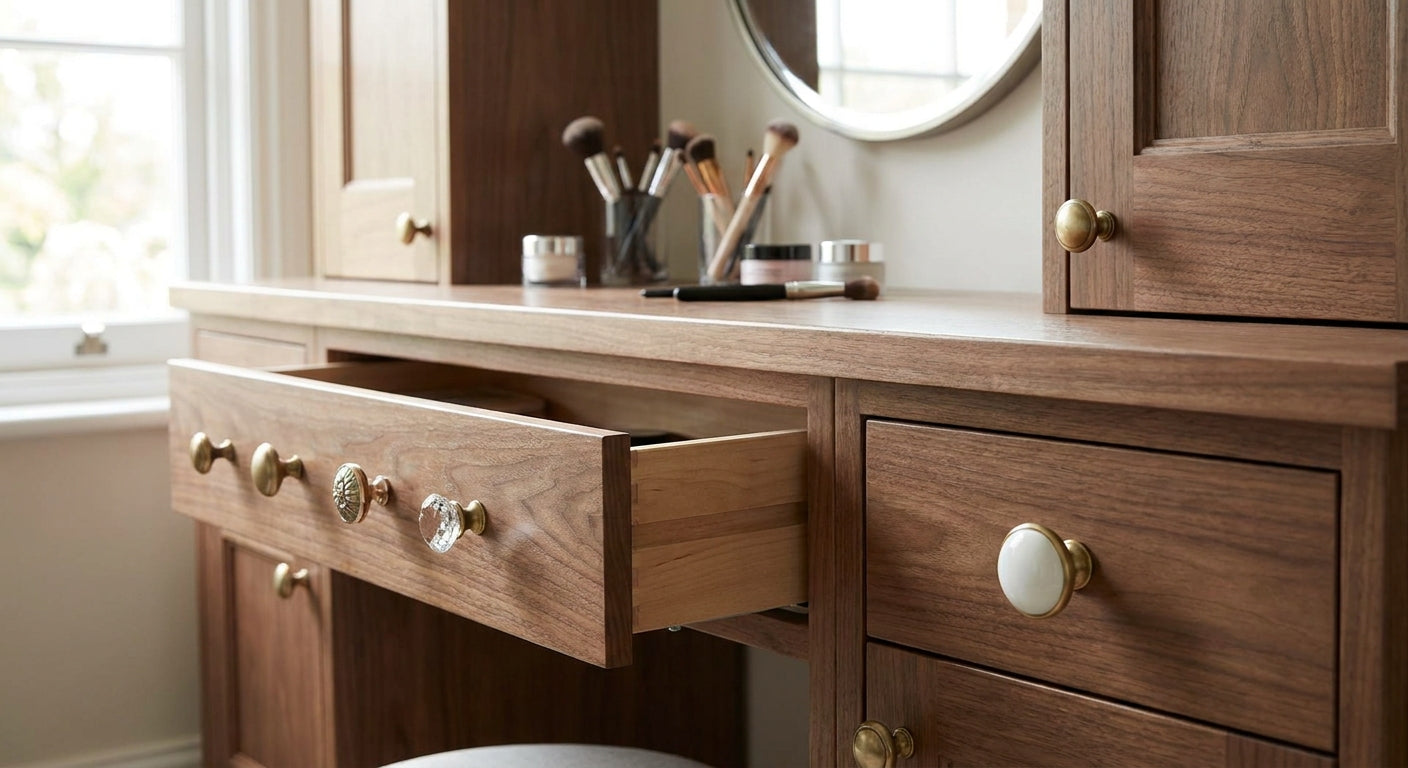
Built-in vanity drawers are usually 3 to 5 inches deep and get touched with lotion-covered or ring-covered hands multiple times a day — the wrong knob turns a pretty vanity into a daily snag hazard. This guide covers what actually matters when picking cabinet knobs for makeup vanity table drawers in 2026, plus four specific picks worth ordering.
- Schaub 704-PN Traditional Round Knob at 1-1/2 inch wins for polished nickel vanities in 2026 — Buy.
- Cabinet knobs for makeup vanity table drawers need 1-1/4 to 1-1/2 inch knobs, not oversized 6-inch-plus bar pulls.
- Britannia's Victoria Knob with a 1-1/4 inch backplate covers old screw holes on antique vanity restorations — Buy.
- Skip unlacquered brass and deep sculptural backplates near a humid vanity area — they tarnish or snag stockings.
Shop the picks from this guide
In stock at Knobs.co · Free shipping on hardware orders $99+ · 110% price match
-
 Alno
Alno A1032 1'' Brass Cabinet KnobPolished Brass
Alno
Alno A1032 1'' Brass Cabinet KnobPolished Brass
$13.46
$14.95 -
 Alno
Alno A726 Charlie's 3 1/2'' CC Cabinet PullAntique English / 3''
Alno
Alno A726 Charlie's 3 1/2'' CC Cabinet PullAntique English / 3''
$24.26
$26.95 -
 Alno
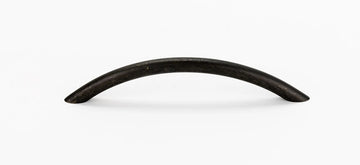
Alno A1298 128mm 5'' CC Brass Cabinet PullBarcelona
Alno
Alno A1298 128mm 5'' CC Brass Cabinet PullBarcelona
$19.76
$21.95 -
 Alno
Alno A1033 1 1/8'' Brass Cabinet KnobPolished Brass
Alno
Alno A1033 1 1/8'' Brass Cabinet KnobPolished Brass
$18.86
$20.95 -
 Alno
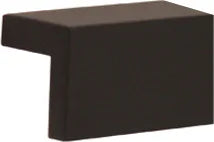
Alno A960 Tab 1 1/2'' CC Brass Cabinet PullBronze / 3/4''
Alno
Alno A960 Tab 1 1/2'' CC Brass Cabinet PullBronze / 3/4''
$16.16
$17.95 -
 Alno
Alno A1145 1 1/4'' Brass Cabinet KnobBarcelona
Alno
Alno A1145 1 1/4'' Brass Cabinet KnobBarcelona
$17.96
$19.95


Why this matters
Most vanity table drawers are narrower than kitchen drawers and shallower than bathroom vanity drawers, which means the standard 3-inch bar pull or 6-inch appliance pull that works everywhere else in the house looks clunky here. A vanity drawer also gets opened one-handed, often while seated, often with wet or product-covered fingers. Knob geometry that ignores that use case is the single most common mistake homeowners make when choosing the right cabinet knob size for a built-in vanity.
Get the diameter, finish, and grip profile right and a vanity's hardware disappears into the design. Get it wrong and every drawer opening becomes a two-handed negotiation with a knob that's either too small to grip or too ornate to grip comfortably.
Who this is for
This guide is for homeowners finishing a built-in makeup vanity table — new construction, a bathroom remodel, or a furniture conversion — who need knobs sized and finished for shallow, frequently-touched drawers rather than full-depth kitchen or dresser drawers. It also applies to interior designers speccing vanity hardware for a client where the mirror, faucet, and drawer pulls all need to read as one finish family.
What to look for in cabinet knobs for a makeup vanity table
Diameter matched to a narrow drawer face
Most built-in vanity drawer fronts run 4 to 8 inches tall, which rules out anything larger than a 1-1/2 inch knob. A knob under 1-1/4 inch disappears visually on a drawer that size; anything past 1-1/2 inch starts crowding a narrow rail and can interfere with an adjacent mirror frame or drawer stack.
Finish that shrugs off makeup and lotion residue
Vanity drawers get touched with foundation, lotion, and hairspray residue daily. Polished nickel and brushed bronze finishes wipe clean with a damp cloth; unlacquered or living-finish brass will patina unevenly wherever fingers land most, which some homeowners like and most don't expect.
Backplate coverage for existing screw holes
If the vanity is a furniture conversion or an older piece getting new hardware, a backplate that's at least as wide as the old hole spacing saves you from filling and refinishing drawer fronts. Skip this on new-build vanities where holes are drilled fresh.
Grip depth for one-handed, seated use
A vanity gets opened while someone is sitting in front of a mirror, often with one hand still holding a brush or phone. A knob with at least 3/8 inch of standoff from the drawer face gives fingers room to hook underneath; flush or low-profile knobs force a fingernail grip that gets old fast.
Style match to the mirror and faucet finish
A vanity area is a small, tightly viewed zone — the drawer hardware, mirror frame, and faucet finish all sit in the same sightline. Matching or intentionally coordinating those three finishes reads as designed; mismatching them by accident reads as unfinished.
Tarnish resistance near humidity
Vanities placed inside or adjacent to a bathroom deal with steam and humidity spikes even without direct water exposure. Plated finishes like polished nickel and brushed bronze hold up better here than raw or lacquered brass over multiple years.
Top picks for vanity table drawer knobs
The classic pick. The Schaub and Company Traditional Round Knob in polished nickel measures 1-1/2 inches in diameter — right at the top of the safe zone for a narrow vanity drawer face. Polished nickel wipes clean of lotion residue in one pass and reads correctly against most mirror and faucet trim from 2026 vanity lines. Buy for any vanity with polished or satin nickel fixtures nearby.
The warm-metal twin. Schaub and Company's Traditional Round Knob also ships in polished brass at the same 1-1/2 inch diameter, giving you the identical grip profile in a warmer tone for vanities running gold or brass faucet hardware. Polished brass needs more frequent wiping than nickel to stay bright, but the shape and comfort match its nickel sibling exactly. Consider it when the vanity's faucet and mirror are already brass-toned.
The wildcard for antique restorations. Britannia's Victoria Knob comes with a 1-1/4 inch backplate in antique pewter, sized to cover most older vanity drawer holes without redrilling. The pewter antique finish is forgiving of fingerprints and hides small dings that show up fast on brighter metals. Buy for a furniture-conversion vanity where matching old hole spacing matters more than a perfectly modern look.
The transitional option. Schaub and Company's Northport Knob Round runs 1-3/8 inches in brushed bronze — a middle-ground diameter and a finish that resists fingerprints better than polished metals. It reads more casual than the polished nickel pick, which makes it a better fit for a farmhouse or transitional vanity rather than a formal one. Consider it if the rest of the room leans warm and matte rather than polished.
What to avoid
- Appliance-length bar pulls. A 12- or 18-inch pull built for a range hood or wine cooler looks oversized on a vanity drawer 4 to 8 inches tall — save those for the kitchen.
- Deep sculptural backplates. Ornate cast backplates that project far off the drawer face catch on sleeves, stockings, and jewelry during the exact seated, close-quarters use a vanity gets.
- Unlacquered brass in a steamy bathroom nook. It looks striking in photos and patinas unevenly within months near daily steam exposure — fine if you want that look on purpose, a problem if you don't.
Verdict comparison
| Pick | Diameter/Size | Finish | Best for | Verdict |
|---|---|---|---|---|
| Schaub 704-PN Traditional Round Knob | 1-1/2 in | Polished nickel | Nickel/chrome vanity fixtures | Buy |
| Schaub 704-03 Traditional Round Knob | 1-1/2 in | Polished brass | Brass/gold vanity fixtures | Consider |
| Britannia Victoria Knob | 1-1/4 in backplate | Antique pewter | Restoring old vanity furniture | Buy |
| Schaub 211-BBZ Northport Knob | 1-3/8 in | Brushed bronze | Farmhouse or transitional vanities | Consider |
“If a knob needs two hands to open a shallow vanity drawer, it's the wrong knob.”
Most vanity drawers take a standard machine screw through a single center hole, and matching the knob's screw length to the drawer front thickness matters more than people expect — too short and the knob wobbles, too long and it protrudes inside the drawer. Order a sample before committing to a full set; a single knob in hand tells you more about grip comfort than any product photo.
FAQ
What size cabinet knob works best for a makeup vanity drawer?
A 1-1/4 to 1-1/2 inch diameter knob fits most built-in vanity drawer fronts, which typically run 4 to 8 inches tall. Anything larger starts to crowd a narrow drawer rail or an adjacent mirror frame.
Are knobs or pulls better for vanity table drawers?
Knobs work better than pulls on most vanity drawers because the drawer faces are usually too narrow for a bar pull to sit centered. A short pull under 4 inches can work on wider vanity drawers, but a knob is the safer default.
What finish resists makeup and lotion residue best?
Polished nickel and brushed bronze wipe clean of daily makeup and lotion residue with a damp cloth. Unlacquered brass patinas unevenly wherever fingers land most, which some homeowners like and others find frustrating.
Can I put backplates on a vanity that already has drilled holes?
Yes, a backplate sized to cover the existing hole spacing lets you update vanity hardware without filling and refinishing the drawer front. Measure the old hole spacing before ordering to confirm the backplate covers it.
Is polished nickel or brushed bronze better for a bathroom-adjacent vanity?
Polished nickel holds up slightly better against humidity and steam over multiple years than most bronze finishes. Brushed bronze hides fingerprints better day to day but shows less contrast against nickel or chrome faucet trim.
How many knobs does a vanity drawer need?
One centered knob is standard for a single vanity drawer under 24 inches wide. Wider drawers over 24 inches sometimes use two knobs spaced evenly, though a single centered pull is more common on vanity-scale furniture.
Should vanity drawer knobs match the mirror and faucet finish?
Matching or intentionally coordinating the knob, mirror frame, and faucet finish reads as a designed vanity area rather than an afterthought. A vanity is a small, tightly viewed zone, so finish mismatches are more noticeable here than elsewhere in a home.
What's the standard screw length for vanity drawer knobs?
Screw length depends on the drawer front thickness, and most cabinet knobs ship with a standard screw that fits typical 3/4 inch drawer fronts. Thicker or thinner drawer fronts may need a different screw length ordered separately.
One last thing
The detail most people miss on a vanity table isn't the knob at all — it's the grip clearance behind it. A knob that measures perfectly on paper can still feel wrong if it sits flush against a drawer front with no room for a fingertip to hook underneath; check the standoff distance before you order a full set, not after.


