

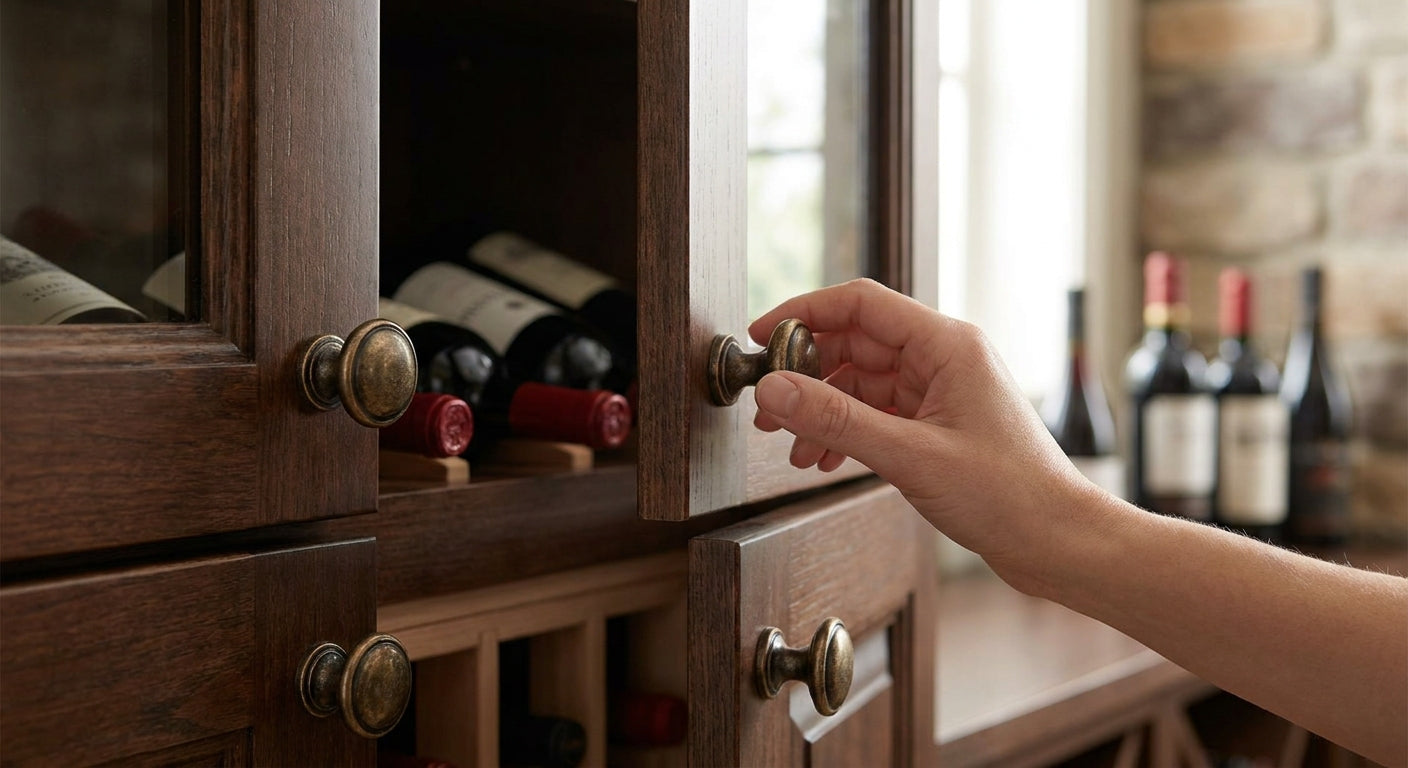
Built-in wine cellar cabinets sit in a room that punishes cheap hardware — humidity, low light, and a hand reaching for a bottle every single day. This guide narrows cabinet knobs for wine cellar builds down to finishes and sizes that hold their look past year one, not just in the showroom, going into 2026.
- Britannia Victoria Knob in pewter antique is the safe pick for cabinet knobs for wine cellar builds — buy it.
- Schaub 211-BBZ Northport Knob in brushed bronze resists humidity tarnish better than polished finishes — buy it.
- Skip polished brass and polished nickel in a cellar; both show water spots and fingerprints within months.
- Top Knobs TK320HB Chareau Reeded Knob in honey bronze suits modern glass-door cellars — consider it.
Shop the picks from this guide
In stock at Knobs.co · Free shipping on hardware orders $99+ · 110% price match
-
 Amerock
Edona 1-1/4'' diam Cabinet Knob BP53005Polished Chrome
Amerock
Edona 1-1/4'' diam Cabinet Knob BP53005Polished Chrome
$3.21
$3.77 -
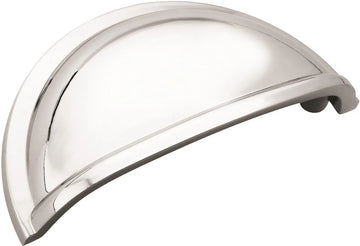 Amerock
Cup Pulls 3'' cc Cabinet Cup Pull BP53010Polished Chrome
Amerock
Cup Pulls 3'' cc Cabinet Cup Pull BP53010Polished Chrome
$4.61
$5.42 -
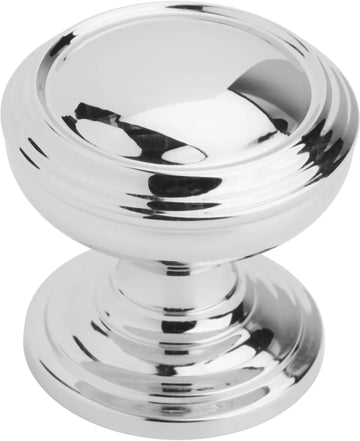 Amerock
Revitalize 1-1/4'' diam Cabinet Knob BP55342Polished Chrome
Amerock
Revitalize 1-1/4'' diam Cabinet Knob BP55342Polished Chrome
$6.42
$7.55 -
 Amerock
Edge Pull 5-1/16'' cc Cabinet Pull BP36575Polished Chrome
Amerock
Edge Pull 5-1/16'' cc Cabinet Pull BP36575Polished Chrome
$5.83
$6.85 -
 Amerock
Ravino 1-1/4'' diam Cabinet Knob BP53012Polished Chrome
Amerock
Ravino 1-1/4'' diam Cabinet Knob BP53012Polished Chrome
$2.79
$3.28 -
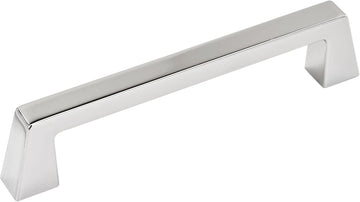 Amerock
Blackrock 5-1/16'' cc Cabinet Pull BP55277Polished Chrome
Amerock
Blackrock 5-1/16'' cc Cabinet Pull BP55277Polished Chrome
$9.63
$11.32


Why this matters
A wine cellar cabinet door gets opened in a room that's colder, damper, and darker than the rest of the house. Polished finishes that look sharp in a bright kitchen tarnish fast under those conditions, and cheap plating flakes where fingers grip it every day. If the built-in also houses a wine cooler or beverage center, the hardware around the appliance itself matters too — see appliance pulls for wine coolers and beverage centers for that half of the build. Get the knob finish wrong here and you're re-drilling holes in solid wood cabinetry in 18 months, which nobody wants in 2026 pricing on labor.
Who this is for
This guide is for homeowners finishing a built-in wine cellar or wine wall — glass-front, solid wood, or a mix — and for designers and contractors specifying hardware for a client's tasting room, wet bar cellar, or basement wine wall. It assumes cabinets that see regular hand contact, some humidity control, and a finish palette that needs to read as intentional, not leftover from the kitchen aisle.
What to look for in cabinet knobs for wine cellar cabinets
Finish that shrugs off humidity swings
Wine cellars run cooler and more humid than the rest of the house, and that condensation cycle is exactly what strips lacquer off cheap plated finishes. Brushed bronze, pewter, and oil-rubbed bronze finishes hide water spotting far better than polished brass or polished nickel, which show every fingerprint and drop under low cellar lighting.
Knob diameter sized to the door style
Glass-front wine cellar doors and thin face-frame doors both call for restraint — a knob over 1-1/2 inches across starts to compete with the glass and the wine labels behind it. A 1-3/8 inch knob reads proportionate on most cellar doors without disappearing into the design.
Backplate coverage for retrofits
If you're swapping hardware on an existing wine cellar built-in rather than building new, a backplate that covers old screw holes saves a full re-drill and re-finish. A 1-1/4 inch backplate is generally enough to hide standard legacy hole spacing without looking like a patch job.
Grip depth for one-handed bottle runs
Cellar doors get opened with a bottle already in one hand more often than kitchen cabinets do. A knob with real projection and a rounded profile grips better under those conditions than a flat, low-profile design that looks sleek but is hard to grab quickly.
Metal tone that matches the room, not just the cabinet
Wine racks, sconces, and tasting-table hardware in a dedicated cellar usually share one metal family. Matching the knob finish to that palette — rather than to whatever matched the kitchen upstairs — keeps the room from looking like two projects stitched together.
Top picks for cabinet knobs for wine cellar cabinets
The safe pick — Britannia Victoria Knob, pewter antique. This one carries a 1-1/4 inch backplate, which makes it the easiest retrofit option if you're replacing older hardware on existing wine cellar cabinetry. The pewter antique finish doesn't chase trends and won't spot under humidity the way brighter finishes do. Buy it for classic wood cellar cabinetry, especially retrofits. See the Britannia Victoria Knob.
The humidity-proof pick — Schaub and Company Northport Knob, brushed bronze, 1-3/8 inch. Brushed bronze is one of the more forgiving finishes in a damp, low-light room because it doesn't rely on a bright, unbroken surface to look good. At 1-3/8 inches diameter, it sits right in the proportionate range for most cellar door styles. Buy it as the default pick for new construction cellar builds. See the Schaub Northport Knob.
The wildcard — Top Knobs Chareau Reeded Knob, honey bronze. The reeded texture adds tactile interest that reads well against glass-front cellar doors and modern, minimal wine walls, and honey bronze is warmer than a straight bronze without going gold. It's a slightly bolder statement than the first two picks. Consider it for contemporary cellar designs, skip it if the rest of the room is strictly traditional. See the Top Knobs Chareau Reeded Knob.
If the built-in also includes door hinges that need to match the antique brass or bronze family above, coordinate them now rather than after the cabinets are hung — mismatched hinge and knob tone is one of the most common callbacks on cellar builds.


What to avoid
- Polished brass and polished nickel knobs look sharp on the showroom shelf but show every water spot and fingerprint under the low, direct lighting most cellars use. The Schaub 704-PN in polished nickel and the Schaub 704-03 in polished brass are both well-made knobs — they're just the wrong finish family for a humid, dimly lit room.
- Oversized statement knobs on glass-front doors. Anything much past 1-1/2 inches starts to visually compete with the wine labels behind the glass instead of framing them.
- Mismatched hinge and knob finishes. Buying the knob first and the hinges later, from two different finish families, is the single most common styling mistake on cellar builds — decide the metal family before you order either.
Verdict comparison
| Pick | Finish | Size | Best for | Verdict |
|---|---|---|---|---|
| Britannia Victoria Knob | Pewter antique | 1-1/4 in backplate | Retrofits, traditional wood cellars | Buy |
| Schaub Northport Knob | Brushed bronze | 1-3/8 in diameter | New construction, most cellar styles | Buy |
| Top Knobs Chareau Reeded Knob | Honey bronze | 1-1/2 in | Modern glass-front cellars | Consider |
| Schaub 704 Traditional Knob | Polished brass/nickel | 1-1/2 in | Bright kitchens, not cellars | Skip |
FAQ
What's the best cabinet knob finish for a wine cellar?
Brushed bronze, pewter antique, and oil-rubbed bronze hold up best in a wine cellar in 2026 because they don't show water spotting or fingerprints the way polished brass and polished nickel do. Matte and satin finishes generally outlast bright, reflective ones in humid rooms.
Are knobs or pulls better for wine cellar cabinet doors?
Knobs work better than pulls on most wine cellar cabinet doors because they take up less visual space next to glass fronts and wine racking. Pulls make more sense on wider drawers built into the same cellar, like bottle storage drawers below a tasting counter.
Does humidity actually damage cabinet hardware?
Yes — repeated condensation cycles strip lacquer and plating faster on bright finishes than on matte or antique finishes. A cellar that swings between cool storage temperature and room temperature accelerates this compared to a standard kitchen.
What size knob fits a glass-front wine cellar door?
A knob between 1-1/4 and 1-3/8 inches in diameter fits most glass-front wine cellar doors without overwhelming the glass panel. Anything larger than 1-1/2 inches starts to visually crowd a narrow door stile.
Can I retrofit new knobs without redrilling my existing wine cellar cabinets?
Yes, if the new knob or its backplate matches or exceeds the existing hole spacing. A knob with a 1-1/4 inch backplate, like the Britannia Victoria, covers most standard legacy holes without a redrill.
Should hardware in a wine cellar match the wine rack finish?
It should at least coordinate with the wine rack and any visible metal fixtures in the room. Mismatched metal tones between racking, hinges, and knobs is the most common visual misstep in cellar builds.
What's the difference between antique brass and unlacquered brass for cellar hardware?
Antique brass is a factory-applied finish meant to look aged from day one, while unlacquered brass is bare metal that develops its own patina over time through exposure. In a wine cellar's humid air, unlacquered brass patinas noticeably faster than it would in a dry kitchen.
One last thing
Unlacquered brass is the one finish on this list that actually gets better with the exact conditions a wine cellar throws at it. The humidity that tarnishes polished plating pushes unlacquered brass into a deeper, richer patina over months, which is why a lot of high-end cellar builds specify it on purpose instead of avoiding it. If you go that route in 2026, plan for the color to shift and don't fight it with polish.


