

Champagne Bronze vs Brushed Brass: Let the Faucet Decide
The faucet settles this one. With no gold installed yet, brushed brass gives you more shapes and wears into itself instead of wearing through.

Champagne bronze vs brushed brass comes down to one question: is there already a gold-toned faucet in the room? If there is, match the faucet and you are done. If nothing warm has been installed yet, buy brushed brass. It comes in more shapes, it holds its color against a wider range of cabinet colors, and its name describes a metal and a surface rather than a color a faucet company invented. At arm's length these two sit within a shade of each other, which is why this is a matching decision more than a style one.
Shop the picks from this guide
In stock at Knobs.co · Free shipping on hardware orders $99+ · 110% price match
-
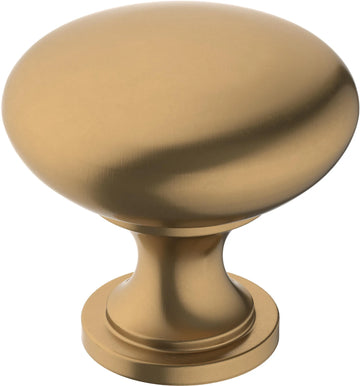 Amerock
Edona 1-1/4'' diam Cabinet Knob BP53005Champagne Bronze
Amerock
Edona 1-1/4'' diam Cabinet Knob BP53005Champagne Bronze
$3.21
$3.77 -
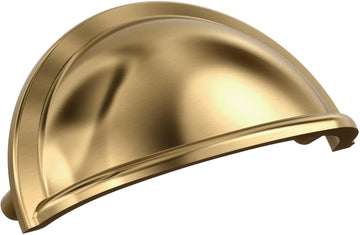 Amerock
Cup Pulls 3'' cc Cabinet Cup Pull BP53010Champagne Bronze
Amerock
Cup Pulls 3'' cc Cabinet Cup Pull BP53010Champagne Bronze
$4.61
$5.42 -
 Amerock
Revitalize 1-1/4'' diam Cabinet Knob BP55342Champagne Bronze
Amerock
Revitalize 1-1/4'' diam Cabinet Knob BP55342Champagne Bronze
$6.42
$7.55 -
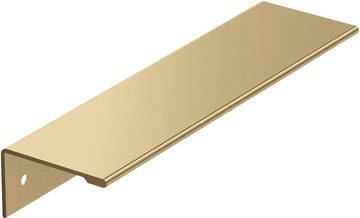 Amerock
Edge Pull 5-1/16'' cc Cabinet Pull BP36575Champagne Bronze
Amerock
Edge Pull 5-1/16'' cc Cabinet Pull BP36575Champagne Bronze
$5.83
$6.85 -
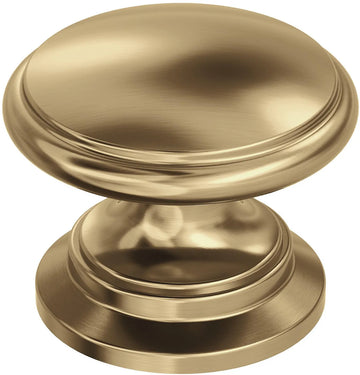 Amerock
Ravino 1-1/4'' diam Cabinet Knob BP53012Champagne Bronze
Amerock
Ravino 1-1/4'' diam Cabinet Knob BP53012Champagne Bronze
$2.79
$3.28 -
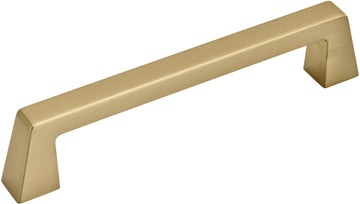 Amerock
Blackrock 5-1/16'' cc Cabinet Pull BP55277Champagne Bronze
Amerock
Blackrock 5-1/16'' cc Cabinet Pull BP55277Champagne Bronze
$9.63
$11.32

Five things you can see, side by side
The pages that rank for this comparison open with mood words: transitional, modern, warm without being loud. None of that survives contact with a real kitchen. Here is what separates champagne bronze from brushed brass on things you can check yourself, and they are the five I walk through in a consultation.
| What to compare | Champagne bronze | Brushed brass |
|---|---|---|
| Color and undertone | Warm gold pulled back toward tan and brown, low yellow | Clearly yellow gold, more saturated |
| Sheen | Satin to matte, returns light evenly | Satin with a directional grain that catches a line of light |
| How it wears | A color over a base metal, so wear shows a different color underneath | Often brass at the surface, so wear reads as patina |
| Faucet matching | Usually bought to match a faucet with the same finish name | Chosen on its own terms, agrees with warm faucets by temperature |
| Cabinet colors it holds up on | Dark and mid-tone doors, goes faint on white and cream | White through navy, can run hot on warm woods |
The last row decides most kitchens. Champagne bronze is lighter and less saturated, so it needs something dark behind it to register as hardware. Brushed brass carries its own color and shows up on nearly any door, including doors where you did not want it to speak that loudly.
One name came from a faucet, the other describes a surface
Champagne bronze began as a faucet maker's finish name, and cabinet hardware brands took it up because buyers started asking for it by name. There is no champagne bronze alloy. The word bronze in it is doing sales work, not chemistry. Brushed brass names two real things: brass, and a directional grain worked into the surface. That grain is why a brushed brass pull catches a thin line of light along its length while a champagne bronze one glows evenly with no highlight to find.
The difference matters at the order stage. No two manufacturers agree on what a finish name means, and champagne bronze drifts more than most, because each brand is matching its own reading of the original rather than a published spec. I have had two champagne bronzes from different makers land on my desk further apart than a brushed brass and a satin brass out of the same catalog. If you are matching a faucet, buy every visible piece from as few sources as you can, and get one in your hand before a whole kitchen ships.
Cabinet color flips the answer more often than style does
On white and cream doors champagne bronze goes quiet. Both are light, both are warm, and there is little value contrast left to work with, so from across the room the pulls turn into faint tan marks. That is sometimes exactly right in a small kitchen with a busy counter. It is also why I have watched someone install a full kitchen of it and ask a week later why the room looks unchanged. If you want the hardware to read as hardware on white, brushed brass does it without going to black.
On navy, forest green, charcoal and black, both finishes work, and champagne bronze is the better-behaved of the two. The door supplies the contrast, so the finish does not have to, and the softer gold keeps a dark kitchen from turning into a jewelry box. Warm woods bring the reverse problem. A tan-gold pull on a white oak or hickory door disappears, and champagne bronze is the finish most likely to do it; brass with more yellow separates by saturation even when the hue is close.
Cool gray is the one pairing I would think twice about with champagne bronze. Its brown undertone against a blue-gray door can go muddy in daylight, the way tan and gray do on a wall. Brushed brass against the same door reads as a warm-cool contrast somebody chose.
Five years in, they fail differently
Champagne bronze is a color applied to a base metal. Nothing under it is champagne bronze, so when it wears at the thumb point on a trash pull-out or the door under the sink, what comes through is a different color, and the eye reads that as damage. Brushed brass has better odds in the same spot: on solid brass hardware the surface and the substance are the same thing, so a worn edge is brighter brass, and brass aging unevenly is a look people pay extra for on purpose.
Not every brushed brass is solid brass, so that is a question to ask rather than assume. The order of durability by process holds steady whatever the color: PVD finishes wear best, electroplated finishes come next, and painted or powder-coated finishes give up at the contact points first. Pick your finish for the three hardest-worked doors in the kitchen and let the quiet ones follow, because those three are the ones that will show you were wrong.
Unlacquered brass is the same idea taken to its end: bare brass that darkens with handling and never stops moving. People who love it love it for that. Anyone who wants the kitchen to look the same in five years should stay with a lacquered or PVD brushed brass.
My call, and what it costs you
Brushed brass is the default I give people starting from nothing, and the cost is commitment. It is more yellow, it warms up further under 2700 K bulbs, and a kitchen full of it is unmistakably a brass kitchen, which is harder to walk back than a champagne bronze one when taste moves. Champagne bronze buys quiet instead. It is what I reach for when the counter has a lot of movement in it, when the backsplash is doing the talking, or when someone is nervous about gold and wants to get there by degrees.
The rule I hold to is about distance. Do not coordinate these two inside one sightline, close enough to touch both at once. A champagne bronze faucet with brushed brass pulls on the sink cabinet puts two near-identical golds close enough to compare directly, and a near miss looks like an error in a way that an open mix, brass with black, never does. On an island or a pantry across the room, nobody registers it. The sink run is the constraint, not the whole kitchen. For living with the softer gold once you have chosen it, we have a longer piece on styling champagne bronze in a kitchen.
Two tests that separate them before you order
The first is the faucet test, and almost nobody runs it correctly. Hold both samples flat against the faucet body in daylight, metal touching metal, not against a cabinet door. Hue differences that vanish at six feet are unmistakable when two metals sit edge to edge, and the faucet is the piece you cannot cheaply change your mind about later.
The second is the night test. Tape both to a door and look after dark, under the bulbs you actually cook by. Light near 2700 K pushes brushed brass toward orange and can drain champagne bronze to plain tan. Light at 4000 K and above pulls brass toward green and leaves champagne bronze slightly gray. The one that keeps its character in your daylight and your evening light is yours. Get a sample of both before you commit; the cost is refunded with your full order, and with two names this loose between makers, a screen is not evidence.
Brass vs champagne bronze: is champagne bronze a kind of brass?
Not necessarily. Brass is an alloy of copper and zinc, a material. Champagne bronze is a finish color, and it can sit on brass, on zinc or on steel. The bronze in the name does not promise a bronze alloy either. Compare it to brass as a color, and if you want solid brass for its weight, its feel or the way it ages into itself, check the material line on the spec sheet rather than the finish name.
Shop Champagne Bronze Cabinet Hardware
-
 Berkshire Cup Pull
$24.30
Berkshire Cup Pull
$24.30
-
 Berkshire Pull
$17.10
Berkshire Pull
$17.10
-
 Berkshire Appliance Pull
$165.60
Berkshire Appliance Pull
$165.60
-
 Berkshire T-Knob
$18.00
Berkshire T-Knob
$18.00
-
 Berkshire Knob Oval
$18.00
Berkshire Knob Oval
$18.00
-
 Berkshire Knob
$17.10
Berkshire Knob
$17.10
-
 Functional Hardware 3/8'' Inset Non-Self Closing Face Mount Cabinet Hinge - 1 Pair BPR3417
$5.32
Functional Hardware 3/8'' Inset Non-Self Closing Face Mount Cabinet Hinge - 1 Pair BPR3417
$5.32
-
 Functional Hardware 3/8'' Inset Self Closing Face Mount Cabinet Hinge - 1 Pair BPR3428
$4.01
Functional Hardware 3/8'' Inset Self Closing Face Mount Cabinet Hinge - 1 Pair BPR3428
$4.01


Browse all 413 in Champagne Bronze Cabinet Hardware → Cabinet knobs Cabinet pulls & handles