

How to Style Champagne Bronze Cabinet Hardware (2026)
Learn how to style champagne bronze cabinet hardware in a kitchen in 2026 — cabinet pairings, finish mixing rules, placement tips, and top product picks.

Champagne bronze hardware transforms a kitchen faster than any paint color, and in 2026 it remains one of the most searched finish upgrades on the market. This guide walks you through exactly how to style champagne bronze cabinet hardware — from cabinet color pairings to mixing metals — so every decision you make reinforces the same warm, layered look.
Shop the finish
Every champagne bronze knob and pull we carry, in one place — filter by size, style, and brand.
Browse Champagne Bronze Hardware →TL;DR: Champagne bronze pairs best with white, cream, warm gray, and natural wood cabinets. Use a consistent finish across pulls, knobs, and hinges. Avoid cool-toned metals in the same room. The Amerock Bar Pulls 8-13/16" cc in Champagne Bronze is the cleanest starting point for a champagne bronze kitchen in 2026 — it reads as transitional enough for shaker cabinets and contemporary enough for flat-front doors.
Shop the picks from this guide
In stock at Knobs.co · Free shipping on hardware orders $99+ · 110% price match
-
 Top Knobs
Amwell Bar Pull 8 13/16'' Honey Bronze M2604
Top Knobs
Amwell Bar Pull 8 13/16'' Honey Bronze M2604
$20.93
$23.25 -
 Amerock
Bar Pulls 8-13/16 inch cc Cabinet Pull BP40521Champagne Bronze
Amerock
Bar Pulls 8-13/16 inch cc Cabinet Pull BP40521Champagne Bronze
$11.93
$14.03 -
 Amerock
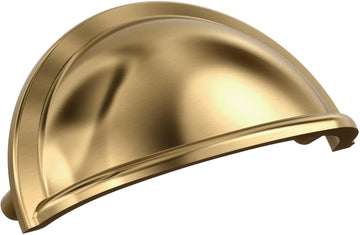
Cup Pulls 3'' cc Cabinet Cup Pull BP53010Champagne Bronze
Amerock
Cup Pulls 3'' cc Cabinet Cup Pull BP53010Champagne Bronze
$4.61
$5.42 -
 Amerock
Versa 1-3/8'' diam Cabinet Knob BP36904Champagne Bronze
Amerock
Versa 1-3/8'' diam Cabinet Knob BP36904Champagne Bronze
$5.35
$6.29 -
 Amerock
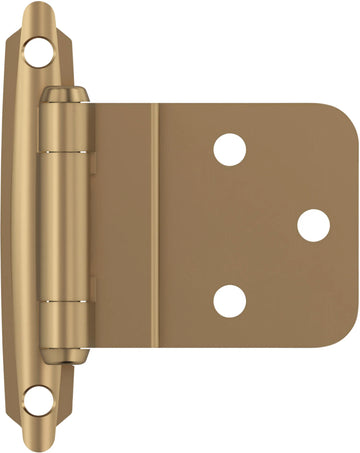
Functional Hardware 3/8'' Inset Self Closing Face Mount Cabinet Hinge - 1 Pair BPR3428Champagne Bronze
Amerock
Functional Hardware 3/8'' Inset Self Closing Face Mount Cabinet Hinge - 1 Pair BPR3428Champagne Bronze
$5.96
$7.01


Why champagne bronze works in kitchens right now
Champagne bronze sits between polished brass and brushed nickel on the warm-metal spectrum. It reads as gold in warm light and tan in cool light, which gives it unusual flexibility. Designers specify it for transitional kitchens because it doesn't date the space the way high-polish brass did in the 1980s, and it adds warmth that matte black and brushed nickel cannot. In 2026, the finish appears in new construction spec packages, whole-home renovations, and single-room refreshes alike.
What you'll need
- Your existing cabinet door and drawer measurements (hole center-to-center for pulls, door thickness for knobs)
- A finish sample or swatch of your cabinet color
- A screwdriver (Phillips or flathead depending on your current hardware)
- A template or tape measure for consistent pull placement
- 15–30 minutes per cabinet run for hardware swap-out
- A clear picture of your countertop material and faucet finish before you order
Step 1: Confirm your cabinet color is a match
Lock in the cabinet-to-finish pairing before you order a single pull.
Champagne bronze is warm and slightly golden. It requires a cabinet color that does not fight that warmth. The pairings below work in 2026 kitchens because the undertones align:
- White and off-white cabinets — The contrast reads as clean without going as stark as matte black. Warm whites (LRV 82–88) work better than bright cool whites.
- Cream and greige cabinets — The closest match on the color wheel. Hardware almost disappears into the cabinetry in a way that feels intentional, not lazy.
- Sage and muted olive green — The earthy green undertone pulls the bronze's warmth forward. One of the highest-performing combinations in 2026 kitchen design.
- Natural wood tones (walnut, white oak, maple) — Champagne bronze reads as an extension of the wood grain rather than a contrast piece.
- Navy and deep blue — Works only when the blue has a warm or neutral undertone. Cool-toned navy fights the bronze.
What to avoid at Step 1: Cool gray cabinets (blue-gray or green-gray undertones). They make champagne bronze look brassy and out of place. If your cabinets are a cool gray, brushed nickel is the cleaner call — the brushed nickel finish collection at Knobs.co is the logical alternative.
Step 2: Choose the right hardware style for your door profile
The hardware silhouette must match the door construction, not just the finish.
Champagne bronze is available across nearly every hardware style, but three profiles dominate kitchen applications in 2026:
Bar pulls
The default choice for flat-front (slab) and shaker cabinets. A 5-inch center-to-center bar pull on a standard 18-inch drawer face hits the visual center perfectly. The Amerock BP40521 bar pull — available at Knobs.co in Champagne Bronze — is a direct match for this use case: an 8-13/16-inch center-to-center spacing and a clean cylindrical profile.
Cup pulls
Better on inset and beaded-inset cabinets. The curved profile echoes the door's dimensional detail. Size them at 3-inch center-to-center for standard drawers — the Amerock BP53010 cup pull comes in Champagne Bronze at exactly that spacing.
Round knobs
Use knobs only on doors, never drawers. A 1-3/8-inch diameter is the standard for a 12–15-inch door height — the Amerock BP36904 Versa knob is available in Champagne Bronze at that exact diameter. Pairing a knob on doors with a matching bar pull on drawers is the most common professional spec for champagne bronze kitchens.
Common mistake at Step 2: Ordering knobs for drawers. Knobs create torque on a pull motion and wear out the wood faster. Every drawer gets a pull; every door gets a knob or pull depending on personal preference.
Step 3: Decide on a consistent finish strategy across all hardware
Champagne bronze only works as an anchor finish — it cannot be a supporting player.
This means: every piece of hardware in the kitchen that touches a cabinet — pulls, knobs, hinges — should be champagne bronze. Mixing champagne bronze pulls with chrome hinges, for example, fractures the look. The hinge is visible every time the door opens, and the cool chrome reads as a mistake.
For hinges specifically:
- Concealed (European) hinges: finish does not matter because they are invisible when the door is closed. No action required.
- Exposed hinges: order champagne bronze to match — the Amerock BPR3428 self-closing hinge offers a Champagne Bronze finish option. Matching the hinge finish is non-negotiable for achieving a finished look in 2026.
Expected outcome: A kitchen where every visible metal surface on cabinetry shares the same warm, muted gold tone. This is what designers call a "single-finish" kitchen — it reads as intentional from across the room.
Step 4: Address the faucet and appliance finishes
The faucet is the loudest metal in the kitchen — it either confirms or contradicts the hardware choice.
Champagne bronze hardware pairs with:
- Champagne bronze faucet — The cleanest outcome. Brands like Moen and Delta both offer champagne bronze faucet lines in 2026.
- Unlacquered brass faucet — Acceptable because unlacquered brass and champagne bronze share warm yellow undertones, even though the patina will differ over time.
- Matte black faucet — Works only as an intentional contrast in a two-tone kitchen where matte black also appears somewhere on the cabinetry.
What does not work: A polished chrome or stainless steel faucet paired with champagne bronze hardware. Chrome is cool-toned; champagne bronze is warm. The two finishes read as a mistake, not a design choice.
For appliance pulls on panel-ready or integrated appliances, keep the same champagne bronze finish. Knobs.co carries appliance pulls sized for refrigerator panels and dishwasher panels — use the same finish family you chose for your cabinets.
Step 5: Place and install hardware at the correct position
Placement consistency matters more than the hardware itself.
Standard placement rules for 2026 kitchens:
- Upper cabinet doors: Pull centered horizontally, positioned 2.5–3 inches from the bottom rail of the door.
- Lower cabinet doors: Pull centered horizontally, positioned 2.5–3 inches from the top rail of the door.
- Drawer faces under 6 inches tall: Single centered pull.
- Drawer faces 6–24 inches tall: Single pull centered on the face.
- Drawer faces over 24 inches tall: Two pulls, each positioned 1/3 from either end of the face.
Use a drill template — a piece of pegboard or a commercial template jig — to keep every pull at an identical height across all doors. Off-by-1/4-inch variations are invisible on a single door and glaring across a full run of 20 doors.
Common mistake at Step 5: Installing pulls on upper cabinets at the same vertical position as lower cabinets. They should mirror each other: upper cabinet pulls go at the bottom of the door, lower cabinet pulls go at the top. This creates a visual symmetry that reads as deliberate when the kitchen is viewed as a whole.
Matching champagne bronze cabinet hardware to a champagne bronze faucet
Champagne bronze is not one fixed color across brands. Faucet lines from Moen, Delta, and Kohler apply it as a PVD coating. Champagne bronze cabinet hardware is usually plated or powder-coated instead. Both processes aim for the same muted warm gold with a grey cast. But the ratio of gold to grey shifts from one manufacturer to the next. One brand's champagne bronze can lean closer to brass, while another reads almost pewter.
Compare the actual faucet and the actual pull in the same room. Do this under the same light, before you order hardware for a full kitchen. Holding a sample pull against the faucet spout for thirty seconds tells you more than any product photo. If the two are close but not identical, that is normal and usually fine. A faucet and a cabinet pull sit at different heights, and shoppers rarely compare them side by side.
A near-match becomes a problem only when the pull and faucet sit within a few inches of each other. That happens on a sink base cabinet, for instance. There, match finish families as closely as you can. Or pick a faucet finish with enough contrast to read as deliberate, not a near miss.
Champagne bronze with stainless steel, chrome or black
Champagne bronze pairs well with stainless steel appliances. Both read as neutral metals, not as competing colors. The warm gold in the hardware sits comfortably next to the cool gray of a refrigerator or range. This combination shows up constantly in real kitchens, not as a rare exception.
Polished chrome is the finish that consistently clashes with it. Chrome is bright and distinctly cool-toned. Set next to champagne bronze, it reads as mismatched hardware rather than an intentional mix. Matte black behaves differently. Used sparingly, on a light fixture or one accent piece, it can sharpen a champagne bronze kitchen rather than compete with it.
Champagne bronze also holds up better than polished brass around a sink. Its muted, slightly grey surface hides water spots that show up fast on a high-shine finish.
Will champagne bronze go out of style?
No. Champagne bronze is a muted, warm-gold finish, and muted metals do not move through trend cycles the way high-shine finishes do. Polished brass has swung in and out of favor for decades. It was a 1980s staple, then unwelcome for twenty years, then back in demand. That boom-and-bust pattern comes from the shine, not the underlying color.
The grey cast in champagne bronze keeps it closer to a neutral than a statement finish. It behaves more like brushed nickel or matte black: a background choice, not a spotlight one. On white cabinets, it reads as warm hardware, not the yellow flash of polished brass. That keeps it from dating a room the way brass can.
Expect champagne bronze to hold its footing in transitional and traditional kitchens for years, not seasons.
Troubleshooting
The hardware looks too yellow under my kitchen lighting. Your light source has a cool color temperature (above 4000K). Switch to bulbs in the 2700–3000K range. Warm LED bulbs pull out the bronze undertone in champagne bronze and suppress the gold flash.
The champagne bronze clashes with my stainless appliances. Stainless is a cool-toned neutral, and champagne bronze pairs with it well. Any clash usually comes from mixing too many other metals in the room, not from the stainless itself. Two fixes: (1) replace the faucet with a champagne bronze or matte black fixture to give the eye a warm anchor, or (2) add a warm wood element — open shelving, a butcher block section, a wood hood vent — that mediates between the stainless and the bronze.
The finish looks uneven across different hardware brands. Champagne bronze is not a standardized finish name across manufacturers. Amerock, Belwith-Keeler, Hickory Hardware, and Sietto each offer a Champagne Bronze option in our catalog, and the shade differs from one to the next. Some brands use a different name for a similar warm, muted-gold tone — Top Knobs' closest match is called Honey Bronze, not Champagne Bronze. Stick to one manufacturer for all hardware in the same visual zone (e.g., all island hardware from one brand, all perimeter hardware from one brand if mixing is unavoidable).
My pulls arrived scratched. Champagne bronze PVD finishes are harder than lacquer-over-brass but still susceptible to abrasion during installation. Use a soft cloth between the screwdriver and the pull face when tightening. Never use power tools on the final turn.
The hole spacing on my existing hardware doesn't match the new pulls. Most bar pulls ship in standard center-to-center increments: 3", 3.75", 5", 6.25", 8". Measure your existing holes before ordering. If the spacing is non-standard, you may need to fill the old holes with wood filler and re-drill — a 20-minute repair per cabinet face.
The champagne bronze reads as too formal for my casual kitchen. Scale down. A smaller, simpler profile — a thin round knob rather than a sculptural bail pull — keeps the warmth of the finish without adding formality. Flat-bar pulls under 5 inches read as casual; ornate backplates read as formal.
Tools and resources
- Drill template jig (available at hardware stores)
- Screwdriver set with soft-grip handles
- Painter's tape for marking placement before drilling
- Wood filler for old hole repair
- Amerock BP40521 Bar Pulls — the recommended starting pull for a champagne bronze kitchen in 2026 (choose the Champagne Bronze finish)
- Appliance pulls at Knobs.co — for refrigerator and dishwasher panel matching
What to do next
Once the hardware is installed, the next decision is whether to extend the champagne bronze finish into adjacent spaces — the laundry room, the butler's pantry, the powder bath. Consistent finish language across connected rooms is what separates a room refresh from a whole-home design. Read the how to match appliance pulls to cabinet hardware guide for the specific rules on keeping finish families aligned across appliance and cabinet hardware in one kitchen.
FAQ
What cabinet colors go best with champagne bronze hardware? White, cream, greige, sage green, warm gray, and natural wood tones all pair well with champagne bronze. Avoid cool gray or blue-gray cabinets — the warm undertone of the finish reads as brassy against cool paint.
Can you mix champagne bronze with brushed nickel in a kitchen? Technically yes, but only as an intentional contrast in a two-zone kitchen (e.g., island in one finish, perimeter in another). Randomly mixing the two reads as incomplete. If you mix, keep each finish contained to a specific zone and make sure both metals appear at least twice so neither looks like an accident.
How do I clean champagne bronze cabinet hardware? Wipe with a soft damp cloth and mild dish soap. Dry immediately. Avoid abrasive cleaners, bleach, and vinegar — acidic cleaners strip the PVD or lacquer coating. Most manufacturers recommend cleaning monthly in high-use kitchens in 2026.
Is champagne bronze hardware going out of style? Not in 2026. It is the dominant warm-metal finish in transitional and traditional kitchen design. Polished brass comes and goes; champagne bronze is the muted, lower-maintenance version that tends to have longer staying power in kitchen design cycles.
What size pull should I use for kitchen cabinets? For upper and lower doors, a 3–4-inch center-to-center pull on a standard 12–15-inch door height is proportional. For drawers, match the pull length to roughly one-third the drawer width. A 36-inch-wide drawer bank takes a 12–14-inch pull; a standard 18-inch drawer takes a 5–6-inch pull.
Does champagne bronze hardware work in a modern kitchen? Yes, specifically in warm-toned modern kitchens with white oak, walnut, or warm white flat-front cabinets. In a cool-toned all-white modern kitchen with stainless appliances, matte black or brushed nickel reads cleaner.
How much does champagne bronze cabinet hardware cost? Entry-level champagne bronze pulls sit at the low end of the price range, aimed at builder-grade jobs. Mid-range Champagne Bronze options from brands like Amerock and Hickory Hardware cost more per pull. Solid brass champagne bronze hardware from specialty manufacturers sits at the top of the range, and it is the option that ages best over time.
Can I use champagne bronze hardware with a white farmhouse sink? Yes. A white apron-front sink with a champagne bronze bridge faucet and matching cabinet hardware is one of the most published kitchen combinations in 2026 design media. The warm metal against the white ceramic reads as classic without being predictable.
One last thing
Champagne bronze is one of the few hardware finishes that ages gracefully if the underlying metal is solid brass. Lacquered finishes wear faster than PVD-coated solid brass. When you're comparing products, check the base material listed on the product page — "champagne bronze" applied over zamak (zinc alloy) can look identical in a photo but won't hold up the same way in a high-traffic kitchen.
Related guides
- How to match appliance pulls to cabinet hardware
- Best mid-century modern pulls in brushed brass
- How to style black hardware on white cabinets
Shop Champagne Bronze Cabinet Hardware
-
 Berkshire Cup Pull
$24.30
Berkshire Cup Pull
$24.30
-
 Berkshire Pull
$17.10
Berkshire Pull
$17.10
-
 Berkshire Appliance Pull
$165.60
Berkshire Appliance Pull
$165.60
-
 Berkshire T-Knob
$18.00
Berkshire T-Knob
$18.00
-
 Berkshire Knob Oval
$18.00
Berkshire Knob Oval
$18.00
-
 Berkshire Knob
$17.10
Berkshire Knob
$17.10
-
 Functional Hardware 3/8'' Inset Non-Self Closing Face Mount Cabinet Hinge - 1 Pair BPR3417
$5.32
Functional Hardware 3/8'' Inset Non-Self Closing Face Mount Cabinet Hinge - 1 Pair BPR3417
$5.32
-
 Functional Hardware 3/8'' Inset Self Closing Face Mount Cabinet Hinge - 1 Pair BPR3428
$5.96
Functional Hardware 3/8'' Inset Self Closing Face Mount Cabinet Hinge - 1 Pair BPR3428
$5.96


Browse all 412 in Champagne Bronze Cabinet Hardware → Cabinet knobs Cabinet pulls & handles