

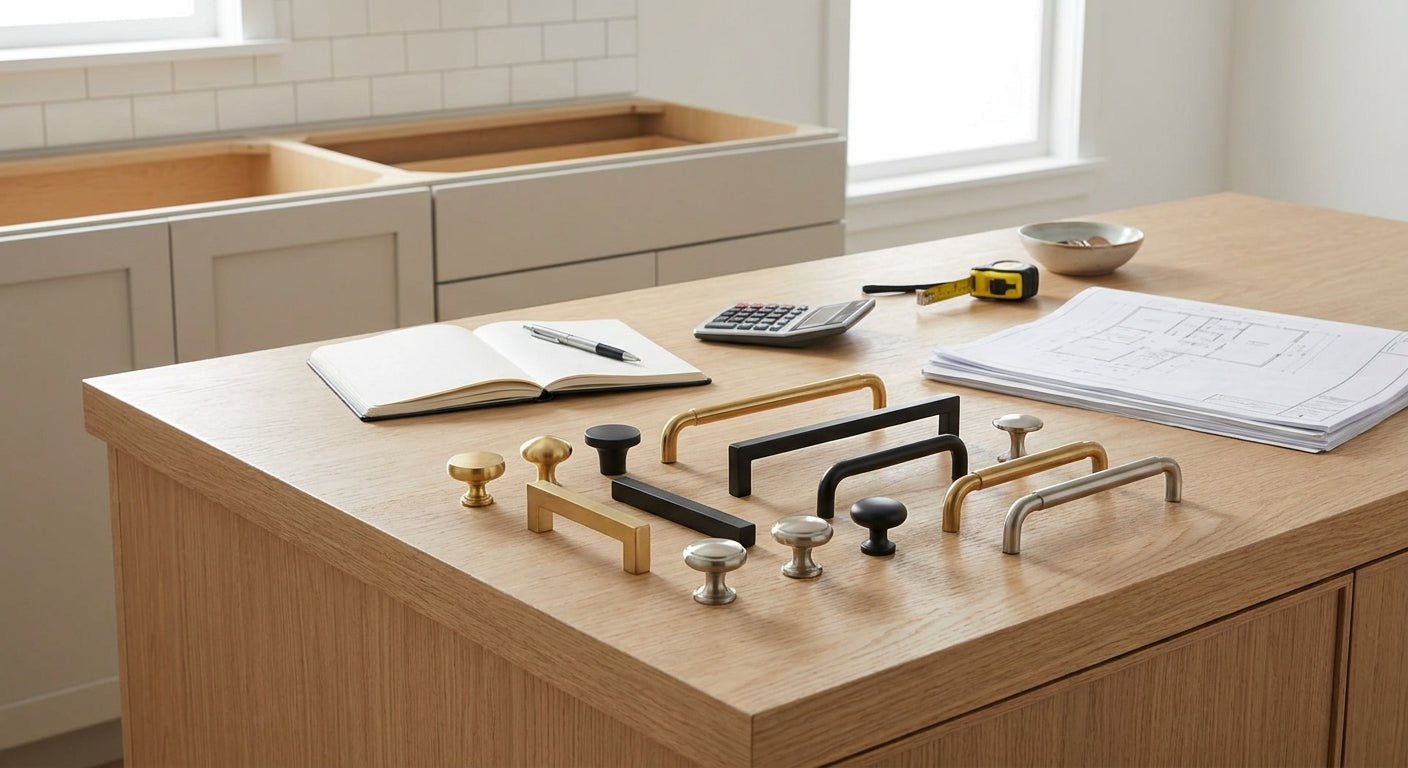
Budgeting cabinet hardware for a full kitchen remodel comes down to one calculation most homeowners skip: counting doors and drawers before picking finishes. Get the math right and hardware runs 2-4% of a remodel budget; get it wrong and you're reordering mid-install.
TL;DR
A cabinet hardware budget for a full kitchen remodel starts with an accurate piece count, not a finish choice. Most kitchens need 30-45 knobs or pulls plus hinges and drawer slides, and pricing ranges from $3 a knob for budget lines to $40+ for designer pulls like Atlas Homewares or Top Knobs. Verdict: budget $400-$1,800 total for a 30-40 piece kitchen in 2026, plus a 10% contingency for breakage, mismeasures, and the one drawer you forgot to count. Order samples before buying in bulk — it's the single step that prevents the most expensive mistake in this process.
Why this matters
Cabinet hardware is one of the last line items homeowners price out during a kitchen remodel, and it's the one most likely to get shortchanged. You've already spent on cabinets, countertops, and appliances by the time hardware comes up, so the instinct is to grab whatever's cheapest.
That's a mistake for two reasons. Hardware touches every cabinet door and drawer in the room, so it's the most-handled surface in your kitchen. And unlike paint or backsplash, it's genuinely inexpensive to get right if you budget for it correctly from the start in 2026.
What you'll need
- A cabinet door and drawer count (walk the kitchen with a notepad or the cabinet shop drawings)
- A center-to-center measurement for existing pull holes, if you're not drilling new ones
- A target price-per-piece range (budget, mid-range, designer)
- A 10% contingency line in your budget spreadsheet
- Sample pieces before you commit to a full order — cabinet hardware samples let you check finish and feel in your actual kitchen light
- A drill and template jig if you're installing hardware yourself
The steps
1. Count every door and drawer, not just the ones you'll see
Walk the kitchen and count cabinet doors, drawers, and any appliance panels that need pulls — dishwasher fronts, panel-ready fridge doors, trash pullouts. Most full kitchens land between 30 and 45 pieces total. Missing appliance pulls is the most common undercount, since they're easy to forget when you're focused on the main cabinet run.
Common mistake: budgeting for cabinet doors only and forgetting drawers need their own pull or knob, which can add 8-12 pieces to your count.
2. Decide knobs, pulls, or a mix — and price each separately
Knobs typically run cheaper per piece than pulls, and many kitchens mix knobs on doors with bar pulls on drawers. Get a real price range by looking at an actual SKU: an Atlas Homewares Alaire pull at 8-13/16" gives you a mid-range reference point to build your per-piece budget around, rather than guessing.
Price this in two tiers — budget line and designer line — since most remodels end up blending both to hit a total number.
3. Multiply piece count by price-per-piece for a subtotal
Take your door/drawer count from step 1 and multiply by your chosen price tier. A 35-piece kitchen at $8 average lands around $280; the same kitchen at $25 average designer pulls runs $875. This subtotal is your hardware-only number before hinges, slides, or accessories.
Expected outcome: a single dollar figure you can compare against your total remodel budget, which should keep hardware in that 2-4% range for most projects in 2026.
4. Add functional hardware — hinges and drawer slides
If you're keeping existing cabinet boxes but replacing doors, or building new cabinets, concealed hinges and drawer slides are a separate line from decorative knobs and pulls. These get overlooked because they're invisible once installed, but a full kitchen can need 60-80 hinges and 15-20 sets of slides depending on drawer count.
Common mistake: forgetting hinges entirely because the cabinet shop assumed you'd source them, and vice versa. Confirm in writing who's buying hinges before you finalize either budget.
5. Order samples before you commit to bulk quantities
This is the step that saves the most money in the long run. A finish that looks right on a screen can read differently under kitchen lighting, and reordering 35 pieces because the finish is wrong costs more than a sample order ever would. Order two or three finish options and hold them against your cabinet doors and countertop before locking your final selection.
6. Build in a 10% contingency
Add 10% to your hardware subtotal for breakage during install, a miscounted drawer, or a finish that needs backplates you didn't originally price. This is standard practice across most home improvement budgeting and it applies just as directly to hardware as it does to tile or flooring.
7. Compare vendor pricing before you lock quantities
Cabinet hardware pricing is largely set by the manufacturer, not the retailer, so the real variable across vendors is shipping cost, price-matching, and sample availability — not the sticker price on the knob itself. Confirm whether a retailer offers free shipping and a price match before placing a full-kitchen order, since that's where the actual savings show up.
8. Place the order with a buffer, not the exact count
Order 5-10% more pieces than your exact count to cover damaged-in-transit pieces or a miscounted drawer you find during install. It's cheaper to return a few extra knobs than to reorder a single piece at standard shipping rates weeks into your 2026 remodel timeline.
Troubleshooting
Problem: your hardware subtotal is blowing past 4% of total remodel cost. Drop the designer-tier pulls to a mix of budget knobs on doors and mid-range pulls on drawers only — most kitchens don't need every piece at the top price tier.
Problem: you measured pull spacing wrong and holes don't line up. Check how to measure cabinet pull hole spacing before drilling anything — this is the single most common install error and it's not a hardware defect, it's a measurement one.
Problem: finishes look mismatched once installed. This usually traces back to skipping the sample step. Order samples under your actual kitchen lighting before the next batch ships.
Problem: you forgot appliance pulls in your original count. Go back to step 1 and re-walk the kitchen counting panel-ready appliances specifically — this alone can shift your budget by $50-150.
Problem: hinges weren't included in either your cabinet quote or your hardware budget. Get written confirmation from your cabinet installer on who's sourcing hinges before finalizing your hardware order.
Tools and resources
- A tape measure and center-to-center gauge for existing hole spacing
- A cordless drill with the correct bit size for your chosen hardware
- A cabinet hardware jig for repeatable, level placement across dozens of pieces
- Sample pieces from your finish shortlist before bulk ordering
- A written cabinet count from your installer or cabinet shop drawings, cross-checked against your own walkthrough
What to do next
Once your budget number is set, the next decision is picking finish and style across the whole kitchen rather than door by door — see best cabinet pulls for a whole kitchen remodel for how to keep finish consistent across knobs, pulls, and appliance hardware in one pass.
FAQ
What's a reasonable cabinet hardware budget for a full kitchen remodel? Most full kitchens land between $400 and $1,800 for 30-45 pieces of hardware in 2026, depending on whether you choose budget knobs or designer pulls. Add 10% contingency on top of that subtotal for breakage or miscounts.
Is it cheaper to buy knobs or pulls? Knobs are generally cheaper per piece than pulls because they use less material and simpler hardware. Most kitchens mix both — knobs on doors, pulls on drawers — to control overall cost.
How many pieces of hardware does an average kitchen need? 30-45 pieces covers doors, drawers, and appliance panels for most full kitchens. Undercounting appliance pulls is the most common reason budgets fall short mid-project.
Should I order samples before buying hardware in bulk? Yes — sample pieces before a full order every time, since finish color shifts under real kitchen lighting compared to a screen or catalog photo. It's the cheapest insurance in the entire budgeting process.
Does cabinet hardware pricing vary much between retailers? Hardware pricing is largely set by the manufacturer, so the real difference between retailers is shipping cost and price-matching, not the sticker price itself. Confirm shipping and price-match terms before comparing two vendors on price alone.
Do I need to budget separately for hinges and drawer slides? Yes — concealed hinges and drawer slides are functional hardware separate from decorative knobs and pulls, and a full kitchen can need 60-80 hinges alone. Confirm with your cabinet installer who's sourcing these before finalizing either budget.
How much contingency should I add to a cabinet hardware budget? Add 10% on top of your hardware subtotal to cover breakage, miscounts, or a finish upgrade you didn't originally price. This mirrors standard contingency practice used across other remodel budget lines.
What's the biggest mistake people make budgeting for cabinet hardware? Skipping the physical door-and-drawer count and estimating instead — this is what causes budgets to run short by $100-300 mid-remodel. Walk the kitchen with a notepad before you price anything.
One last thing
The piece that blows most hardware budgets isn't the knob — it's the backplate. If you're covering old screw holes from a previous hardware style, budgeting backplates into your per-piece cost from the start avoids a second, unplanned order once you discover the holes don't match your new pulls.