

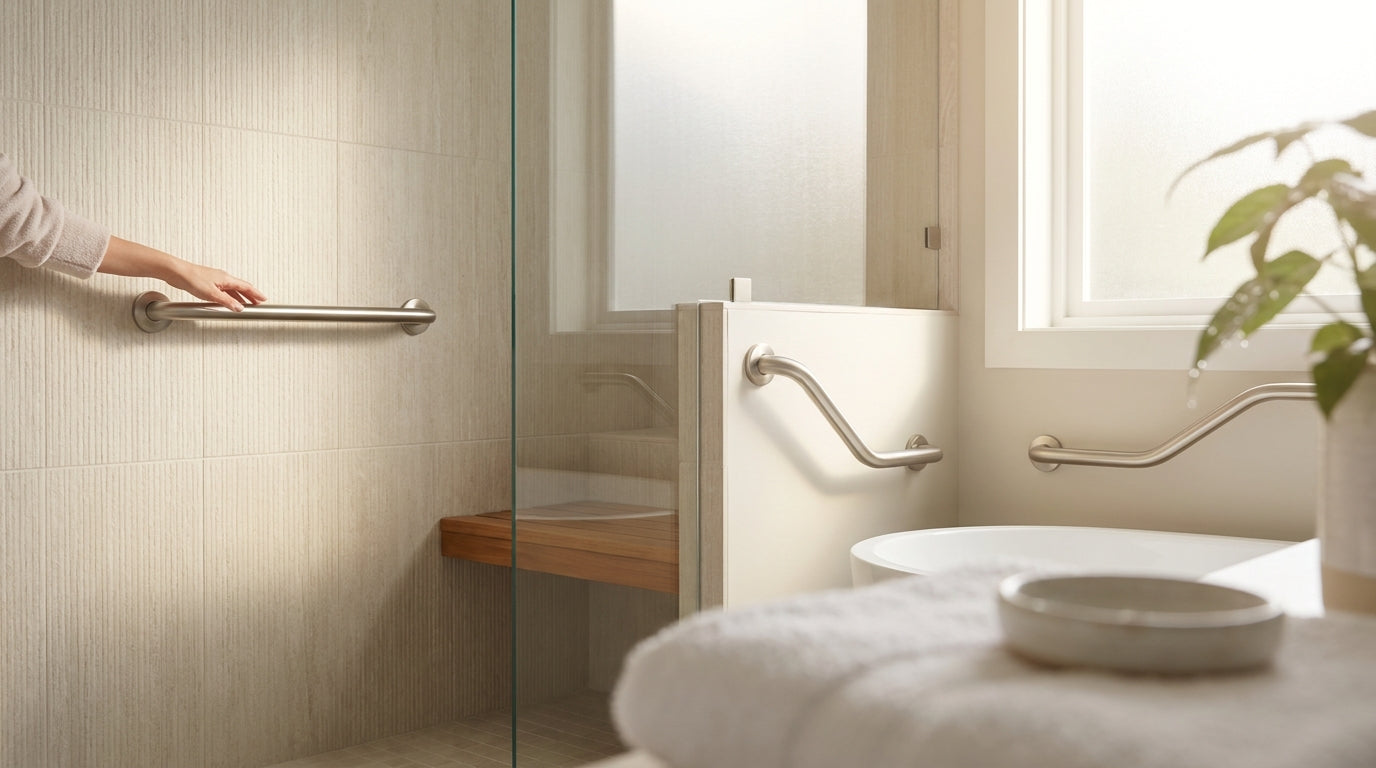
Grab bars are the one piece of bathroom hardware where looks matter less than the numbers behind them — weight rating, mounting method, and grip diameter decide whether the thing holds a person up or comes off the wall in someone's hand.
Shop grab bars
Every grab bar we carry, in one place — filter by length, finish, and load rating.
Browse Grab Bars →TL;DR
How to choose a grab bar for a bathroom in 2026 comes down to three specs: weight rating, mounting method, and diameter. Buy a bar rated to at least 250 pounds (the ANSI A117.1 standard used in accessible design calls for 500 pounds), mounted into wall studs or code-rated blocking, with a grip diameter between 1-1/4 and 1-1/2 inches. Skip anything sold as a decorative towel bar for grip support — towel bars aren't load-tested and will pull straight out of drywall under real weight. Match the finish to the rest of the bathroom's hardware so the bar reads as a fixture, not an afterthought bolted on in 2026 after a fall scare.
Why this matters
A grab bar only works if it's rated for the load and anchored into something solid. Two numbers matter more than any other spec on the package: the weight rating and the mounting requirement. A bar rated for 250 pounds mounted into a single drywall anchor is not the same product as a bar rated for 500 pounds mounted into three studs — even if they look identical in the box.
Most bathroom falls happen at the tub, shower, and toilet transitions, which is exactly why building codes specify grab bar placement at those three zones. Getting the hardware finish wrong isn't a safety issue, but it's the detail that makes a homeowner rip the bar back out during the next remodel — so it's worth solving both problems at once.
What you'll need
- Stud finder (electronic or magnetic) or a mounting plate rated for hollow-wall installs
- Drill with a wood bit for studs and a masonry/tile bit if you're going through tile
- Grab bar rated for a minimum of 250 pounds, ideally ANSI A117.1-rated at 500 pounds
- Level and pencil for marking mounting points
- Adjustable wrench and a Phillips or Torx bit matching the bar's hardware
- 100% silicone caulk (exterior-grade, mold-resistant)
- Matching-finish bathroom hardware if you're coordinating the rest of the room
The steps
1. Locate the studs — or plan around them
Stud spacing in most bathrooms runs 16 inches on center, but tub surrounds and tiled walls often have blocking installed specifically for grab bars. Run a stud finder across the whole span before you commit to a bar length. If there's no stud where you need one, you'll need a mounting plate or toggle-bolt anchors rated for the bar's full weight class — not standard drywall anchors, which typically top out well under 100 pounds.
Common mistake: drilling a pilot hole before confirming stud location, then patching and moving six inches over. Mark twice, drill once.
2. Pick the length and orientation
Bars come in 18, 24, and 32-inch straight lengths, plus angled and vertical configurations for tight corners near the toilet. A 32-inch bar mounted diagonally in a tub surround gives both a sitting and standing grip point, which is why it's the most common spec in 2026 remodels. Vertical bars near the toilet should sit within reach of someone sitting down, not just standing.
3. Confirm the grip diameter
A grip between 1-1/4 and 1-1/2 inches in diameter fits an average adult hand with enough clearance to wrap fingers fully around the bar. Anything thinner feels like a towel bar and won't take a firm grip; anything thicker is hard to close a hand around, especially for anyone with arthritis or reduced grip strength.
4. Verify the weight rating before you buy
This is the spec that gets skipped most often. A 250-pound rating is the residential minimum worth buying; 500 pounds is the ANSI A117.1 commercial and accessible-design standard, and it's a reasonable target for any household member using the bar regularly. If the packaging doesn't list a tested weight rating, don't install it as a safety bar — it's decorative only.
5. Match the finish to the rest of the room
A grab bar in the wrong finish looks like a hospital retrofit, not a bathroom feature. If the room already runs brushed nickel or polished chrome on towel bars and robe hooks, buy the grab bar in that same finish family. Knobs.co stocks bathroom hardware like the Emma bath towel bar in brushed nickel and the Alno universal robe hook specifically so the rest of the room's hardware can match whatever grab bar finish gets installed.
Common mistake: buying a grab bar in "oil-rubbed bronze" from one brand and a towel bar in "venetian bronze" from another — the two bronzes rarely match under bathroom lighting.
6. Mount and seal it properly
Drill pilot holes at the marked stud locations, drive the mounting screws until snug (not stripped), then run a bead of silicone caulk around each base plate. The caulk isn't decorative — it keeps water out of the wall cavity behind the anchor points, which is where rot and mold start in older bathrooms.
7. Load-test before anyone relies on it
Pull down and outward on the installed bar with full body weight before calling the job done. A properly anchored 500-pound-rated bar won't flex at all. Any give at the base plate means an anchor missed the stud or blocking.
Troubleshooting
- No stud lines up with the ideal spot. Use a mounting plate rated for the bar's full weight class, or add blocking behind the wall if you're mid-remodel and drywall isn't closed up yet.
- Tile cracks when drilling. Switch to a carbide-tipped masonry bit, run the drill slow, and apply painter's tape over the drill point to stop the bit from wandering.
- Bar wobbles after a few weeks. Re-torque the mounting screws first; if they're stripped, the anchor missed solid backing and needs to be relocated, not just tightened.
- Finish doesn't match anything else in the room. Swap the towel bar and robe hook to a matching finish rather than trying to match the grab bar to mismatched existing hardware — it's the cheaper fix.
- Bar sits too far from the toilet or tub edge. ADA reach guidelines put grab bars within 12 inches of the fixture they're supporting; reposition rather than relying on someone stretching for it.
Tools and resources
Knobs.co carries 50,000+ SKUs of cabinet and bathroom hardware, which makes finish-matching after a grab bar install straightforward rather than a hunt across five different retailers. Two starting points for coordinating finishes: the Emma towel bar in brushed nickel and the Alno universal robe hook. Neither is a grab bar substitute — they're the accessories that make a properly rated grab bar look like it was planned, not patched in.
What to do next
Once the grab bar is installed and load-tested, walk the rest of the bathroom's hardware and decide what else needs to match. The guide on robe hooks for bathroom walls and doors covers placement and finish pairing for the accessory most people update at the same time as a grab bar.
FAQ
What's the best grab bar for a bathroom in 2026? The best grab bar for most bathrooms is a straight or angled bar rated for at least 250 pounds, with a 1-1/4 to 1-1/2 inch grip diameter, mounted into studs or code-rated blocking. Stainless steel and powder-coated steel bars hold up best against bathroom humidity long-term.
Is a suction grab bar safe to use? Suction grab bars are not a substitute for a mounted bar and shouldn't be relied on for real weight support. Suction seals degrade with soap residue, temperature changes, and tile texture, and none carry the 250-500 pound ratings a mounted bar does.
How high should a grab bar be mounted? Most building codes and ADA guidance put horizontal grab bars 33 to 36 inches above the floor. Vertical bars near a toilet or tub edge should be positioned within easy reach of someone seated, not just standing.
Can I install a grab bar without hitting a stud? Yes, with a mounting plate or toggle-bolt anchor system rated for the bar's full weight class — but a stud or added blocking is always the stronger, more reliable option for anything rated above 250 pounds.
What's the difference between a grab bar and a towel bar? A grab bar is load-tested and rated for body weight, typically 250 to 500 pounds; a towel bar is rated only for the weight of wet towels, often under 20 pounds, and will fail if used as a grip point.
How much weight should a grab bar hold? 250 pounds is the practical residential minimum. 500 pounds is the ANSI A117.1 standard used in accessible and commercial bathroom design, and it's a safe target for household use regardless of who's using the bar.
What finish should I choose for a grab bar? Match the finish already used on the room's towel bars, robe hooks, and faucet hardware. Brushed nickel and matte black are the two most common 2026 bathroom finishes, and both have wide availability across grab bar and hardware lines.
Do I need a professional to install a grab bar? Not for a stud-mounted install with basic tools, but tile walls, no-stud locations, or anyone unsure about load-bearing anchors should bring in a contractor rather than guess.
One last thing
The detail that trips up more buyers than any spec sheet: plenty of "decorative" towel bars are shaped and sized almost identically to real grab bars, with none of the weight testing behind them. Read the packaging for an actual pound rating before mounting anything near a tub or toilet — if it doesn't list one, treat it as decorative only, no matter how sturdy it feels in the store.


