

Lazy Susan Size: Measure the Swing, Not the Cabinet
Measure from the center of rotation to the nearest obstruction, subtract an inch, double it. That number beats every cabinet-width chart online.

Lazy susan size is set by how far the tray can turn before it hits something, not by the width written on your cabinet. Find the point the tray will spin around, measure from there to the nearest thing in its way, take an inch off, and double it. That is your largest workable diameter, and you round down from there to a size that is actually made. The cabinet-width tables everywhere online are a decent starting guess for a factory kitchen, and they mislead anyone with a custom box, an older kitchen, or a blind corner, which describes most of the people who bring me this question.
Shop the picks from this guide
In stock at Knobs.co · Free shipping on hardware orders $99+ · 110% price match
-
 Rev-A-Shelf
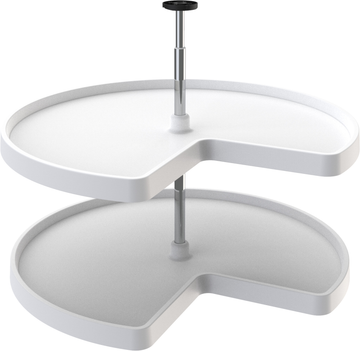
 32 in Polymer Kidney Lazy Susans 2-Shelf 3472-32-52White
Rev-A-Shelf
Rev-A-Shelf 32 in Polymer Kidney Lazy Susans 2-Shelf 3472-32-52White
$117.90
$130.99 -
 Rev-A-Shelf
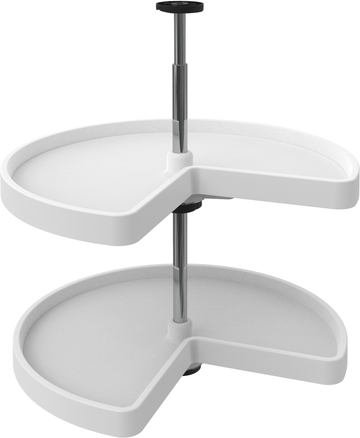
 24 in Polymer Kidney Lazy Susans 2-Shelf 3472-24-52White
Rev-A-Shelf
Rev-A-Shelf 24 in Polymer Kidney Lazy Susans 2-Shelf 3472-24-52White
$90.00
$99.99 -
 Rev-A-Shelf
 20 in Polymer Full Circle Lazy Susans 3-Shelf 3073-20-536White
Rev-A-Shelf
Rev-A-Shelf 20 in Polymer Full Circle Lazy Susans 3-Shelf 3073-20-536White
$119.70
$132.99 -
 Hardware Resources
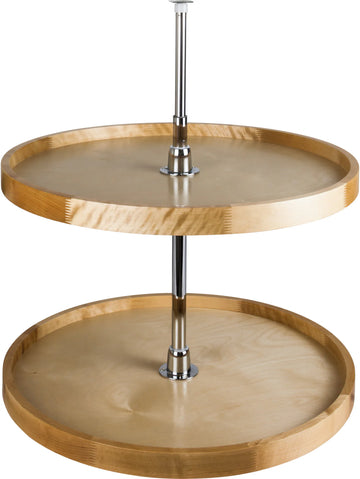
LazySusans 24'' Round Two-Shelf Wood Lazy Susan Set LSR224-SET
Hardware Resources
LazySusans 24'' Round Two-Shelf Wood Lazy Susan Set LSR224-SET
$490.50
$545.00 -
 Hardware Resources
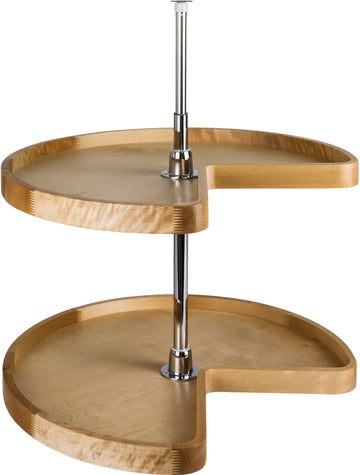
LazySusans 32'' Kidney Two-Shelf Wood Lazy Susan Set LSK232-SET
Hardware Resources
LazySusans 32'' Kidney Two-Shelf Wood Lazy Susan Set LSK232-SET
$601.84
$668.71 -
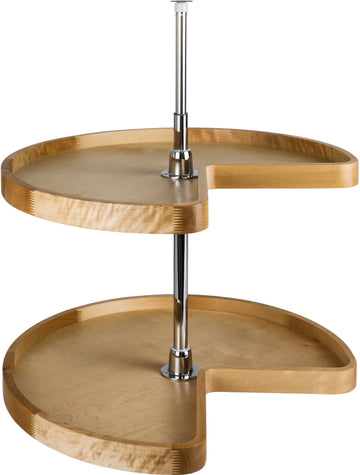 Hardware Resources
LazySusans 28'' Kidney Two-Shelf Wood Lazy Susan Set LSK228-SET
Hardware Resources
LazySusans 28'' Kidney Two-Shelf Wood Lazy Susan Set LSK228-SET
$527.39
$585.98

The swing radius is the only measurement that settles it
A rotating shelf does not care about your cabinet's face width. It cares about the radius it sweeps. So stand at the open cabinet and work out where the center of rotation lands. On a pole-mount unit that is the pole, roughly centered in the box. On an independently rotating unit it is the bearing, same place. Working from that point, measure out to the closest obstruction in every direction you can reach: the back corner, each side wall, and, the one people forget, the inner edge of the face frame on either side of the door opening. I take the shortest of those measurements, subtract about an inch, and double it.
On a factory corner base you will usually land within an inch of the chart below. On a kitchen where somebody boxed in a pipe, or where the face frame is wide, or where a previous owner added a center stile, you will land two or three inches lower, and that is exactly the case the charts get wrong. A tray an inch too wide does not rub slightly. It catches on one pass out of every turn, and that noise is the thing people cannot live with.
A lazy susan size chart is a starting guess, not an answer
| Corner cabinet | Usual tray diameter | Shape it usually takes |
|---|---|---|
| 33 in (84 cm) base | 24 to 28 in (61 to 71 cm) | Full round or kidney |
| 36 in (91 cm) base | 28 to 32 in (71 to 81 cm) | Full round |
| 39 in (99 cm) base | 32 in (81 cm) | Full round |
| Blind corner base | Set by the opening, not the width | D-shape or half-moon |
| Diagonal wall cabinet | Small end of the range | Full round |
Diameters on the market run roughly 18 to 32 in (46 to 81 cm), and the increments between them are coarse, so most people are choosing between two sizes rather than dialing in a number. When a measurement falls between two of them, I go smaller. The storage you give up on a 28 in tray instead of a 32 is one row of tall things near the rim; the storage you give up on a tray that binds is all of it, because you stop using the cabinet.
The shape is decided before the diameter, and the door decides the shape
Buying a diameter before settling the shape is the sequence error I see most. Look at the door first. A diagonal or blind corner with a plain door takes a full round. A diagonal corner with a bifold or a single door takes a kidney, whose flat side clears the frame where a circle would catch. A pie-cut is attached to a 90-degree bifold door and turns with it, so the door and the shelves are one assembly and the door hardware becomes part of the decision. D-shapes are for blind corners, where a circle would sweep into the hidden section and stop dead.
Pie-cut units are where lazy susan hardware and door hardware stop being separate purchases. The door swings well past what a normal hinge allows, so the hinges have to open wide enough to let the leading edge clear the face frame, and a knob or pull that projects too far can strike the frame on the way around. Check the swing with the shelves loaded, not empty, since a loaded tray sits lower on its bearing.
Height decides what you can actually keep in there
Diameter is the number everyone asks about and shelf spacing is the number they regret. A two-shelf unit divides the box into two fixed slots, and the taller your usual items, the fewer of them fit anywhere in the cabinet. Before I let anyone order, I ask what has to live on the bottom shelf: a stand mixer, a stock pot, a tall bottle. Measure the inside height of the box from floor to the underside of the cabinet top, then measure that item. If the tallest thing on your list will not clear the shelf above it, you need a different shelf count, not a different diameter.
Pole-mount units need something solid at the top to anchor into. Most factory corner bases have a full top or a pair of stretchers, and that is fine. A cabinet built for a countertop to sit straight on its sides may not have one, and then the pole needs a brace added across the top before anything else happens. Units that rotate independently on a base bearing skip that problem, which is why I point retrofitters at them first.
Check that the tray can physically get into the cabinet
This is the check that keeps a Saturday morning from becoming a whole Saturday. A 32 in tray does not walk through a 20 in door opening flat. It goes in tilted, corner to corner, so measure the diagonal of the opening rather than its width and height alone, and make sure you have room in front of the cabinet to angle it. I assemble in this order too: pole and lower shelf first, upper shelf after, because installing the top shelf first leaves you feeding the bottom one past it.
Two more measurements I would take before ordering. Measure the door opening height, since a deep tray with a raised rim eats more vertical room going in than its own thickness suggests. And check what sits inside the opening on the hinge side, because a concealed hinge cup and its mounting plate project into the box and are frequently the nearest obstruction of all, closer than any wall.
Adding a lazy susan to a corner cabinet that never had one
A retrofit is a different measuring job from a replacement. On a replacement, the honest shortcut is to take out the old tray and measure it, since the previous unit already solved the fit. On a retrofit, the face frame does the deciding: the inside edges of the stiles usually sit closer to the center of rotation than the cabinet walls do, so measure to them and ignore the box. Corner cabinets narrower than about 24 in rarely give a rotating shelf enough radius to be worth the trouble, and a fixed shelf with a couple of organizers in the adjacent bank gets more use out of that corner.
Most kits, including the Rev-A-Shelf pole-mount units people ask about by name, ship with a template and a sequence to follow, and the sequence matters more than the tools. Our step-by-step install walkthrough covers the mounting itself. The part I would not skip is dry-fitting the bottom shelf on the pole and spinning it by hand before a single screw goes in permanently.
What size lazy susan for a 36 corner cabinet
A 36 in corner base usually takes a 28 to 32 in tray, and which of the two depends on the face frame rather than the box. Measure from the center of rotation to the inside edge of the door opening on the tighter side; at 17 in or more you have room for a 32, and at 15 to 16 in you want the 28. The same 36 in nominal width shows up as a diagonal-front box and as a blind corner, and those two take different shapes entirely, so confirm which one you have before you shop a diameter.
Can I put a lazy susan in my kitchen counter's corner
Two different things get called the same name here. Inside the corner base cabinet under the counter, yes, and that is the whole subject above. On top of the counter, in the dead triangle behind the sink or under an upper cabinet, what you want is a turntable rather than cabinet hardware: no pole, no mounting, just a bearing plate you set down. Measure the depth from the backsplash to the counter edge and stay a couple of inches inside it, because a turntable that overhangs gets caught by a sleeve every time somebody reaches past.
Shop Lazy Susans
-
 LazySusans 24'' Round Two-Shelf Wood Lazy Susan Set LSR224-SET
$490.50
LazySusans 24'' Round Two-Shelf Wood Lazy Susan Set LSR224-SET
$490.50
-
 LazySusans 32'' Kidney Two-Shelf Wood Lazy Susan Set LSK232-SET
$601.84
LazySusans 32'' Kidney Two-Shelf Wood Lazy Susan Set LSK232-SET
$601.84
-
 LazySusans 28'' Kidney Two-Shelf Wood Lazy Susan Set LSK228-SET
$527.39
LazySusans 28'' Kidney Two-Shelf Wood Lazy Susan Set LSK228-SET
$527.39
-
 LazySusans 24'' Kidney Two-Shelf Wood Lazy Susan Set LSK224-SET
$483.30
LazySusans 24'' Kidney Two-Shelf Wood Lazy Susan Set LSK224-SET
$483.30
-
 LazySusans 38'' Wood Half-Moon Lazy Susan HMLS-W-3818
$732.96
LazySusans 38'' Wood Half-Moon Lazy Susan HMLS-W-3818
$732.96
-
 LazySusans 35'' Wood Half-Moon Lazy Susan HMLS-W-3515
$625.67
LazySusans 35'' Wood Half-Moon Lazy Susan HMLS-W-3515
$625.67
-
 LazySusans 32'' Wood Half-Moon Lazy Susan HMLS-W-3212
$541.18
LazySusans 32'' Wood Half-Moon Lazy Susan HMLS-W-3212
$541.18
-
 LazySusans 38'' Plastic Half-Moon Lazy Susan HMLS-P-3818
$467.21
LazySusans 38'' Plastic Half-Moon Lazy Susan HMLS-P-3818
$467.21


Browse all 130 in Lazy Susans → Cabinet knobs Cabinet pulls & handles