

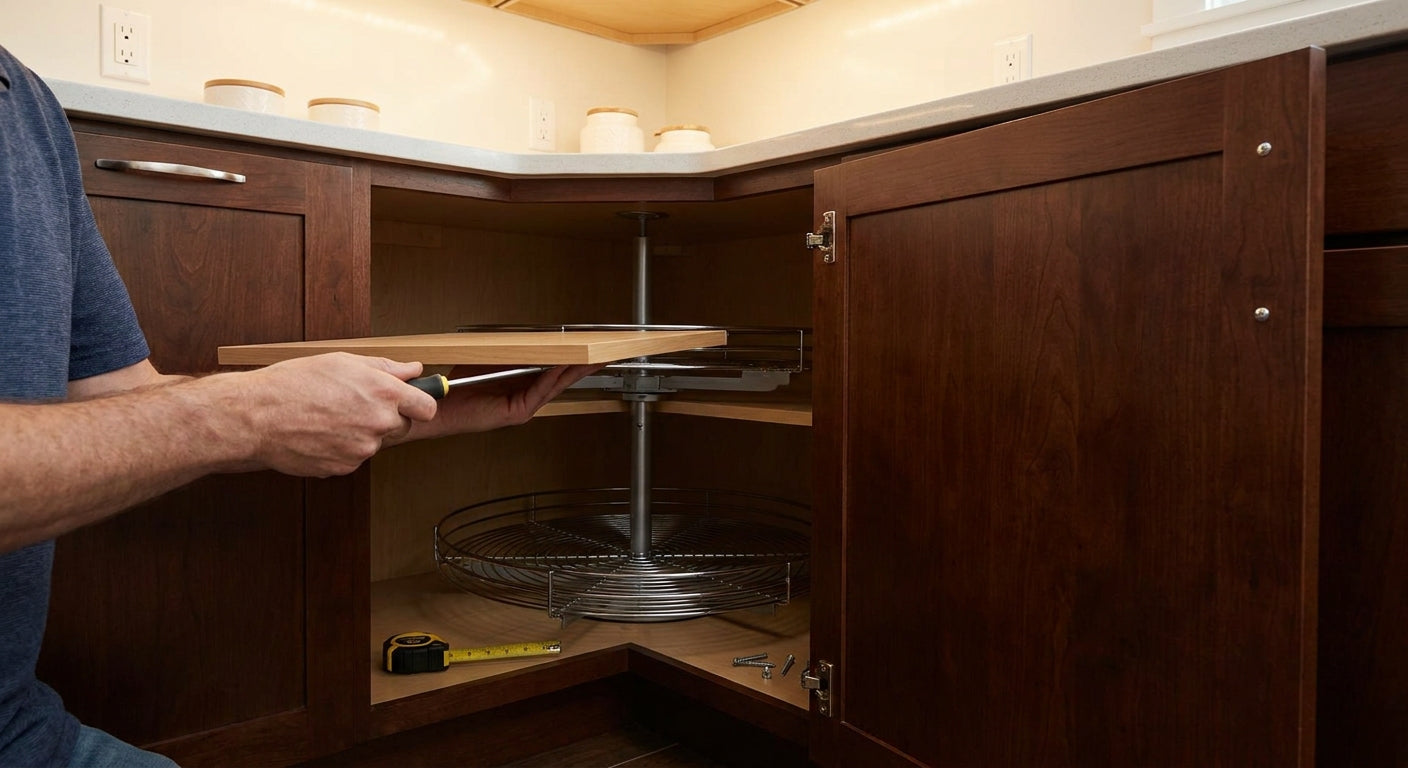
Corner base cabinets waste 30-40% of their storage volume until you put a rotating shelf inside them, and a lazy susan is the fastest fix for that dead space. This guide walks through measuring the opening, picking the right shape, and mounting the hardware so the door swings clear and the shelves spin without binding.
Shop the finish
Every polished nickel knob and pull we carry, in one place — filter by size, style, and brand.
Browse Polished Nickel Cabinet Hardware →- Measure the cabinet opening before buying - most lazy susans need a 28 to 33 inch corner base cabinet to clear the door swing.
- Full circle lazy susans fit true corner cabinets; kidney and D-shape units fit blind corner cabinets with an offset door.
- A 165-degree self-close hinge is required for lazy susan doors - standard 110-degree hinges will bind the shelf on the swing.
- Rev-A-Shelf 18 to 32 inch units run $79 to $500 depending on shelf count and material, and installation takes under 90 minutes with the right jig.
Shop the picks from this guide
In stock at Knobs.co · Free shipping on hardware orders $99+ · 110% price match
-
 Alno
Alno A1032 1'' Brass Cabinet KnobPolished Brass
Alno
Alno A1032 1'' Brass Cabinet KnobPolished Brass
$13.46
$14.95 -
 Alno
Alno A726 Charlie's 3 1/2'' CC Cabinet PullAntique English / 3''
Alno
Alno A726 Charlie's 3 1/2'' CC Cabinet PullAntique English / 3''
$24.26
$26.95 -
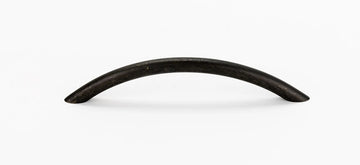 Alno
Alno A1298 128mm 5'' CC Brass Cabinet PullBarcelona
Alno
Alno A1298 128mm 5'' CC Brass Cabinet PullBarcelona
$19.76
$21.95 -
 Alno
Alno A1033 1 1/8'' Brass Cabinet KnobPolished Brass
Alno
Alno A1033 1 1/8'' Brass Cabinet KnobPolished Brass
$18.86
$20.95 -
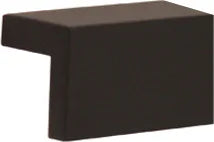 Alno
Alno A960 Tab 1 1/2'' CC Brass Cabinet PullBronze / 3/4''
Alno
Alno A960 Tab 1 1/2'' CC Brass Cabinet PullBronze / 3/4''
$16.16
$17.95 -
 Alno
Alno A1145 1 1/4'' Brass Cabinet KnobBarcelona
Alno
Alno A1145 1 1/4'' Brass Cabinet KnobBarcelona
$17.96
$19.95


Why this matters
A corner base cabinet without a lazy susan forces you to crawl in on your knees to reach anything past the first 12 inches. Once you install a lazy susan in a corner cabinet, that same space becomes fully accessible storage instead of a black hole for casserole dishes.
The install itself isn't complicated, but three things trip up most DIYers in 2026: buying the wrong shape for their cabinet type, skipping the 165-degree hinge, and mounting the center pole off-center by even a quarter inch. Get those three right and the rest is straightforward.
What you'll need
- Tape measure and a pencil
- Drill with a Phillips bit and a 1/8 inch pilot bit
- Level
- The lazy susan unit itself - full circle, kidney, D-shape, or pie-cut, sized to your cabinet
- A 165-degree self-close hinge set rated for lazy susan doors (shop hinge options for corner cabinets)
- A cabinet hardware jig if you're also swapping pulls or knobs on the door
- 30 to 90 minutes depending on whether the old shelving needs to come out first
The steps
1. Measure the cabinet opening and identify the corner type
This step determines every other purchase decision, so don't skip it. Measure the interior width of the cabinet opening at the front face frame and again at the back wall - corner cabinets are rarely square, and the difference tells you whether you have a true corner (equal walls) or a blind corner (one wall extends past the door).
Most residential corner base cabinets run 33 to 36 inches wide with a 24 to 28 inch interior diagonal. A true corner cabinet with a diagonal door takes a full circle or pie-cut lazy susan. A blind corner cabinet with an offset door takes a kidney or D-shape unit, because those shapes clear the extended wall without hitting it on rotation.
Common mistake: measuring only the door opening and ignoring the depth to the back wall. A lazy susan that's too deep for the cabinet will bind against the rear panel every time it rotates.
2. Choose the right lazy susan size and shape
Size the unit to leave at least 1 inch of clearance on every side of the rotating shelf. An 18 inch full circle unit fits most 24-27 inch corner openings; a 32 inch unit needs a 33-36 inch cabinet. Lazy susan hardware for corner kitchen cabinets breaks down sizing by cabinet width if you're not sure which measurement applies to your kitchen.
Material matters too. Polymer shelves run lighter and cost less - a Rev-A-Shelf 18 inch polymer full circle two-shelf unit runs $79.14 - while banded wood units like the 18 inch three-shelf model at $329.70 hold more weight and match wood cabinetry better.
Common mistake: buying based on the door width instead of the interior diagonal. The door can be 15 inches wide while the usable interior space is only 24 inches deep.
3. Remove the old fixed shelves and hardware
Unscrew any existing fixed shelves, shelf pins, or brackets from the cabinet interior. Most corner cabinets built before 2015 have a single fixed shelf with no rotating hardware at all, so this step is usually just removing a shelf and patching old pin holes.
Check the cabinet floor for a factory-drilled center hole - many manufactured cabinets already have a locator hole for the lazy susan pole. If yours doesn't, you'll drill one in the next step.
4. Mount the center pole and set it plumb
Center the mounting pole in the cabinet interior, measuring equal distance from both side walls. Off-center by more than a quarter inch and the shelf will scrape one wall on every rotation - this is the single most common lazy susan install mistake.
Use a level to confirm the pole sits perfectly vertical before driving the base screws. A pole that's even 2 degrees off plumb causes visible wobble at the outer edge of a 32 inch shelf.
5. Attach the rotating shelves to the post
Slide the bottom shelf onto the post first and secure it per the manufacturer's clip or screw system, then repeat for each additional tier. Two-shelf units like the Rev-A-Shelf D-shape at $147.72 are standard for most kitchens; three-shelf and five-tier units add capacity but need at least 30-32 inches of vertical clearance inside the cabinet.
Spin the shelf through a full 360 degrees by hand before moving to the door. It should rotate freely with zero drag against the back wall or side panels.
6. Install the 165-degree self-close hinges on the door
Lazy susan doors need a 165-degree hinge, not the standard 110-degree hinge used on flat cabinet doors - the wider swing angle is what lets the door clear the rotating shelf without the shelf catching on the door edge. A polished nickel concealed hinge like the Belwith HH075224-14 runs $56 and is built specifically for this application.
Mount the hinge plate to the cabinet face frame first, then attach the hinge cup to the door at the marked location. A cabinet hardware jig keeps hinge and pull placement consistent if you're drilling multiple holes on the same door.
Common mistake: reusing the old 110-degree hinges to save money. The door will bind against the shelf edge within the first few uses and eventually crack the face frame screw holes.
7. Test the full rotation with the door closed and open
Open the door fully and spin the shelf through a complete rotation, then close the door and confirm it seats flush without gapping or catching. Run this test with the shelves empty first - troubleshooting an empty unit is far easier than troubleshooting one loaded with dishes.
Adjust the hinge's depth and height screws in small increments if the door doesn't sit flush. Most hinge systems give you 2-3mm of adjustment in each direction.
8. Load the shelves and do a final weight check
Load the shelves with your heaviest typical items - mixing bowls, small appliances, canned goods - and spin again. A properly centered, plumb-mounted lazy susan should rotate with one finger even fully loaded.
Most polymer shelf units carry a 25-35 lb per-shelf rating; wood shelf units on steel bearing hardware, like the 32 inch kidney-shape unit at $273.36, handle more weight per tier without sagging.


How to fix a lazy susan that won't turn, sags or scrapes
An older lazy susan usually fails in one of four ways. Each points to a specific part, not the whole unit.
| Symptom | Likely cause | Fix |
|---|---|---|
| Tray scrapes the cabinet wall | Center pole has worked off-center, or the tray is slightly oversized for the opening | Loosen the base plate and re-center the pole; if it still scrapes, move down to a tray with more side clearance |
| Tray sags or wobbles at the outer edge | Worn bearing, a loose pole collar, or floor screws that have stripped out | Tighten or replace the pole collar, swap the worn bearing, or re-drive screws into fresh pilot holes |
| Door binds against the shelf mid-swing | A 110-degree hinge was used instead of the 165-degree hinge pie-cut doors require | Replace it with a 165-degree self-close hinge sized to your door's overlay |
| Pole-mount tray won't turn | The bearing has seized, or debris has built up in the track | Clear the track and lubricate the bearing; replace the bearing if it still won't spin freely |
| Tray spins but wobbles near the top shelf | Tall pole-mount units can flex without upper support | Add a top pivot bracket to steady the pole at the highest shelf |
Most of these repairs take under thirty minutes and don't require pulling the door off its hinges. Sometimes the pole, collar, and bearing are all original to the cabinet. In that case, a new replacement lazy susan tray is often simpler than fixing each part.
Replacing an old lazy susan in an existing corner cabinet
Measure before you order. Note the tray's outer diameter, the distance between shelf tiers, and the pole's diameter at the base plate. Those three numbers narrow down which replacement fits your cabinet.
Pole-mount trays use a single center post with clip-on shelves. They're simple to service, but the collar and bushing wear down after years of daily turns. Bearing-mount trays, sometimes called a "super susan," ride on a steel bearing ring instead of a post. They turn smoother and carry more weight per shelf. See our guide to choosing a corner cabinet organizer for help matching tray shape to your cabinet.
Check the hinge before you check out. If the existing door already runs a 165-degree hinge, keep it. Most replacement trays fit the same swing without new hardware. Reuse the door, the factory center hole in the cabinet floor, and any mounting screws that are still tight. Replace only the worn pole, collar, bearing, or shelves.
Troubleshooting
- Shelf scrapes the back wall on rotation: the center pole is off-center. Loosen the base plate and shift it toward the opposite wall in small increments until the shelf clears all sides.
- Door won't close flush: the hinge depth adjustment needs tightening or loosening - most 165-degree hinges give 2-3mm of play in the depth screw.
- Shelf wobbles at the outer edge: the pole isn't plumb. Recheck with a level and re-drive the base screws after correcting the angle.
- Rotation feels stiff or grinds: debris or sawdust in the bearing race. Wipe the bearing surface clean and check that the shelf clips are fully seated.
- Door catches the shelf mid-swing: you installed a 110-degree hinge instead of a 165-degree hinge - this is not adjustable, the hinge has to be swapped.
- Unit sags under normal load: you exceeded the per-shelf weight rating. Redistribute weight across tiers or move to a steel bearing unit rated for heavier loads.
Tools and resources
- 165-degree self-close hinges sized for your door thickness
- A drill with a sharp 1/8 inch pilot bit to avoid splitting the face frame
- How to choose the right cabinet hinge for your cabinets for hinge angle and mounting-plate compatibility
- A cabinet hardware jig for repeatable hinge and pull placement across multiple doors
- A level and tape measure for the center-pole step
What to do next
Once the lazy susan rotates cleanly and the door seats flush, check whether the rest of your kitchen's hardware finish still matches. A polished nickel hinge next to oil-rubbed bronze pulls looks unfinished - swap the door pull to match before calling the project done.
FAQ
What's the best lazy susan for a corner cabinet?
For a true corner cabinet with a diagonal door, a full circle unit like the Rev-A-Shelf 18 inch three-shelf model works best. For a blind corner cabinet with an offset door, a kidney or D-shape unit clears the extended wall on rotation.
Is a full circle or kidney shaped lazy susan better?
Full circle units maximize storage in true corner cabinets with equal wall lengths. Kidney shaped units are built for blind corner cabinets where one wall extends past the door, and a full circle unit would hit that wall on rotation.
How much does it cost to install a lazy susan?
The hardware itself runs $79 to $500 in 2026 depending on shelf count, material, and size, plus $56 or so for the required 165-degree hinge set. Most homeowners complete the install themselves in under 90 minutes without hiring labor.
Do all corner cabinets fit a lazy susan?
No - the cabinet needs at least 24 inches of interior diagonal clearance and enough vertical height for the shelf tiers you want. Cabinets under 24 inches wide typically can't fit a functional rotating unit.
What size lazy susan do I need for a 33 inch cabinet?
A 33 inch corner base cabinet typically fits a 28 to 32 inch lazy susan, leaving roughly 1 inch of clearance on each side. Measure your actual interior diagonal before buying since cabinet manufacturers vary.
How much weight can a lazy susan shelf hold?
Polymer shelf units typically carry 25 to 35 lbs per shelf. Wood shelves on steel bearing hardware, like a 32 inch kidney shape unit, handle heavier loads per tier without sagging.
Can I install a lazy susan myself?
Yes - the install requires a drill, a level, and basic measuring, and takes 30 to 90 minutes depending on whether old shelving needs removal first. The most common failure point is skipping the required 165-degree hinge.
How long does it take to install a lazy susan?
Most installs take 30 to 90 minutes once the unit and hinges are on hand. Add time if the cabinet has existing fixed shelves that need removal or old hinge holes that need patching.
One last thing
The hinge, not the shelf, is what fails first on most corner cabinet lazy susans. A shelf unit can outlast the cabinet itself, but a 110-degree hinge forced into a 165-degree job will crack the face frame screw holes within a year of daily use - buy the correct hinge the first time and you won't touch this project again.


