

Modern Farmhouse Kitchen Cabinet Hardware: One Shape, One Gesture
One plain shape in a single dark metal across the whole kitchen, and the farmhouse half of the style confined to one cabinet group you can point at.

In a modern farmhouse kitchen, the cabinet hardware that reads right is one plain, unornamented shape in a single dark metal, repeated on every drawer and door, with exactly one place where the farmhouse half of the name gets to show. A flat bar pull on the drawers, a plain round knob on the doors, is the arrangement I specify most often. The condition that changes it is standing behind you while you shop: if the appliances are stainless and the faucet is not, that room already holds two metal temperatures, and the hardware has to join one of them rather than start a third.
Shop the finish
Every black knob and pull we carry, in one place — filter by size, style, and brand.
Browse Black Cabinet Hardware →Shop the picks from this guide
In stock at Knobs.co · Free shipping on hardware orders $99+ · 110% price match
-
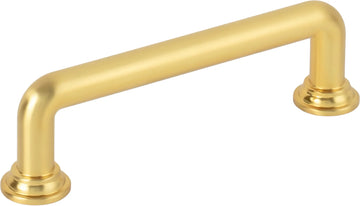 Jeffrey Alexander
Davis 96 mm cc Bar PullBrushed Gold
$10.98
$12.20 -
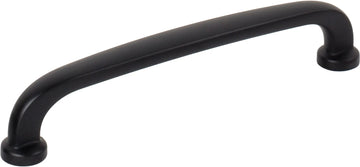 Jeffrey Alexander
Weser 128 mm cc Bar PullMatte Black
$11.02
$12.24 -
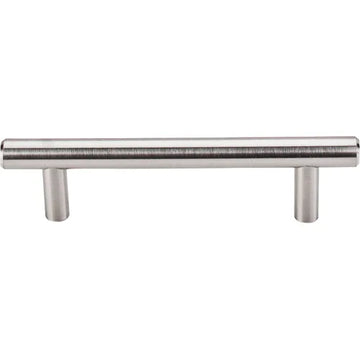 Top Knobs
Bar s Hopewell Bar Pull 3 3/4'' cc M429 Brushed Satin Nickel
$9.90
$11.00 -
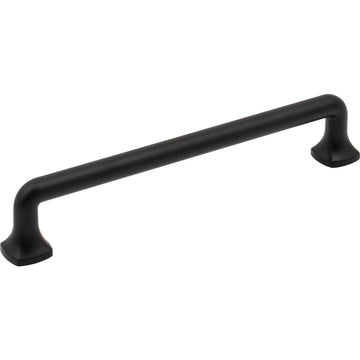 Jeffrey Alexander
Griffin 160 mm cc Bar PullMatte Black
$14.42
$16.02
The ratio is lopsided, and most kitchens get it backwards
Both words in the name have to be visible, and not in equal amounts. Rustic farmhouse gives every piece of hardware texture: hammered faces, cast bin pulls, forged iron, a patina somebody applied on purpose. Contemporary gives no piece any texture at all. Modern farmhouse is the split between those two, and the split is nearly all plain, with one cabinet group carrying the reference.
When every cabinet carries it, you have a rustic kitchen that happens to be painted white. When none does, you have a contemporary kitchen that happens to have shaker doors. The version I get called about is the first one, and it usually arrives in one order: cup pulls on all the base drawers, latches on the uppers, a bin pull on the dishwasher panel. Each piece was defensible on its own product page. Together they outvote the modern half of the brief.
The working rule is that the farmhouse gesture belongs on one cabinet group you can point at from the doorway. The sink base, or the pantry, or the run under the window. Everything else gets the plain shape. If you want the aged, textured version throughout, that is traditional farmhouse and a different brief, covered in our guide to farmhouse kitchen hardware.
Your appliances already put a cool metal in the room
The largest piece of metal in this kind of kitchen is almost never the hardware. It is a stainless refrigerator door, a stainless range front and a stainless dishwasher panel, and the style pages never mention them. Brushed stainless is cool-toned and it does not recede. Add a black faucet and warm brass pulls and someone standing in the doorway sees three metal temperatures at once.
Stainless appliances do get a partial pass, because people read them as equipment rather than as a decision anybody made. The pass runs out where a wide slab of steel sits directly beside a cabinet run. A French-door refrigerator next to a pantry puts that pantry hardware within a hand's width of brushed steel, and a warm metal there has to hold its own at close range. I ask what the appliances are before I ask what color the cabinets will be.
So count metals rather than styles. Hardware and faucet should agree on temperature, warm with warm or cool with cool, unless the mix is deliberate and has enough weight behind it to read as a decision. Where they cannot agree, the faucet wins. It is bigger, it sits at eye level, it is already installed, and nobody swaps a faucet to rescue a drawer pull.
Cup pulls earn their place on one run, not on every base drawer
The cup pull is the most legible farmhouse signal there is, which is the reason to ration it. I like them. I do not want twenty of them. Two things the style pages leave out.
First, it is open at the bottom, and open things collect. On a sink base the trough of a cup pull gathers crumbs and the fine grease film that any cooking kitchen produces, and it cleans with a brush rather than a wipe. That is a small chore repeated for years, worth knowing before you commit a whole run to it.
Second, it dictates the grip. Fingers come up from underneath, which is natural on a drawer at waist height and clumsy anywhere the hand pulls sideways or down, so a cup pull on a tall pantry door fights you every time. Cup pulls also live in a narrow band of drill centers, clustered at the short end, so on a wide island drawer one sits in the middle of a flat plane looking like a small ornament somebody dropped there. Keep them on the modest drawers. Bin pulls behave the same way behind a flatter back plate.
Matte black on white shaker is turning into a period marker
Almost everything written about this style leads with matte black, and that is a real answer rather than a lazy one. I specify it constantly. What I will not do is pretend it is neutral ground. Flat black hardware went into a very large number of kitchens alongside white shaker doors and an apron sink, all in the same stretch of years, and the eye has begun to take those three as a single date stamp instead of three independent choices. Honey oak beside mirror-polished brass stopped being two finishes and turned into 1994 by the same mechanism.
The finish is not the culprit. The agreement of all three elements is. If you want black, change one of the other two: a door that is not white shaker, or a cabinet color with some depth in it, or a second metal carrying real weight rather than one brass knob on an island, which reads as an afterthought. Breaking any single leg of the set is enough.
Two practical notes. Matte black arrives as a coating rather than a plating, most often powder or e-coat. It beats gloss on fingerprints and loses to nearly everything on dust and the grease film a range throws off, and where the coating is thin the edges give out first. Black is also not one color. Brands run from a soft charcoal with a faint sheen to a hard, dead-flat black, and a black faucet from a plumbing manufacturer seldom matches a black pull from a hardware manufacturer. Order a sample of each, hold them against the faucet; samples can be credited on a qualifying order (see our sample policy).
The honest price of my own recommendation: one plain shape in a dark metal is the most-installed look of the past decade, so you are buying the safe answer, and safe answers date on schedule. Going warm and dark instead, honey bronze or an antique brass, buys distinctiveness and costs you matching, because warm darks vary more from brand to brand than blacks do and are harder to pair with a faucet you already own.
A decorative latch needs a face frame, so check the cabinet first
The icebox latch on a pantry door is the other farmhouse gesture people fall for, and it is the one that fails at the cabinet rather than in the design. A surface-mounted latch comes in two parts: the lever on the door, and a strike that screws to the cabinet beside it. The strike needs an exposed surface to sit on.
A frameless cabinet has no face frame at all, and its doors cover the box edge to edge, leaving nothing beside the door for a strike to land on. A face-frame cabinet with a partial overlay leaves a visible band of frame, and that band is where a latch works. Inset doors are easiest of the three, since the frame sits in the same plane as the door. So close the door and look for exposed frame beside it before you order. If there is none, the surface latch you liked is decoration with nowhere to land, and the magnetic or roller catch that holds a door shut is a separate product that lives inside the cabinet.
What I would order for a kitchen like this
- One plain shape for the whole kitchen. A straight bar pull on the drawers, a plain round knob on the doors; going all pulls also works and reads a shade more modern.
- One cabinet group for the farmhouse gesture, picked from what is visible standing in the doorway rather than from what looked good in a photo of a single drawer.
- Name the faucet finish out loud before shopping, then decide whether the hardware agrees with it or opposes it on purpose. Agreeing is the call I make most.
- Close the pantry door and look for exposed face frame, if a latch is anywhere in the plan.
- Look at the final two after dark, with the kitchen lights on rather than daylight. A 2700 K bulb pushes a soft black toward brown; step up to 4000 K and that same pull turns gray-blue.
- Tape both to the real door and live with them for two days. Two companies will print the same finish name on visibly different metal, so one brand's matte black is another's flat black.
One idea to keep: the word doing the work in modern farmhouse is the first one. The farmhouse half is a single cabinet's worth of hardware, and it lands harder for being the only place it turns up.
Shop Bar Pulls
-
 Nouveau III Square Bar Pull 6 5/16'' cc M1156 Flat Black
$12.60
-
 Brockwell Stanmore 3 3/4'' cc Bar Pull
$14.04
-
 Brockwell Stanmore 5 1/16'' cc Bar Pull
$16.34
-
 Brockwell Lambert 3 3/4'' cc Bar Pull
$13.10
-
 Brockwell Stanmore 12'' cc Bar Pull
$45.32
-
 Brockwell Lambert 7 9/16'' cc Bar Pull
$22.59
-
 Brockwell Lambert 6 5/16'' cc Bar Pull
$19.40
-
 Brockwell Stanmore 7 9/16'' cc Bar Pull
$23.63


Browse all 330 in Bar Pulls → Cabinet knobs Cabinet pulls & handles