

Traditional Kitchen Cabinet Hardware: Shape First, Finish Second
A turned knob, a cup pull, a bail, all scaled to the door panel rather than the drawer. Shape is what dates a kitchen; finish only sets the mood.

Traditional kitchen cabinet hardware is a shape decision before it is a finish decision: a knob with a turned or stepped profile on the doors, a cup pull or a bail pull on the drawers, and everything scaled smaller than a modern kitchen would use. Get the shapes right and almost any warm metal reads as traditional. One condition outranks the rest. If your cabinets are face-frame with hinges showing on the outside of the doors, the hinges set the metal for the whole room, and the knobs join them rather than the other way round.
Shop the picks from this guide
In stock at Knobs.co · Free shipping on hardware orders $99+ · 110% price match
-
 Amerock
Edona 1-1/4'' diam Cabinet Knob BP53005Polished Chrome
Amerock
Edona 1-1/4'' diam Cabinet Knob BP53005Polished Chrome
$3.21
$3.77 -
 Amerock
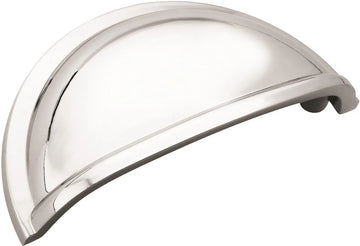
Cup Pulls 3'' cc Cabinet Cup Pull BP53010Polished Chrome
Amerock
Cup Pulls 3'' cc Cabinet Cup Pull BP53010Polished Chrome
$4.61
$5.42 -
 Amerock
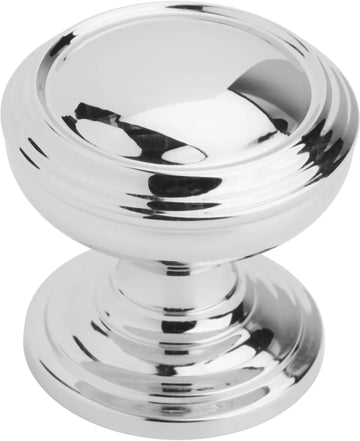
Revitalize 1-1/4'' diam Cabinet Knob BP55342Polished Chrome
Amerock
Revitalize 1-1/4'' diam Cabinet Knob BP55342Polished Chrome
$6.42
$7.55 -
 Amerock
Ravino 1-1/4'' diam Cabinet Knob BP53012Polished Chrome
Amerock
Ravino 1-1/4'' diam Cabinet Knob BP53012Polished Chrome
$2.79
$3.28 -
 Amerock
Everyday Heritage 1-1/4'' diam Cabinet Knob BP29113Satin Nickel
Amerock
Everyday Heritage 1-1/4'' diam Cabinet Knob BP29113Satin Nickel
$2.14
$2.51 -
 Amerock
Mulholland 5-1/16'' cc Cabinet Pull BP53529Polished Chrome
Amerock
Mulholland 5-1/16'' cc Cabinet Pull BP53529Polished Chrome
$10.78
$12.68


Shape carries the period, finish only sets the mood
Every guide I read while checking this answers the style question with a list of metals, and that is backwards. A straight bar pull in antique brass still reads as a modern kitchen wearing a warm color. A bail pull in matte black still reads as an old house. Shape is what the eye dates; finish is what it feels about the date.
Three things make a profile read as traditional. It is symmetrical about a vertical axis, so it looks the same reflected. It has a visible transition between its parts, a step, a collar, a turned neck, rather than one continuous extrusion. And it meets the door somewhere defined, on a rosette or a backplate or a footed post, instead of floating on two bare screw posts. Modern hardware removes all three, which is precisely what makes it modern.
Once you can see those cues you stop needing anyone's style label. The traditional range is a useful shortcut, but the cues work on any product grid in any catalog.
How to spot a traditional profile on a product grid
Photographs on a white background strip away the scale and most of the depth, so buy on silhouette. These are the cues I look for:
- A knob with a waist: an urn, a mushroom, a turned column. The neck is narrower than the head, and the base flares back out.
- A stepped or fluted edge on a round knob rather than a smooth dome.
- A cup or bin pull, which is a trough with a closed top, gripped from underneath.
- A bail: a swinging handle hung from two posts or a plate, the oldest drawer hardware still in production.
- A ring, hanging from a rosette, which belongs on a door more comfortably than on a drawer.
- An arched pull whose ends turn down into short feet, so it sits on the door rather than standing off it.
- A backplate under a knob. On a painted door it is a period cue, and it gives a small knob enough weight to hold a wide stile.
What breaks the look, in order of how often I see it: the long straight bar pull, the tab or edge pull, and the square knob with sharp unrelieved corners.
Traditional kitchen cabinet hardware is scaled to the panel, not to the drawer
This is the mistake that costs the most and gets mentioned the least. The usual rule of thumb sizes a pull at roughly a third of the drawer width, and on a slab front that works. A traditional drawer front is not a slab. It is five pieces: two rails, two stiles and a raised center panel, with an edge profile running round the inside of the frame. That inner panel is the field the hardware belongs in.
Run a pull long enough to satisfy the one-third rule on a wide five-piece front and its ends cross off the panel and onto the frame, cutting through the lines the door was built to show. So on traditional fronts I size to the panel and let the rule bend. That is why traditional kitchens land on 3 in (76 mm) and 3-3/4 in (96 mm) centers where a contemporary kitchen with the same drawer widths would be buying 5 in (128 mm) or 6-5/16 in (160 mm). Pull sizes are quoted center to center, which is the distance between the two screw holes and not the length of the piece, so measure a pull you already like from hole to hole before you compare anything.
On a drawer past about 30 in, two cup pulls spaced off the panel's ends beat one long pull, and that is the historically correct answer as well as the better looking one. For knobs, work off the stile rather than off a tape measure: center the knob in the width of the stile opposite the hinge, and land it roughly 2-1/2 to 3 in in from the corner: the bottom corner upstairs, the top corner below the counter.
If the hinges show, they decide the metal before the knobs do
Traditional cabinetry is usually face-frame, and a lot of it uses semi-concealed or surface-mounted hinges, which means part of the hinge lives on the outside of the door where you can see it. That makes the hinge a piece of visible hardware with a vote, and it votes first, because changing cabinet hinges means new screw holes in the frame and a day of realigning doors, while changing knobs means a screwdriver.
So look at a door before you shop. If a knuckle or a leaf shows, write down that finish and shop only for knobs and pulls that exist in it, which will narrow your list considerably and save you the version of this job where the pulls arrive and the hinges suddenly look wrong. Our notes on brass hinges on traditional cabinetry go further into the hinge types. If the doors use concealed European hinges, nothing is visible and you are free to choose on the knobs alone.
Cup pulls and bail pulls each come with a habit attached
Nobody selling these will tell you what living with them is like. A cup pull is a trough, mounted with the opening facing down, and a trough collects. On the drawers either side of a cooktop it gathers cooking film and crumbs, and because you grip it from inside, your fingers put that film straight back on the metal. I tell people to run a cloth along the underside every few weeks. That is a small price for the right look, but it should be a decision rather than a surprise.
Bail pulls swing, and a swinging handle taps its backplate every time the drawer closes. In a busy kitchen nobody notices. In a quiet house at eleven at night, some people find it charming and some find it a reason to change the hardware, and there is no way to know which you are until they are up. They also need a flat landing area on the drawer front that is wide enough for the plate, which is another reason to check the panel before the catalog.
Pick the finish last, and pick it for the room's temperature
With the shapes settled, finish is about mood. Antique brass reads as already lived in and forgives an old kitchen its unevenness. Unlacquered brass is the live option: it starts bright and browns where hands land, so it ages into the room instead of standing apart from it, and the catch is that a second batch ordered a year later will start over at bright. Pewter is the quiet end of the silver family, dark enough to hold its shape on white paint, and it suits a kitchen meant to look inherited. Polished nickel is the formal answer, a warm silver mirror I specify for dressy traditional kitchens with glass-front uppers, and it shows every fingerprint. The builder era's default here was oil-rubbed bronze, which lands closer to rustic than to formal, and that is fine if rustic is what you are after.
Whatever the shortlist, get samples of the two finishes on it; the cost is refunded with your full order. Leave them taped to the doors and check after dark. A bulb at 2700 K pushes every brass toward orange and warms pewter up; take the bulbs up past 4000 K and nickel turns cool while brass drifts slightly green.
Amerock traditional classics cabinet knob
That search points at a particular maker's collection rather than at a style, and it is worth knowing what sits inside it: Amerock's Traditional Classics is built largely around glass-jewelled knobs, clear and amber glass set on metal bases, offered across warm and dark finishes. Glass is a real period cue, not a novelty, and it behaves differently from metal, since it takes the color of whatever is behind it and disappears against a busy door. A glass knob earns its place on painted cabinets, on glass-front uppers, and in a bathroom, and it is the one traditional shape I would not spread across a whole kitchen.
Shop Traditional
-
 Nouveau Hollow Round Knob 1 3/16'' Honey Bronze M2205
$8.15
Nouveau Hollow Round Knob 1 3/16'' Honey Bronze M2205
$8.15
-
 Milan 96 mm cc Bar Pull 1092AB
$11.69
Milan 96 mm cc Bar Pull 1092AB
$11.69
-
 Madison 1-3/16'' Diameter Mushroom Knob 3910-SN-30
$122.58
Madison 1-3/16'' Diameter Mushroom Knob 3910-SN-30
$122.58
-
 Hearthstone Matte Black Knob 4086-1055-P
$7.64
Hearthstone Matte Black Knob 4086-1055-P
$7.64
-
 56''-72'' Satin Nickel Adjustable Curved Shower Curtain Rod - Retail Packaged SR02-SN-R
$83.81
56''-72'' Satin Nickel Adjustable Curved Shower Curtain Rod - Retail Packaged SR02-SN-R
$83.81
-
 56''-72'' Polished Chrome Adjustable Curved Shower Curtain Rod - Retail Packaged SR02-PC-R
$79.56
56''-72'' Polished Chrome Adjustable Curved Shower Curtain Rod - Retail Packaged SR02-PC-R
$79.56
-
 Emerling 12in. CC Matte Black Appliance Pull 2462-1055-P
$107.71
Emerling 12in. CC Matte Black Appliance Pull 2462-1055-P
$107.71
-
 56''-72'' Brushed Oil Rubbed Bronze Adjustable Curved Shower Curtain Rod - Retail Packaged SR02-DBAC-R
$92.60
56''-72'' Brushed Oil Rubbed Bronze Adjustable Curved Shower Curtain Rod - Retail Packaged SR02-DBAC-R
$92.60


Browse all 1073 in Traditional → Cabinet knobs Cabinet pulls & handles