

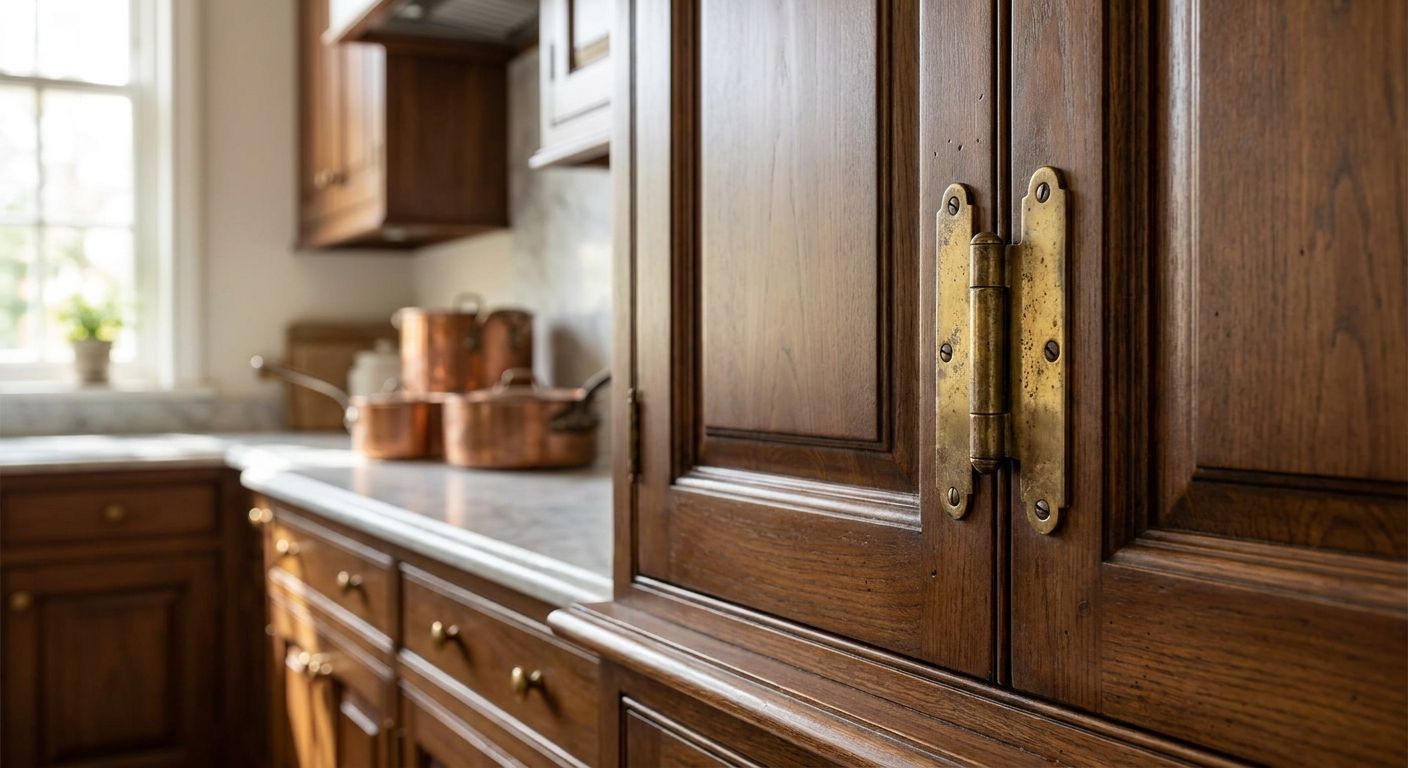
Traditional cabinetry needs hinges that look like they belong on a face-frame door built before soft-close was invented, and brass is the finish that does that job without looking costumed. This guide breaks down which brass cabinet hinges actually suit inset and overlay traditional cabinets, and which ones are brass-tone imposters built for frameless kitchens.
Shop cabinet hinges
Every cabinet hinge we carry, in one place — filter by overlay, mount type, and brand.
Browse Cabinet Hinges →- Semi-concealed self-closing brass hinges are the safe buy for face-frame inset doors in 2026 traditional kitchens.
- Unlacquered brass hinges develop a living patina over months; polished brass stays bright but shows fingerprints faster.
- Most doors under 40 inches need two hinges; taller or heavier raised-panel doors need three.
- Skip European 35mm concealed cup hinges labeled 'brass' — most are zinc-coated and built for frameless boxes, not traditional face frames.
- Soft-close retrofit hinges in brushed brass work if you want traditional looks with modern door control.
Why this matters
Hinges get ignored until a door sags or slams, and by then the wrong hinge is already mortised into the cabinet. Traditional cabinetry runs on face frames, inset or partial-overlay doors, and finish continuity between hinges, knobs, and pulls — mismatch any of that and the whole cabinet reads as generic. How to choose the right cabinet hinge for your cabinets covers the mechanics; this guide narrows it to brass specifically, because brass in 2026 traditional kitchens is doing more work than any other finish on the market.
Getting the hinge style wrong is the single most common hardware mistake on a traditional remodel. A concealed cup hinge disappears inside a frameless cabinet box — it has nothing to grip on a face frame, and forcing it in strips the screws within a season.
Who this is for
This is for homeowners restoring a face-frame kitchen, contractors matching existing period cabinetry, and interior designers specifying hardware for a client who wants the door hinge itself to read as a design detail, not just a mechanism. If your cabinets are frameless with a 1/2-inch reveal, most of this guide doesn't apply — you want European concealed hinges, not brass butt hinges.
What to look for in brass cabinet hinges for traditional cabinetry
Finish and patina behavior
Unlacquered brass shifts color over months of hand contact and humidity, developing a living patina that many traditional-kitchen owners want on purpose. Polished or lacquered brass stays bright and uniform but shows fingerprints and doesn't age the same way, so pick based on whether you want the hinge to look identical in 2030 or to look older.
Overlay style match
Inset doors sit flush inside the frame and need a hinge designed for zero reveal; full-overlay doors cover the frame and need a hinge with more offset. Buying the wrong overlay hinge means the door either won't close flush or leaves a visible gap that no amount of adjusting fixes.
Knuckle count and load rating
A 3-knuckle decorative hinge looks period-correct but isn't rated for a heavy raised-panel door; a 5-knuckle ball-tip hinge carries more weight and is the standard on solid wood traditional doors. Check the load rating against your actual door weight, not just the look.
Self-closing mechanism
Self-closing brass hinges use spring tension instead of a separate catch, which matters in kitchens where doors get bumped open constantly. Manual-tension hinges are quieter and more period-accurate for a historic restoration where a catch or friction ball is expected instead.
Screw pattern and mortise depth
Brass hinges vary in screw spacing and mortise depth even within the same nominal size, and swapping brands mid-project often means re-drilling. Confirm mortise depth before ordering if you're matching existing cabinetry rather than building new boxes.
Finish continuity with pulls and knobs
A brass hinge next to a nickel pull looks like an afterthought on traditional cabinetry, where hardware finish is expected to read as one decision. Polished brass cabinet pulls for traditional kitchens is worth checking before you finalize the hinge finish, so the whole run matches.
Top picks
The traditional workhorse. Semi-concealed self-closing brass hinges built for face-frame inset doors are the default pick for most 2026 restorations. They carry a 5-knuckle profile rated for standard cabinet door weight and close flush without a separate catch. Cabinet hinges for inset doors walks through sizing this style correctly. Buy.
The heritage detail. Decorative 5-knuckle ball-tip surface hinges in polished or antique brass sit on top of the door rather than mortised in, which is exactly what pre-1950s cabinetry used. They're visible by design, so the finish has to match every knob and pull in the room. Consider if the kitchen is a true period restoration where visible hardware is the point.
The soft-close upgrade. Brushed brass soft-close hinges retrofit into traditional face-frame openings and eliminate slamming without changing the door's look from the front. Soft-close cabinet hinges for kitchen cabinets covers the retrofit process and what clearance it needs. Buy for households with kids or heavy daily use.
The budget partial-overlay option. Standard semi-concealed hinges in unlacquered brass cost less than the self-closing versions and still hold up on lighter partial-overlay doors. They lack the spring mechanism, so doors need a separate catch or magnet. Consider for a budget-driven remodel where every door doesn't need self-close.
The frameless import. European 35mm concealed cup hinges sometimes get marketed with a brass-tone finish for cross-shopping, but they're engineered for frameless cabinet construction with a 1/2-inch to 3/4-inch reveal. On a traditional face-frame box they have nothing to seat into. Skip unless the cabinet is actually frameless.
What to avoid
- Brass-plated stamped hinges. These wear through to base metal at the knuckle within a year of daily use — they look identical to solid brass on the shelf and nowhere near it after 12 months.
- Mismatched knuckle counts on heavy doors. A 3-knuckle mini hinge saves a few dollars but sags under a solid raised-panel door within months.
- European cup hinges rebranded as "traditional." No mortise depth or screw pattern on a concealed cup hinge works with a face-frame box — the finish name doesn't change the engineering.
“A hinge finish that doesn't match the pulls is the fastest way to make a new kitchen look unfinished.”
Verdict comparison
| Pick | Hinge style | Common brass finish | Best for | Verdict |
|---|---|---|---|---|
| Semi-concealed self-close | Inset/face-frame | Antique, oil-rubbed | Everyday traditional kitchens | Buy |
| 5-knuckle ball-tip surface | Full overlay, decorative | Polished, satin | Period restorations | Consider |
| Soft-close retrofit | Concealed cup, face-frame compatible | Brushed brass | Busy households | Buy |
| Standard semi-concealed | Partial overlay | Unlacquered | Budget remodels | Consider |
| European 35mm cup | Frameless only | Brass-tone coating | Frameless cabinets | Skip |
FAQ
What's the best brass cabinet hinge finish for traditional cabinetry?
Antique or unlacquered brass is the best match for most traditional kitchens because it echoes the patina of original period hardware. Polished brass works too, but it stays bright and shows fingerprints faster than an unlacquered finish.
Is unlacquered brass better than polished brass for hinges?
Neither is objectively better — unlacquered brass develops a living patina over months of use, while polished brass keeps a uniform shine with a protective lacquer coat. Pick unlacquered if you want the hinge to age with the kitchen, polished if you want it to look the same in 2030 as it does now.
How many hinges does a traditional cabinet door need?
Most cabinet doors under 40 inches tall use two hinges. Taller or heavier raised-panel traditional doors typically need three hinges to prevent sagging over time.
Do brass cabinet hinges work with inset doors?
Yes, but only if the hinge is designed for zero-reveal inset mounting rather than overlay. A hinge built for overlay doors won't let an inset door sit flush inside the frame.
What's the difference between semi-concealed and full-surface hinges?
Semi-concealed hinges mortise partly into the door and frame, showing only the knuckle from outside. Full-surface hinges mount entirely on the face of the door and frame, making them visible by design — common on period-style traditional cabinetry.
How much do brass cabinet hinges cost in 2026?
Cost depends on knuckle count, finish, and whether the hinge is self-closing — decorative surface hinges generally cost more than standard semi-concealed hinges. Check current listings for exact pricing since finish and brand shift cost significantly.
Can I mix brass hinges with a different pull finish?
You can, but traditional cabinetry reads best when hinge and pull finishes match or coordinate closely. A brass hinge next to a chrome or nickel pull tends to look like an unplanned mismatch rather than an intentional mixed-metal design.
Are self-closing brass hinges worth the extra cost?
Yes for households with kids or heavy daily cabinet use — the spring mechanism prevents slamming and door damage over time. For a strict historic restoration where a visible catch is period-correct, a manual-tension hinge may be the better fit instead.
One last thing
The detail most people miss on a traditional remodel isn't the hinge finish — it's the knuckle visibility. A fully concealed hinge disappears when the door is closed, which is exactly wrong for a period kitchen where the hardware is supposed to read as craftsmanship. If the goal is authenticity, pick a hinge that shows itself on purpose in 2026, not one that hides.


