

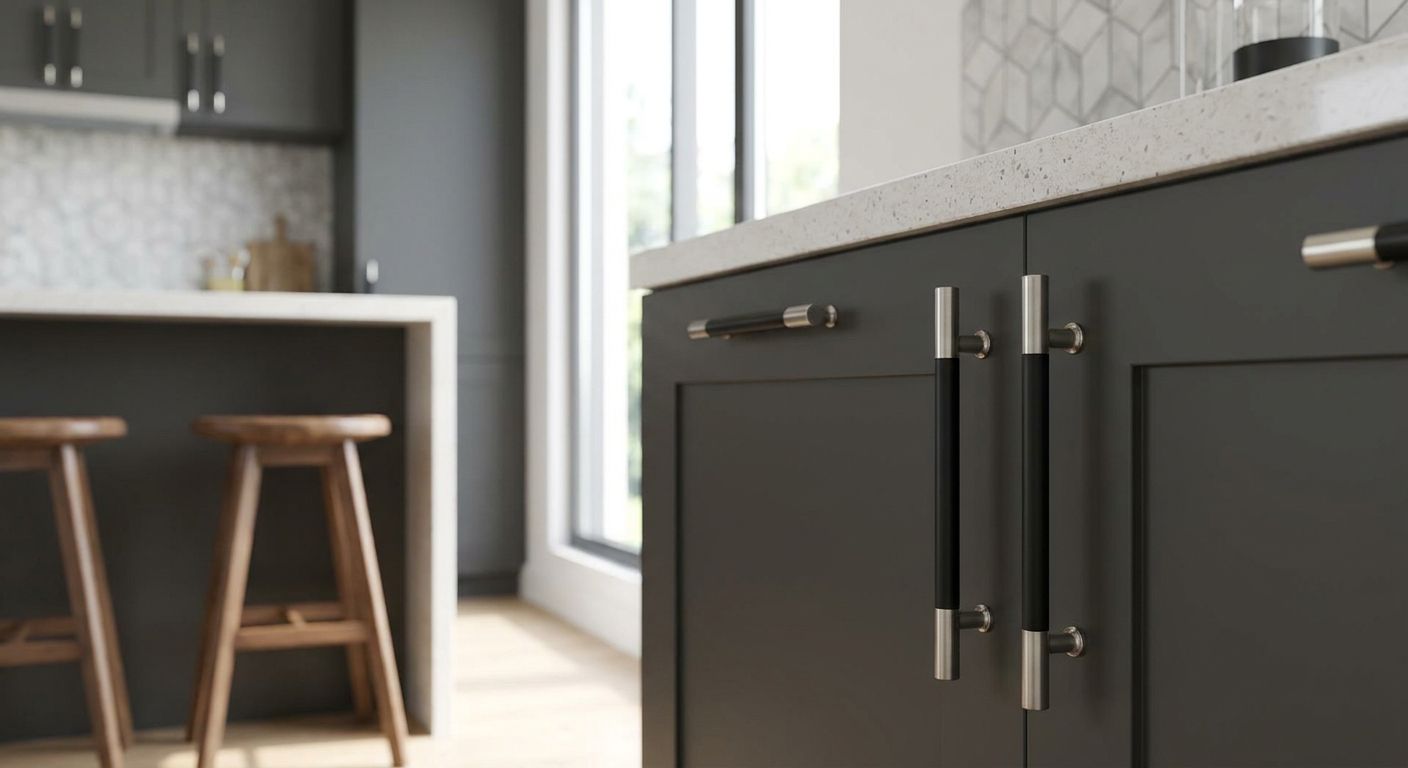
Nickel and black is the two-tone pairing that reads modern without going cold, and it works because both metals share cool undertones instead of fighting each other.
Shop the finish
Every black knob and pull we carry, in one place — filter by size, style, and brand.
Browse Black Cabinet Hardware →- Top Knobs TK1014PN Grace Riverside Pull in polished nickel is the safe buy for flat-front modern kitchens in 2026.
- Top Knobs TK703BLK Transcend Ascendra Pull anchors the black side at a 3-3/4 inch center-to-center for narrow drawers.
- Skip oil-rubbed bronze in a nickel-and-black two-tone scheme -- the warm undertone clashes with both metals.
- Buy pulls from one hardware collection in both finishes so hole spacing and bar profile stay consistent across the kitchen.
Shop the picks from this guide
In stock at Knobs.co · Free shipping on hardware orders $99+ · 110% price match
-
 Amerock
Edona 1-1/4'' diam Cabinet Knob BP53005Satin Nickel
Amerock
Edona 1-1/4'' diam Cabinet Knob BP53005Satin Nickel
$3.21
$3.77 -
 Amerock
Cup Pulls 3'' cc Cabinet Cup Pull BP53010Satin Nickel
Amerock
Cup Pulls 3'' cc Cabinet Cup Pull BP53010Satin Nickel
$4.61
$5.42 -
 Amerock
Revitalize 1-1/4'' diam Cabinet Knob BP55342Satin Nickel
Amerock
Revitalize 1-1/4'' diam Cabinet Knob BP55342Satin Nickel
$6.42
$7.55 -
 Amerock
Edge Pull 5-1/16'' cc Cabinet Pull BP36575Satin Nickel
Amerock
Edge Pull 5-1/16'' cc Cabinet Pull BP36575Satin Nickel
$5.83
$6.85 -
 Amerock
Ravino 1-1/4'' diam Cabinet Knob BP53012Satin Nickel
Amerock
Ravino 1-1/4'' diam Cabinet Knob BP53012Satin Nickel
$2.79
$3.28 -
 Amerock
Blackrock 5-1/16'' cc Cabinet Pull BP55277Satin Nickel
Amerock
Blackrock 5-1/16'' cc Cabinet Pull BP55277Satin Nickel
$9.63
$11.32


Why this matters
A two-tone kitchen only looks intentional when the hardware finish split is decisive, not accidental. Homeowners who grab a handful of polished nickel pulls from one aisle and matte black knobs from another usually end up with a kitchen that looks like two separate remodels instead of one modern design.
The fix is picking two finishes that were built to sit next to each other -- something like the Grace Riverside pull in polished nickel, which shares its bar profile with the matte black version in the same Top Knobs line. That consistency is what separates a coordinated 2026 kitchen from one that looks unfinished.
Who this is for
This guide is for homeowners and designers finishing a flat-front or shaker kitchen who've already decided on a two-tone cabinet scheme -- black lowers with white or light uppers, or a black island against pale perimeter cabinets -- and need hardware that doesn't undercut the contrast they already paid for. It's also for contractors buying in volume who need one source for both finishes instead of splitting an order across two vendors.
What to look for in two-tone nickel and black cabinet pulls
Finish contrast that reads as intentional
The nickel needs enough shine to read as a distinct metal next to the black, not a washed-out gray. Polished or satin nickel does this; a dull pewter or brushed steel often looks like a compromise finish instead of a deliberate second tone.
PVD plating, not a sprayed coating
Black cabinet hardware that's sprayed rather than PVD-plated chips at the edges within a year of daily use. Check the product description for plating method before you order 30 pulls for a full kitchen.
Consistent hole spacing across both finishes
If the nickel pulls in a collection use a 6-5/16 inch center-to-center and the black version in the same line uses something different, your install gets messy fast. Buy both finishes from the same product family, like the Grace Riverside line, so every drawer front drills the same.
Bar profile suited to flat-front cabinets
A thick, rounded pull looks traditional no matter what finish you put on it. Modern kitchens want a slim bar profile with sharp transitions -- that's what makes a pull read as "modern" independent of its color.
Matching appliance pulls, not just cabinet pulls
A two-tone kitchen with mismatched appliance pulls on the fridge or dishwasher breaks the whole scheme. Confirm the collection offers an appliance-length pull in both finishes before committing.
Price per pull at kitchen volume
A 30-40 pull kitchen makes a $3 per-pull difference add up to over $100 fast. Compare nickel and black pricing within the same collection before assuming they cost the same -- some finishes run a few dollars higher per unit.
Top picks for two-tone nickel and black cabinet pulls
The daylight pick: Top Knobs TK1014PN Grace Riverside Pull. Polished nickel, 6-5/16 inch center-to-center, straight bar profile built for flat-front and shaker doors alike. This is the nickel half of a matched collection that also ships in honey bronze and black, so the drilling stays identical across finishes. Verdict: Buy.
The anchor tone: Top Knobs TK703BLK Transcend Ascendra Pull. Matte black, 3-3/4 inch center-to-center, sharp square-edge bar that reads distinctly modern rather than transitional. Use this on lower cabinets and the island to set the black as the dominant tone. Verdict: Buy.
The budget stretch: Additions Tab Pull in brushed satin nickel. A 3 inch tab pull with a softer satin finish than polished nickel -- good for a secondary run of drawers where you want nickel present without it competing with the main bar pulls. Verdict: Consider.
The wildcard: Berenson Metro matte black pull, 224mm center-to-center. Longer run than the Transcend Ascendra, better suited to wide drawer fronts on an island. It's a heavier, more architectural bar than the Top Knobs black option, which works if your cabinet doors are already substantial. Verdict: Consider.
What to avoid
- Oil-rubbed bronze mixed into a nickel-and-black scheme. It looks correct in a showroom photo and wrong in your kitchen -- the warm brown undertone fights both the cool nickel and the flat black.
- Buying the two finishes from different manufacturers. Bar thickness and end-cap shape vary enough between brands that a nickel pull from one line and a black pull from another rarely match up close.
- Spray-coated black hardware at drawer height. High-touch areas like drawer pulls near a stovetop or sink show wear on cheap coatings inside 12 months; PVD-plated black holds up through 2026 and well beyond.
Verdict comparison
| Pick | Finish | Center-to-Center | Best For | Verdict |
|---|---|---|---|---|
| Top Knobs Grace Riverside | Polished nickel | 6-5/16" | Flat-front & shaker doors | Buy |
| Top Knobs Transcend Ascendra | Matte black | 3-3/4" | Narrow drawers, black lowers | Buy |
| Additions Tab Pull | Brushed satin nickel | 3" | Secondary drawer runs | Consider |
| Berenson Metro | Matte black | 224mm | Wide island drawers | Consider |
FAQ
What's the best two-tone nickel and black cabinet pulls for a modern kitchen in 2026?
The Top Knobs Grace Riverside Pull in polished nickel paired with the Top Knobs Transcend Ascendra Pull in matte black is the strongest match for 2026 -- both use a sharp bar profile suited to flat-front doors. Buying both finishes from the same collection keeps hole spacing identical across the kitchen.
Is nickel and black two-tone hardware still trendy in 2026?
Yes -- nickel and black remains one of the more durable two-tone pairings because both metals carry cool undertones and don't clash the way warm and cool finishes do. It reads as contemporary rather than a passing trend tied to one color year.
How do I mix nickel and black hardware without it looking mismatched?
Pick one finish as dominant across most of the kitchen and treat the second as an accent on the island or a single wall of uppers, rather than alternating pull-by-pull. Buying both finishes from one hardware collection also keeps the bar shape and hole spacing consistent.
What center-to-center size should I buy for modern flat-front cabinets?
Most modern flat-front drawers use a 3 to 6.5 inch center-to-center pull, with longer bars on wider drawers and shorter tab pulls on narrow ones. Measure your existing hole spacing if you're replacing hardware, since redrilling adds time to an install.
Can I mix brushed and polished nickel with matte black in the same kitchen?
You can, but it works best when one nickel finish dominates rather than using both brushed and polished nickel at once alongside black. Three finishes in one kitchen usually reads as cluttered rather than layered.
Do two-tone pulls cost more than single-finish hardware?
Pricing varies by collection more than by finish count -- a black pull and a nickel pull in the same product line are often priced within a few dollars of each other. The bigger cost driver is the pull's size and bar thickness, not the two-tone concept itself.
Should cabinet knobs match the pulls exactly in a two-tone kitchen?
Knobs and pulls don't need to be the identical product, but they should share the same two finishes and a similar visual weight. A delicate knob paired with a heavy architectural pull in the same finish still looks off-balance.
How many finishes is too many in a two-tone kitchen?
Two is the ceiling for most modern kitchens -- nickel and black, plus maybe an unlacquered brass faucet as a third accent metal used sparingly. Three or more hardware finishes on cabinets specifically starts to look unplanned.
One last thing
The pattern that consistently reads as intentional in 2026 kitchens: pick one finish as the primary across most of the cabinetry and use the second only on the island or a single accent wall of uppers, rather than alternating pull by pull across every door. Kitchens that split 50/50 evenly across every run tend to look busy rather than designed.


