

Best Brushed Nickel Cabinet Knobs for Craftsman Homes 2026
Square and barrel brushed nickel cabinet knobs are the correct pick for craftsman homes in 2026. This guide names the right profiles, sizes, and brands to buy.

Craftsman homes have strong design rules — exposed joinery, natural materials, square profiles, and zero tolerance for anything that reads as fussy or chrome-bright. Brushed nickel sits in the exact middle of that aesthetic: warm enough to read with oak and walnut, understated enough not to fight the woodwork. This guide tells you which brushed nickel cabinet knobs actually fit a craftsman interior and which ones will look wrong the day you install them.
TL;DR: For craftsman homes in 2026, square or barrel-profile brushed nickel knobs in 1.25"–1.5" diameter are the correct buy. Oval and round knobs work on painted cabinets; avoid anything with ornate casting, beveled edges, or a high-polish nickel finish — those read Victorian, not Arts & Crafts. Knobs.co's brushed nickel collection carries 50,000+ SKUs, so the filter work is on you — this guide narrows it down.
Shop the picks from this guide
In stock at Knobs.co · Free shipping on hardware orders $99+ · 110% price match
-
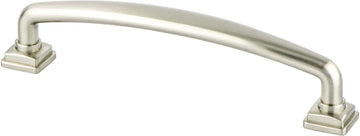 Berenson
Tailored Traditional 128mm CC Brushed Nickel Pull 1284-1BPN-P
Berenson
Tailored Traditional 128mm CC Brushed Nickel Pull 1284-1BPN-P
$10.93
$13.66 -
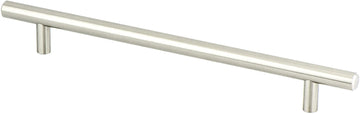 Berenson
Tempo 192mm CC Brushed Nickel Bar Pull 0806-2BPN-P
Berenson
Tempo 192mm CC Brushed Nickel Bar Pull 0806-2BPN-P
$11.53
$14.41 -
 Berenson
Bravo 56mm CC Brushed Nickel Edge Pull 1057-4BPN-P
Berenson
Bravo 56mm CC Brushed Nickel Edge Pull 1057-4BPN-P
$9.83
$12.28 -
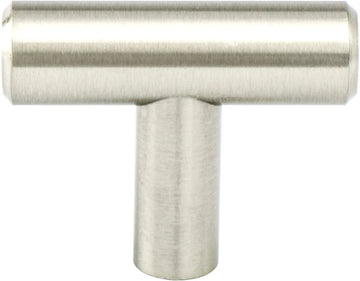 Berenson
Transitional Advantage Two Brushed Nickel T-Bar Knob 9435-2BPN-P
Berenson
Transitional Advantage Two Brushed Nickel T-Bar Knob 9435-2BPN-P
$2.80
$3.50 -
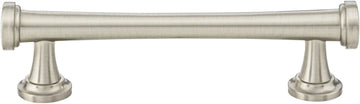 Atlas Homewares
Browning Pull 3 3/4'' ccBrushed Nickel
Atlas Homewares
Browning Pull 3 3/4'' ccBrushed Nickel
$14.50
$16.11 -
 Berenson
Folklore 3in. CC Brushed Nickel Cup Pull 8340-1BPN-P
Berenson
Folklore 3in. CC Brushed Nickel Cup Pull 8340-1BPN-P
$12.92
$16.15


Why This Matters for Craftsman Interiors
Craftsman design, codified between roughly 1905 and 1930, borrows from the Arts & Crafts movement: honest construction, no applied ornament, materials that show their nature. Hardware is a small detail with outsized visual authority. A mismatched knob on a quartersawn oak cabinet door can undercut a $15,000 kitchen renovation. Brushed nickel is the right finish for this style — it has the warmth of aged silver without the cold, reflective quality of polished chrome or the industrial weight of matte black. The shape, not the finish, is where most buyers get it wrong.
Who This Guide Is For
This guide is for homeowners renovating a bungalow, Foursquare, or prairie-style home built between 1900 and 1940, and for interior designers and contractors working on craftsman-inspired new builds in 2026. If your cabinets are frame-and-panel with flat or slightly raised panels, quartersawn oak, hickory, or painted white maple, every recommendation here applies directly. If your kitchen is slab-door modern, this is the wrong guide — consider mid-century modern hardware instead.
What to Look for in Brushed Nickel Knobs for Craftsman Homes
Profile Geometry
Square, cylindrical, and barrel profiles are period-correct for craftsman cabinetry. Round knobs are acceptable on painted cabinets but feel slightly soft against the linear joinery typical of mission-style millwork. Avoid anything with scrolling, fluting, or cast floral detail — those profiles belong to a different architectural era entirely. A 1.25" square knob on a shaker-panel door is close to the historical original.
Finish Quality: Brushed vs. Satin vs. Polished
Brushed nickel and satin nickel are not the same thing. Brushed nickel has a linear grain texture applied mechanically; satin nickel uses a chemical process that produces a smoother, slightly warmer tone. Both work in craftsman interiors. Polished nickel — mirror-bright — does not. In 2026, most quality hardware brands include a finish code in the SKU; look for "BN" (brushed nickel) or "SN" (satin nickel) and avoid "PN" (polished nickel) entirely when shopping for this style.
Size and Scale
Craftsman cabinet doors tend to be larger than standard — a 36" upper cabinet is common in bungalow kitchens. Scale your knob to the door: 1.25" diameter for standard uppers, 1.5" for wider drawer fronts, 1" for small medicine cabinets or built-in bookcases. A knob that is undersized on a wide stile looks like an afterthought. Measure your door stile width before ordering; on craftsman millwork, a 2.5" stile is typical, and a 1.25"–1.5" knob hits center with correct visual weight.
Base Plate Design
Many craftsman-appropriate knobs ship with a square or rectangular backplate. This is not decorative — it protects the finish around the bore hole and adds visual mass that suits the style. A backplate also covers old bore holes if you are replacing hardware on a renovated home and the centers do not match. For new installs, a backplate is optional, but it reads as more intentional in period-correct interiors.
Material and Durability
Solid zinc alloy (zamak) and solid brass are the two standard base metals under a brushed nickel finish. Brass holds the finish longer under daily use — kitchen hardware gets touched 20–40 times per day per drawer. Zinc is fine for low-traffic areas like bathrooms and built-ins. For kitchen cabinets specifically, prioritize solid brass construction under the nickel plating; it will not pit or flake at the contact points within 3–5 years the way thin-plated zinc can.
Brand Consistency Across the Home
Craftsman homes typically have built-ins, kitchen cabinets, bathroom vanities, and mudroom storage — all visible to each other through open sightlines. Buying all hardware from a single product family ensures the profile, finish tone, and base plate style match across rooms. Knobs.co carries major brands like Top Knobs, Amerock, and Hickory Hardware; within each brand, look for a "collection" name and stay inside it for the entire project.
Top Picks
The Safe Pick — Square Bar Knob, 1.25"
Hook: Period-correct geometry, zero design risk.
A 1.25" square knob in brushed nickel is the hardware equivalent of a load-bearing wall — it is right in almost every craftsman application. The flat faces read cleanly against shaker panels; the square profile echoes the square-cut joinery of mission millwork. Spec: 1.25" square face, 1" projection, solid brass base, brushed nickel finish.
Verdict: Buy. This is the default choice for kitchen uppers, lowers, and bathroom vanities in any craftsman renovation in 2026.
The Upgrade Pick — Barrel Knob with Backplate, 1.5"
Hook: More visual presence on wide doors without going ornate.
A 1.5" barrel (cylindrical) knob paired with a 2" square backplate adds weight to larger cabinet doors — especially 18"–24" wide doors common in craftsman pantries and built-in hutches. The cylinder profile is historically grounded in Arts & Crafts hardware catalogs from the 1910s. Spec: 1.5" diameter, 1.25" projection, square backplate, solid brass, brushed nickel.
Verdict: Buy for large doors and drawer banks. Consider for standard uppers if you prefer a slightly more formal look.
The Wildcard — Cup Pull Knob Hybrid, 1"
Hook: Correct for small built-ins and library cabinetry.
For craftsman bookcases, china cabinets, and mudroom cubbies, a small 1" cup pull or ring knob in brushed nickel reads as more refined than a standard dome knob. The ring pull appears in original Stickley furniture catalogs. Spec: 1" ring or cup, solid brass, brushed nickel. Note: this profile does not work on kitchen uppers — too small, too delicate.
Verdict: Buy for built-ins and accent cabinetry. Skip for kitchens.
The Budget Pick — Amerock Round Knob, 1.25"
Hook: Correct finish, acceptable profile, entry-level price point.
Amerock's brushed nickel round knobs are widely available, priced around $3–5 each, and carry a clean finish that does not look cheap at arm's length. The round profile is the weakest geometric choice for strict craftsman interiors but is perfectly acceptable on painted white maple cabinets where the door profile already softens the style. Spec: 1.25" round, zinc alloy base, brushed nickel.
Verdict: Consider if budget is the primary constraint. Skip on quartersawn oak or dark-stained cabinets where profile geometry is more visible.
The Avoid Pick — Faceted Crystal-Look Knob with Brushed Nickel Post
Hook: The finish is right; everything else is wrong.
These knobs are common in big-box stores and are frequently misread as craftsman-compatible because the post is brushed nickel. The faceted glass or acrylic body is Victorian, not Arts & Crafts. On a craftsman cabinet, they look anachronistic — and the glass body does not age well under kitchen use.
Verdict: Skip.
What to Avoid
- Beveled or faceted profiles: These belong to Victorian and Edwardian hardware traditions, not craftsman. The visual language is completely different, and the conflict is noticeable even to non-designers.
- Polished nickel or chrome finish: Both finishes are too reflective for craftsman interiors, which rely on matte and natural surface quality. A single polished knob on a matte-finished cabinet will draw the eye for the wrong reason.
- Oversized dome knobs (2"+): These read as contemporary or transitional, not period craftsman. Above 1.5" diameter, round knobs lose their architectural connection to the style.
Comparison Table
| Pick | Profile | Size | Base Metal | Best For | Verdict |
|---|---|---|---|---|---|
| Square Bar Knob | Square | 1.25" | Solid brass | Kitchen uppers/lowers, vanities | Buy |
| Barrel + Backplate | Cylinder | 1.5" | Solid brass | Wide doors, pantry, hutch | Buy |
| Cup/Ring Pull | Ring/Cup | 1" | Solid brass | Built-ins, library, accent | Buy |
| Amerock Round | Round | 1.25" | Zinc alloy | Painted cabinets, budget projects | Consider |
| Faceted Crystal Post | Faceted | 1.25" | Zinc alloy | — | Skip |
FAQ
What's the best knob profile for craftsman kitchen cabinets in 2026? Square and barrel (cylindrical) profiles are period-correct and the safest choices. Round knobs work on painted cabinets but are a weaker fit on stained wood with visible grain and joinery.
Is brushed nickel or matte black better for craftsman homes? Brushed nickel is warmer and historically closer to the original hardware used in Arts & Crafts-era homes. Matte black hardware works well in craftsman interiors with dark-stained cabinets or as a contrast on white painted millwork, but it reads as more contemporary than traditional craftsman.
How many knobs do I need for a typical craftsman kitchen? A standard craftsman kitchen renovation in 2026 uses 20–40 knobs depending on cabinet count. Order 10% extra — typically 3–5 additional pieces — to account for future replacements and finish matching. Discontinued SKUs are a real problem on long renovations.
What size brushed nickel knob fits a craftsman shaker door? For a shaker door on a standard 12"–18" upper cabinet, a 1.25" knob is the correct scale. For 24"+ wide doors or full-height pantry doors, move to 1.5". Position the knob centered on the stile, 2.5"–3" from the door edge.
Can I mix brushed nickel knobs with brushed nickel pulls in the same craftsman kitchen? Yes — mixing knobs on doors and pulls on drawers is standard practice and correct for craftsman interiors, provided both pieces come from the same hardware family. Different manufacturers with slightly different finish tones will look mismatched under natural light.
Do brushed nickel knobs work with quartersawn oak cabinets? Brushed nickel is one of the best finish pairings for quartersawn oak. The warm gray-silver tone complements the medullary ray figure in the wood without competing with it. Avoid polished chrome or polished nickel — both finishes pull the eye away from the wood.
How much do quality brushed nickel craftsman knobs cost? Solid brass brushed nickel knobs in period-appropriate profiles range from $8–$22 per knob from major brands in 2026. Budget zinc-base knobs run $3–6 each. For a 30-knob kitchen, budget $240–$660 for quality hardware, which is under 5% of most cabinet renovation costs.
Is satin nickel the same as brushed nickel for craftsman hardware? Not exactly. Satin nickel is slightly warmer and smoother; brushed nickel has a linear mechanical texture. Both are period-appropriate for craftsman interiors, and both are sold under "brushed nickel" labeling by some brands. Check the brand's finish code to confirm — the visual difference is small but noticeable in side-by-side comparison.
One Last Thing
Original hardware from craftsman-era homes (1905–1930) was almost never chrome. The dominant finish of that period was japanned (black-lacquered) steel, bronze, and early nickel plating — all matte, all with visible texture. Modern brushed nickel is a close functional equivalent that also holds up better under everyday use. If you are restoring rather than renovating, that distinction matters: staying matte and textured is more historically accurate than any bright finish, regardless of metal type.
Related Guides
- Brushed nickel hardware for bathrooms
- Brushed nickel pulls for kitchen renovations
- Best brushed nickel pulls for shaker cabinets
Shop Brushed Nickel Cabinet Hardware
-
 Bradbury Pull 6 5/16'' cc
$16.57
Bradbury Pull 6 5/16'' cc
$16.57
-
 Crystal Legacy Square Knob 1 5/16''
$41.36
Crystal Legacy Square Knob 1 5/16''
$41.36
-
 Dot Knob 1 1/4''
$10.23
Dot Knob 1 1/4''
$10.23
-
 Dot Knob 2''
$14.63
Dot Knob 2''
$14.63
-
 Malin Pull 3 3/4'' cc
$13.64
Malin Pull 3 3/4'' cc
$13.64
-
 Malin Pull 6 5/16'' cc
$19.71
Malin Pull 6 5/16'' cc
$19.71
-
 Malin Pull 7 9/16'' cc
$23.63
Malin Pull 7 9/16'' cc
$23.63
-
 Sweetbriar Lane Pull 5 1/16'' cc
$18.27
Sweetbriar Lane Pull 5 1/16'' cc
$18.27


Browse all 1076 in Brushed Nickel Cabinet Hardware → Cabinet knobs Cabinet pulls & handles