

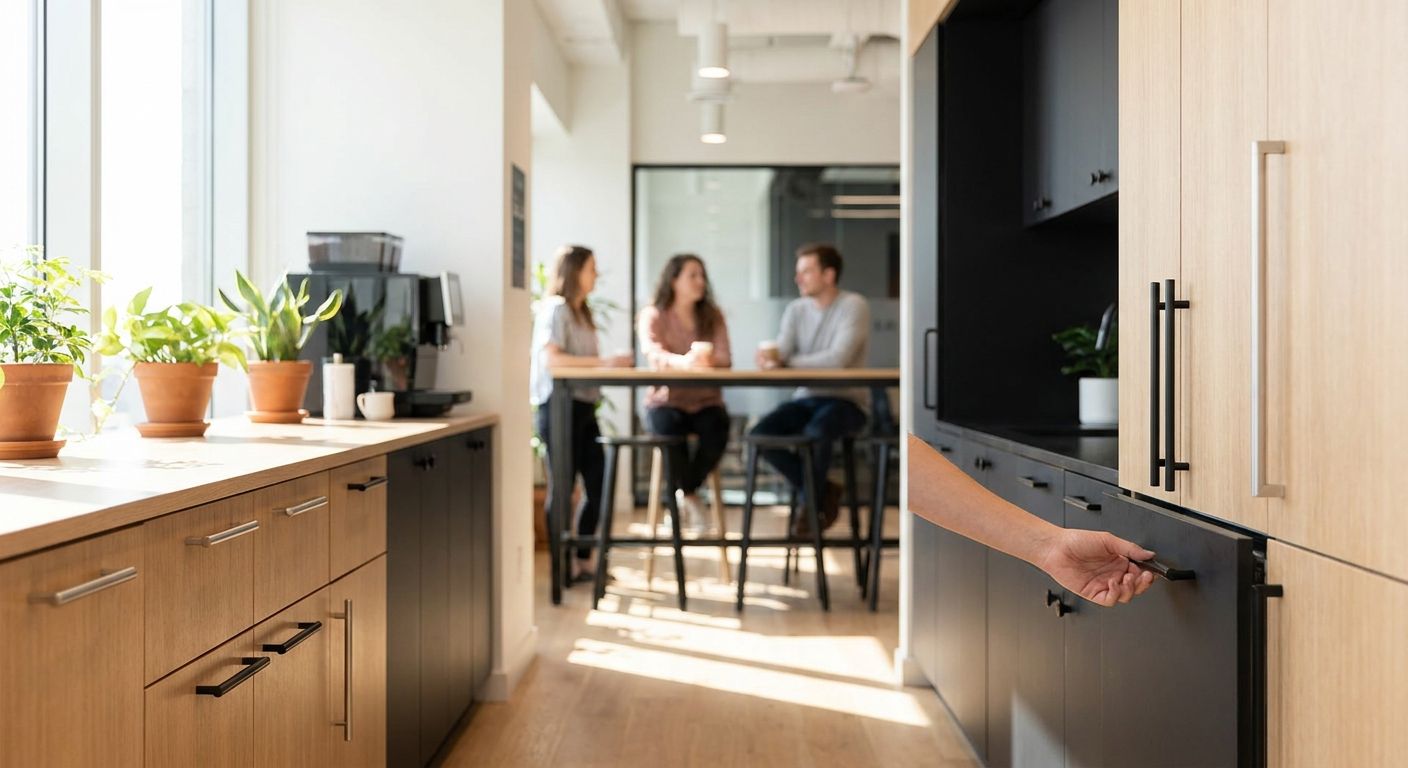
Cabinet hardware for coworking kitchenette spaces is hardware selected for constant multi-user contact, not for a single household's habits — the goal is fewer service calls and a break room that still looks sharp after 500 uses a week. A shared kitchenette gets touched by dozens of different hands daily, which means knobs loosen faster, finishes show wear sooner, and anything delicate gets treated like it's indestructible. The fix isn't fancier hardware — it's hardware built for abuse.
- Bar pulls beat knobs in coworking kitchenettes because one-handed, gloved, or hurried grabs miss small knobs and bend them.
- Satin brass, brushed nickel, and matte black hide fingerprints better than polished chrome in a high-touch coworking kitchenette.
- Soft-close hinges cut the slam-and-bang noise that turns a shared kitchenette into a distraction for the open floor plan around it.
- Cabinet hardware for coworking kitchenette upgrades should be ordered as samples first — one finish mismatch across 40 doors is expensive to fix.
- Knobs.co stocks bar pulls, appliance pulls, and soft-close hinges across 50,000+ SKUs for multi-unit coworking buildouts.
Why cabinet hardware matters in a shared kitchenette
A coworking kitchenette isn't a home kitchen with more people in it — it's a fixture that gets zero maintenance attention between cleaning crew visits, and it has to survive members who don't own the space and don't treat it gently. Commercial kitchen cabinet hardware exists as a category for exactly this reason: it prioritizes grip, finish durability, and hardware that stays functional after thousands of open-close cycles a year.
The stakes are different from a residential remodel. A loose knob in a house gets tightened by the homeowner within a week. A loose knob in a coworking kitchenette gets ignored until someone complains to facilities, and by then three more knobs have failed the same way. Property managers and facilities leads who spec cabinet hardware for coworking kitchenette buildouts in 2026 are buying against that failure pattern, not against a design mood board.
Choose pulls over knobs for shared traffic
Knobs require a pinch grip. Pulls let you hook fingers or a whole hand, which matters when someone's carrying a coffee mug in the other hand or wearing a jacket sleeve that catches on a small knob. For a kitchenette where dozens of different people open the same door every day, pulls survive longer and get used more accurately.
- Favor bar pulls at 5 to 12 inches on cabinet doors — length gives multiple grip points.
- Skip small round knobs on high-traffic doors; save them for rarely opened cabinets.
- Cup and bin pulls work well on drawers that get opened one-handed while carrying dishes.
- Match pull length to door width — undersized pulls on wide doors force awkward grabs that bend hardware over time.
Pick a fingerprint-resistant finish
Polished chrome and bright brass show every touch within a day of cleaning. A shared kitchenette in 2026 needs a finish that hides oil and hand contact between cleanings, not one that needs polishing every shift.
- Satin brass and brushed nickel mask smudges better than polished or mirror finishes.
- Matte black hides fingerprints well but shows water spotting near sinks — wipe-dry habits matter more with this finish.
- Champagne bronze and warm brass split the difference: warm tone, low shine, low visible wear.
- Check the fingerprint-resistant pulls guide before locking a finish across every unit in a building.
Standardize on one hardware family for multi-unit buildouts
Coworking operators rarely fit out one kitchenette — it's five, ten, or fifty across a portfolio of locations. Picking one bar pull family and ordering it consistently is faster than re-specifying hardware per site, and it's the point where a stocked catalog beats a custom order.
- Standardizing on a single bar pull, like the Top Knobs Amwell bar pull, keeps replacement stock simple across every kitchenette in the portfolio.
- Order 10-15% extra units per buildout so a damaged pull gets swapped same-day instead of waiting on a reorder.
- Keep one screw length and backplate spec on file so maintenance crews don't guess.
- Document the finish name and SKU in the facilities binder, not just "gold" or "black."
Match appliance pulls to shared equipment
Most coworking kitchenettes run a compact fridge, a dishwasher, and sometimes an under-counter freezer, all opened dozens of times a shift. Appliance pulls need to be sized and rated for that door weight, not repurposed cabinet pulls.
- Use appliance-length pulls (12-30 inches) on panel-ready fridges and freezers, not standard cabinet pulls.
- Stainless steel and brushed finishes on appliance pulls resist the heavier daily grip force better than decorative finishes.
- Confirm drill-center spacing against the appliance panel before ordering — appliance pulls aren't universal.
- Keep the appliance pull finish close to the cabinet pull finish so the kitchenette doesn't look mismatched from six feet away.
Add soft-close hinges to cut noise and damage
Open-plan coworking floors put the kitchenette a few feet from someone on a client call. A slamming cabinet door isn't just annoying — it's a support ticket waiting to happen, and it's also how hinges fail early.
- Soft-close hinges eliminate the bang that travels across an open floor plan.
- They also reduce door sag over time by controlling the closing force instead of letting gravity and momentum do it.
- Retrofit soft-close dampers work on existing hinges if a full hinge swap isn't in budget.
- Face-frame and frameless cabinets need different hinge types — confirm cabinet construction before ordering.
Organize the inside, not just the outside
A kitchenette that looks fine on the doors but is chaos inside the cabinets still generates complaints. Pull-out organizers keep shared items — mugs, snacks, cleaning supplies — from turning into a daily scavenger hunt.
- Soft-close pull-out organizers keep bins accessible without a full cabinet dig.
- Stainless or wipeable liners hold up better than fabric-lined bins in a shared, spill-prone space.
- Dedicated bins for shared supplies (coffee, filters, snacks) cut down on member-to-member clutter disputes.
- Label zones inside cabinets so restocking staff don't have to guess placement.
Order samples before committing across every unit
A finish that looks right on a screen or in a showroom can read differently under a kitchenette's fluorescent lighting. Ordering a handful of samples before a 40-door buildout is the cheapest insurance in the whole project.
- Order 2-3 finish samples and hold them against the actual cabinet color under kitchenette lighting.
- Test grip feel on the actual pull profile, not a similar-looking substitute.
- Confirm lead times for the full order before finalizing the buildout schedule.
- Loop in whoever handles facilities maintenance so they sign off on the finish before it's ordered at volume.


Comparing hardware options for coworking kitchenettes
| Option | Best for | Key limitation |
|---|---|---|
| Bar pulls | High-traffic cabinet doors opened by many different users | Longer pulls need wider door stiles to sit correctly |
| Cup/bin pulls | Drawers opened one-handed while carrying items | Less grip surface than a full bar pull |
| Appliance pulls | Shared fridges, dishwashers, and freezers | Must match drill-center spacing on the specific appliance |
| Soft-close hinges | Any door near an open floor plan or client-facing area | Retrofit dampers add cost per door if hinges aren't replaced |
| Small decorative knobs | Rarely opened cabinets, not daily-use doors | Poor grip under gloves, bags, or hurried single-hand use |
Bar pulls in a fingerprint-resistant finish are the right default for cabinet hardware for coworking kitchenette buildouts in 2026 — they survive the grip pattern a shared space actually gets.
Common mistakes coworking operators make
- Specifying residential knobs at commercial scale. A knob that looks fine in one home kitchen fails fast across 40 daily users in a shared kitchenette.
- Mixing finishes across units in the same portfolio. Facilities crews end up carrying five different SKUs for what should be one standardized pull.
- Skipping soft-close on floors with open seating. The slam noise becomes a recurring complaint long before the hinge itself fails.
- Ordering the full buildout before sampling the finish. A finish that photographs well can look wrong under a kitchenette's actual lighting.
- Ignoring pull sizing for accessibility. Undersized pulls make cabinets harder to open for members with limited grip strength, which matters in a shared amenity space.
“A loose knob in a house gets fixed in a week. A loose knob in a shared kitchenette gets ignored until three more fail the same way.”
FAQ
What's the best cabinet hardware for a coworking kitchenette?
Bar pulls in a fingerprint-resistant finish like satin brass, brushed nickel, or matte black hold up best in 2026 shared-use kitchenettes. Knobs work fine on low-traffic cabinets but fail faster on doors opened dozens of times a day.
Is matte black or brushed nickel better for a shared kitchenette?
Both hide fingerprints well; matte black shows water spotting near sinks while brushed nickel hides oil and hand contact more evenly. Pick based on how close the hardware sits to the sink and how often the space gets wiped down.
Do coworking kitchenettes need soft-close hinges?
Soft-close hinges are worth the upgrade any time the kitchenette sits near an open floor plan, since slamming doors interrupt calls and meetings nearby. They also reduce door sag from repeated hard closes over time.
How do I standardize cabinet hardware across multiple coworking locations?
Pick one bar pull family and one finish, document the SKU and screw length in a facilities reference, and order 10-15% extra stock per buildout. That keeps replacements consistent without re-specifying hardware at every new site.
What size appliance pull fits a shared kitchenette fridge?
Appliance pulls for panel-ready fridges and freezers typically run 12 to 30 inches, sized to the appliance door height. Confirm drill-center spacing against the specific appliance panel before ordering — appliance pulls aren't universal across brands.
Should I order hardware samples before a full kitchenette buildout?
Yes — order 2-3 finish samples and hold them against the actual cabinet under kitchenette lighting before committing to a multi-unit order. A finish that looks right on screen can read differently under fluorescent light.
What cabinet hardware mistakes should coworking operators avoid?
The most common mistake is specifying small residential knobs at commercial scale — they fail faster under high-frequency, multi-user grip patterns. Mixing finishes across a multi-site portfolio is the second most common, and it complicates maintenance stock.
Does Knobs.co carry hardware for commercial or shared-use kitchens?
Knobs.co stocks bar pulls, appliance pulls, and soft-close hinges across 50,000+ SKUs, including finishes suited to high-traffic coworking and commercial kitchenette use.
One last thing
The detail most coworking buildouts skip is drill-center matching across a mixed-brand kitchenette — a fridge from one manufacturer and cabinets from another rarely share a spacing standard, and finding that out mid-install costs a trip back to the supplier. Confirm drill centers on every appliance and cabinet door before the order goes in, not after the hardware arrives on-site in 2026.