

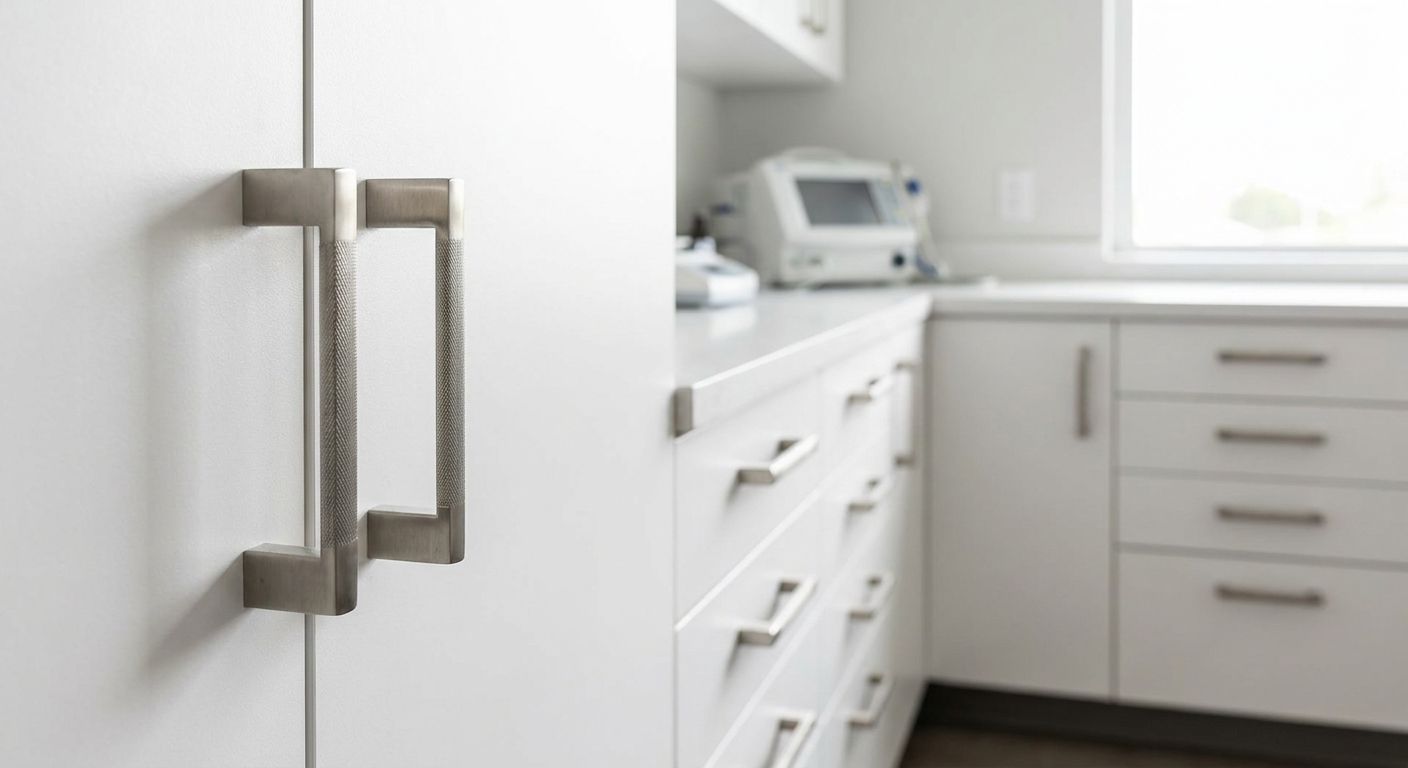
Cabinet hardware for medical offices is the knobs, pulls, hinges, and drawer glides that hold up to constant disinfecting, gloved-hand use, and ADA scrutiny without cracking a finish or blowing a build-out budget. Reception casework, exam room storage, and supply closets each put different demands on that hardware, and picking one standard for the whole office in 2026 saves money on replacement orders later.
Shop the finish
Every stainless steel knob and pull we carry, in one place — filter by size, style, and brand.
Browse Stainless Steel Cabinet Hardware →- Cabinet hardware for medical offices should use pulls, not knobs, in every patient-facing room.
- 2010 ADA Standards cap operating force at 5 lbf, which rules out most twist-grip knobs in public areas.
- 12 inch or longer appliance pulls fit sterilizer units and mini-fridges without custom drilling.
- Standardize one finish across every exam room so a broken pull in room 4 still matches room 1.
Why cabinet hardware matters for medical offices
Medical office cabinetry gets wiped down with bleach, quaternary ammonium, or alcohol-based disinfectant multiple times a day, which is more chemical contact than a home kitchen ever sees. Staff wear gloves for a large share of the shift, and gloved hands lose grip on a small round knob faster than they lose grip on a full pull.
Any cabinetry in a public-facing area of a medical office also falls under the 2010 ADA Standards for Accessible Design. Section 309.4 caps the force needed to operate hardware at 5 lbf and rules out designs that require tight pinching, grasping, or twisting of the wrist. That single rule eliminates a large share of decorative knob designs from patient-facing rooms before finish or durability even enter the conversation.
The same logic that governs cabinet hardware for assisted living facilities applies here: any space serving the public in 2026 needs hardware that works for a hand with reduced grip strength, not just a hand with full dexterity.
Standardize on pulls, not knobs, for patient-facing rooms
Swap round knobs for pulls anywhere a patient or visitor touches cabinetry, starting with the highest-traffic surfaces.
- Use bar pulls with 3 to 7 inch centers on standard exam-room and reception drawers
- Replace check-in desk knobs first — that surface gets the most hand contact of any cabinet in the building
- The Grace Riverside pull, 8 13/16 inch centers works as a mid-size option for standard exam-room drawer widths
- Reserve knobs for staff-only supply closets where ADA public-access rules and gloved grip aren't a factor
Confirm ADA operable-parts compliance before you order
Run every hardware option through the ADA operable-parts test before it goes on a purchase order, not after installation.
- Confirm the hardware needs no more than 5 lbf to operate, per Section 309.4 of the 2010 ADA Standards
- Skip anything that needs a pinch, twist, or tight grasp — that includes most small knobs and recessed finger pulls
- Mount pulls at a height and reach range consistent with the rest of the room's ADA layout
- Test the same pull with a gloved hand and a bare hand; both need to work the same way
Pick a finish that survives daily disinfecting
The finish decides whether hardware still looks new in three years or gets flagged for replacement after one facilities audit.
- Favor solid metal finishes — stainless steel, satin nickel, oil-rubbed bronze — over painted or plated coatings that flake under repeated bleach or alcohol wipes
- Test a physical sample against your office's actual cleaning chemical before ordering for every room; a finish that holds up to alcohol can still dull under quaternary ammonium
- Skip antique or "living finish" brass in daily-scrubbed rooms — those finishes are built to change color with handling, not to resist chemical wear
- Standardize on one finish for the whole office so replacement stock always matches
Size pulls and appliance hardware for what's behind the door
Standard cabinet pulls don't fit appliance-sized doors, and guessing on drill centers is an expensive mistake to fix after installation.
- Use 12-inch-or-longer appliance pulls for mini-fridges, sterilizer cabinets, and tall linen storage
- Match drill-center spacing to the appliance manufacturer's spec before ordering; appliance pulls don't share hole spacing with standard cabinet pulls
- Size drawer pulls to the actual drawer width rather than to what looks proportional in a showroom photo
Specify hinges and organizers rated for high-cycle daily use
Exam room and supply cabinets open far more times a day than a home kitchen cabinet, and the hardware needs to be specced for that cycle count.
- Choose soft-close hinges on high-traffic supply and exam-room cabinets to cut noise and slamming over hundreds of daily openings
- Fill narrow gaps between cabinet runs with a pull-out organizer instead of leaving that space dead; Rev-A-Shelf builds soft-close wall-filler pull-outs designed for exactly this footprint
- Use stainless steel base-cabinet organizers where wipeability matters more than decorative finish
Order hardware in bulk once the spec is locked
Getting the spec right on paper before ordering saves a facilities manager from managing three different finish lots across one building.
- Order one physical sample of each hardware type before committing to a full multi-room buildout
- Buy pulls, hinges, and slides in matching finish lots so mid-project replacements don't create a mismatched wall
- Set up a repeat-order account with your supplier if you're outfitting more than one location
Hardware options for medical office cabinetry compared
| Hardware type | Best for | Key limitation |
|---|---|---|
| Bar pulls, 3-7 inch centers | Exam room and supply drawers under daily glove use | Longer bars need wider stile clearance; awkward on narrow drawer fronts |
| Appliance pulls, 12 inch+ | Mini-fridges, sterilizer units, tall linen cabinets | Wide drill-center spacing means no swap onto standard cabinet doors |
| Cup or bin pulls | Reception and waiting-room casework with a traditional look | Recessed shape traps debris in corners, needs more frequent wipe-downs |
| Wire pulls | Budget multi-room buildouts on a tight timeline | Thin profile flexes if grabbed off-center; best kept to low-traffic supply rooms |
| Knurled or ribbed knobs | Low-traffic closets, not patient-facing cabinetry | Textured surface holds cleaner residue; ADA discourages twist-grip in public areas |
Verdict: bar pulls and appliance pulls in a solid metal finish are the safe default for medical office cabinet hardware in 2026 — knobs and heavily textured designs belong in staff-only rooms.


Common mistakes medical offices make with cabinet hardware
- Installing knobs on patient-facing casework. Most round knobs need a pinch grip that fails the ADA's 5 lbf operable-parts rule for public areas.
- Mixing finishes room to room during a phased buildout. Two years in, none of the leftover stock matches when a pull breaks in exam room 6.
- Choosing a decorative "living finish" brass for a heavily-sanitized front desk. These finishes are built to patina with handling, not to resist chemical wear, and they'll look blotchy within months.
- Skipping a physical sample before ordering 40-plus identical pulls. The finish that looked fine on screen can react badly to the office's actual disinfectant.
- Under-sizing appliance pulls on tall sterilizer or refrigerator cabinets. A 6-inch pull meant for a kitchen drawer is the wrong tool for a full-height appliance door.
FAQ
What is the best cabinet hardware for medical offices?
Bar pulls and appliance pulls in a solid metal finish like stainless steel or satin nickel are the safest default for medical office cabinet hardware in 2026. They meet ADA operable-parts requirements and hold up to daily disinfecting better than painted or plated finishes.
Should medical offices use pulls or knobs on cabinets?
Pulls, not knobs, for any cabinet a patient or visitor touches. Knobs require a pinch grip that fails the ADA's 5 lbf operable-parts standard in public-facing areas; save knobs for staff-only supply closets.
Is ADA compliance required for medical office cabinet hardware?
Yes, for any cabinetry in a public-facing part of the office. The 2010 ADA Standards for Accessible Design, Section 309.4, cap operating force at 5 lbf and rule out hardware that needs tight grasping, pinching, or wrist twisting.
What finish holds up best to disinfecting wipes?
Solid metal finishes like stainless steel, satin nickel, and oil-rubbed bronze outlast painted or plated coatings under repeated bleach or alcohol wipes. Test a physical sample against your specific cleaning chemical before ordering for every room.
Can stainless steel hardware be used in exam rooms?
Yes, stainless steel is a common choice for exam room and supply cabinet hardware because it wipes clean easily and resists the corrosion that plated finishes can show over time. It's also a practical match for stainless steel base-cabinet organizers.
How do you order cabinet hardware for multiple exam rooms at once?
Lock the finish and pull style with one physical sample first, then order pulls, hinges, and slides in matching finish lots for every room at once. Setting up a repeat-order account avoids mismatched replacement stock later.
What's the difference between appliance pulls and bar pulls for medical cabinetry?
Appliance pulls run 12 inches or longer with wide drill-center spacing built for mini-fridges, sterilizer units, and tall linen cabinets. Bar pulls run shorter, typically 3 to 7 inch centers, and fit standard exam-room and reception drawers.
Do medical offices need antimicrobial cabinet hardware?
There's no code requirement for antimicrobial hardware in a standard medical office, but copper and many brass alloys carry an EPA antimicrobial registration for continuously reducing bacteria on the metal surface between cleanings. That's a bonus, not a substitute for the office's disinfecting routine.
One last thing
Copper and many brass alloys carry an EPA antimicrobial registration, meaning the metal itself keeps working on bacteria between cleanings — not a reason to skip a disinfecting routine, but a real advantage to weigh when two finishes otherwise tie on durability and cost for a 2026 buildout. If the office is choosing between two otherwise-equal pulls, that's the tiebreaker worth checking on the spec sheet.


