

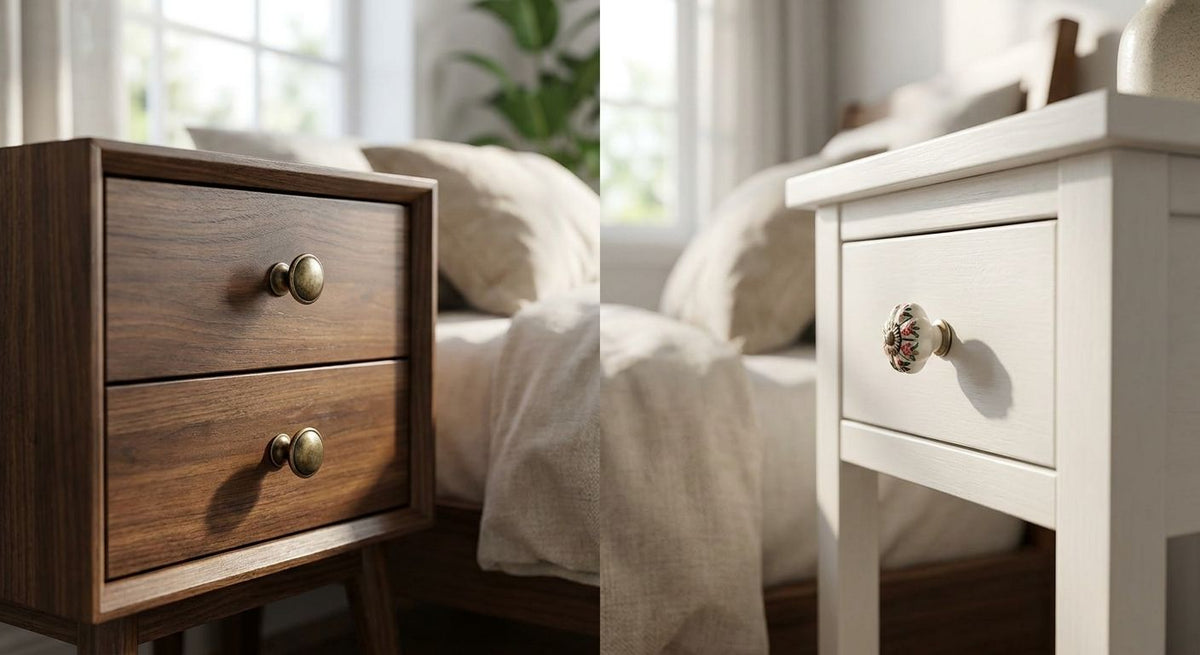
Cabinet knobs for nightstands are small-format drawer knobs, usually 1 inch to 1.25 inches in diameter, sized to match a bedside table's narrow drawer front rather than a full kitchen cabinet door. The right knob has to work at arm's length in low bedroom light, open with one hand, and hold its proportion on a piece that might have only one or two drawers total. That's a different design problem than kitchen hardware, where the same knob repeats twenty or thirty times across a run of identical cabinets.
- Cabinet knobs for nightstands run 1 to 1.25 inches — anything over 1.5 inches overwhelms a 14 to 16 inch drawer front.
- The Portobello Road Knob Plain and Britannia Victoria knob both suit traditional bedside tables without extra redrilling.
- Match existing hole spacing before ordering — one hole means a knob, two holes locks you into a pull.
- Order a sample first; finish reads differently under a bedside lamp than under a kitchen ceiling fixture.
- Skip backplates on narrow drawer stiles — the added visual weight overwhelms a small nightstand drawer fast.
Why cabinet knobs matter for nightstands and bedside tables
Nightstand hardware gets handled every night, usually in the dark, at a distance of inches rather than feet. That's a different job than a kitchen cabinet knob mounted three feet from the nearest chair, where scale mistakes get absorbed by distance.
Most nightstand projects also replace one or two knobs total, not the twenty-plus pulls a full kitchen remodel needs, so a mismatch in scale or finish is far more visible per piece purchased. A Portobello Road Knob Plain reads as a quiet, proportional detail on a two-drawer nightstand; the same knob would disappear entirely on a bank of kitchen drawers.
Bedside tables also skew older than kitchen cabinetry. Vintage dressers repurposed as nightstands, hand-me-down pieces, and thrifted furniture show up far more often than in a uniform kitchen run, which means existing hole spacing, drawer material, and screw thread type vary a lot more than shoppers expect going into a 2026 furniture refresh.
If the piece you're updating is smaller than a standard nightstand — a jewelry box, a vanity drawer, a small accent chest — the same scale logic applies at an even tighter range; the guide on cabinet knobs for small furniture covers sizing at that end.
Measure your drawer front and existing hole spacing
Do this before you open a browser tab to shop. A knob that's the right finish but the wrong hole spacing means a redrill, wood filler, and a repaint you didn't plan for.
- Measure drawer front height and width — most nightstand drawers run 12 to 20 inches wide.
- If replacing existing hardware, measure center-to-center on any current backplate or two-hole pull.
- Check drawer material thickness; thin vintage veneer needs shorter screws than modern 3/4-inch MDF.
- Confirm whether the drawer has one hole (knob) or two (pull) — this decides whether you can swap styles without redrilling.
- Note whether the current hardware uses a wood screw or a machine screw threaded into a nut — older furniture mixes both.
Match knob scale to the nightstand, not the kitchen
Scale is the single most common miss on this kind of project. A knob that looks restrained in a kitchen showroom photo can look like a doorknob on a small bedside table.
- Use 3/4 to 1 inch knobs on compact nightstands under 14 inches wide.
- Step up to 1 to 1.25 inches on standard 16 to 20 inch nightstand drawers.
- Stay under 1.5 inches on any single small drawer — proportion breaks down fast on furniture this size.
- On a two-drawer nightstand, center one knob per drawer rather than spanning both with a long bar pull.
- Round or oval knobs read smaller than square or rectangular knobs at the same measured width.
Pick a finish that matches the room's other metal
A nightstand knob sits close to a lamp base, a mirror frame, and often a bed frame's hardware. Those three finishes set the standard the knob has to match.
- Match the knob finish to lamp bases, mirror frames, or bed frame hardware already in the room.
- Warm finishes like antique brass or pewter suit traditional bedrooms; nickel and chrome suit contemporary ones.
- A single contrast knob works as an accent only if one other surface in the room repeats that finish.
- Painted or refinished nightstands carry a statement knob well — a White Marble Cabinet Knob works this way on a neutral or transitional piece.
- Two-tone bedrooms (black hardware plus brass fixtures, for example) can carry mixed-finish knobs if the mix is intentional and repeated elsewhere.
Decide between a bare knob and a knob with a backplate
This decision usually comes down to what's already drilled into the drawer front, not personal preference.
- A bare knob works cleanly on a drawer front with no old screw holes to hide.
- A backplate covers worn or oversized holes left behind by a prior pull or knob.
- Skip backplates on narrow drawer stiles — the added visual weight overwhelms a small nightstand drawer fast.
- The Britannia Victoria knob ships with a built-in 1-1/4 inch backplate, useful for covering a mismatched existing hole without sourcing a separate plate.
Order a sample before you commit to a full set
This is the step most people skip, and the one that causes the most returns.
- Order a single unit or sample before committing to knobs for every drawer in the room.
- Check the finish under the room's actual lamp — bedside lighting reads warmer than store fluorescents.
- Hold the physical knob against the drawer front to confirm scale before drilling anything.
- Knobs.co ships free samples across much of its 50,000-plus SKU catalog, which is the cheapest way to catch a finish mismatch before committing to a full nightstand set in 2026.
Install with a jig for centered, even placement
A nightstand drawer front is small enough that a half-inch off-center placement is obvious from across the room.
- Use a cabinet hardware jig to center a knob on a narrow drawer stile without guesswork.
- Predrill on veneer or thin drawer fronts to avoid splitting the wood.
- Confirm screw length against drawer thickness before driving it — an oversized screw punches through a shallow drawer front.
- Test the drawer glide after installing to be sure the knob doesn't catch on the nightstand's inner frame or an adjacent piece of furniture.
Comparing knob options for nightstands and bedside tables
| Option | Best for | Key limitation |
|---|---|---|
| Bare knob, no backplate | Drawers with clean, unworn screw holes | Won't hide a mismatched or oversized existing hole |
| Knob with integrated backplate | Covering a worn or oversized hole from prior hardware | Adds visual weight; skip on already-narrow drawer stiles |
| Small bar pull (2.5 to 3 inch) | Wide single-drawer nightstands over 20 inches | Needs two mounting holes instead of one |
| Statement or novelty knob (marble, ceramic) | Painted or refinished vintage pieces | Reads busy if mixed with more than one other accent finish |
For most standard nightstands, a bare 1 to 1.25 inch knob is the safer buy — reach for a backplate only when you're covering an existing mismatched hole.
Common mistakes buying knobs for nightstands and bedside tables
- Buying kitchen-scale knobs. A 1.5-inch-plus knob built for a kitchen island looks oversized on a 14-inch nightstand drawer.
- Skipping the hole-spacing check. Swapping a two-hole pull for a single knob without measuring first means new drilling and filled-in holes.
- Ignoring the room's other metal. A cool nickel knob clashes fast next to a warm brass lamp base or a gold mirror frame.
- Ordering one knob for a two-drawer piece. Order matched pairs, not a single unit, whenever the nightstand has two drawers.
- Skipping the sample step. A finish that reads right on a screen or under store lighting often looks different under an actual bedside lamp — Knobs.co's free samples exist specifically to catch this before a full cabinet knob order ships.
FAQ
What size cabinet knob works best for a nightstand?
Most nightstands take a 1 to 1.25 inch knob. Compact nightstands under 14 inches wide look better with a 3/4 to 1 inch knob, and anything over 1.5 inches tends to overwhelm a small drawer front.
Should I use one knob or two on a nightstand drawer?
A single narrow drawer under 20 inches wide typically takes one centered knob. Wider drawers, or drawers that already have two mounting holes, work better with a small bar pull instead.
Can a backplate knob go on a small nightstand drawer?
Yes, but only if you're covering a worn or oversized existing hole. On a drawer with clean holes, a backplate adds visual weight the small drawer front doesn't need.
How do I match new nightstand knobs to existing bedroom hardware?
Match the knob finish to the lamp base, mirror frame, or bed frame hardware already in the room. Warm finishes like antique brass or pewter suit traditional bedrooms; nickel and chrome suit contemporary ones.
Do older or vintage nightstands need different screws for new knobs?
Often, yes. Vintage furniture sometimes uses a machine screw threaded into a nut rather than the wood screw standard on new cabinet knobs, so check the existing hardware before ordering replacements.
Is it worth ordering a sample before buying knobs for a whole bedroom set?
Yes. A single sample lets you check scale and finish under the room's actual lighting before committing to knobs for every drawer, which avoids a return on an entire order.
What's the difference between a knob and a pull for a nightstand drawer?
A knob mounts on one hole and suits narrow drawers; a pull mounts on two holes spaced apart and suits wider drawers, typically 20 inches or more.
One last thing
Check the screw thread before you check anything else on a vintage piece: older nightstands sometimes use a machine screw threaded into a tapped hole rather than the wood screw that ships standard with most new cabinet knobs in 2026, and that single mismatch is the most common reason a hardware swap stalls halfway through installation.


